Midterm 1 review → · Tonight, seated by 6:45 PM · no calculator. Order: Learn a slot → Drill it → Flashcards → Mock (2024, once, at the end).
The exam is 12 recurring problem types ("slots"). Learn each recipe, then hit Drill this slot.
Slot 1 Lagrange on a circle/ellipse
Spot it: You see 'find the absolute max and min of f on the curve g = C' (circle, ellipse). The constraint is an equation, so use Lagrange.
Recipe
Write f and g. Compute ∇f and ∇g.
Set ∇f = λ∇g. That gives one equation per variable.
Add the constraint g = C. Now you have as many equations as unknowns.
Solve. Use cases or ratios. NEVER divide by x or y until you know it is not 0.
Plug every solution point into f. Biggest value = max, smallest = min.
Report the values AND the points.
Write this on the exam: The circle is closed and bounded and f is continuous, so by the Extreme Value Theorem the absolute max and min exist and occur at the points from the Lagrange system.
Traps
Dividing by a variable that might be 0 loses solutions. Split into cases.
Giving only the point and not the value of f (or the other way around).
Stopping after one solution. Lagrange on a circle usually gives two points: one max, one min.
Worked example (#R25-1)
Find the absolute maximum and minimum values of f(x, y) = 2x − y on the circle x² + y² = 5. Give the values and the points where each occurs.
Show worked solution
Answer: Absolute max = 5 at (2, −1). Absolute min = −5 at (−2, 1).
g = x² + y². ∇f = ⟨2, −1⟩ and ∇g = ⟨2x, 2y⟩.
∇f = λ∇g gives 2 = 2λx and −1 = 2λy.
Neither equation can hold if λ, x or y is 0 (the left side is a nonzero number). So all three are nonzero and we may divide.
x = 1/λ and y = −1/(2λ). So x = −2y.
Constraint: (−2y)² + y² = 5, so 5y² = 5, y = ±1.
y = 1 gives x = −2: point (−2, 1). y = −1 gives x = 2: point (2, −1).
f(2, −1) = 4 + 1 = 5. f(−2, 1) = −4 − 1 = −5.
Circle is closed and bounded, f is continuous, so EVT says these are the max and min.
Say the recipe from memory
Explain how you attack this slot in general. AI scores it against the recipe.
Slot 2 Tangent plane to level surface
Spot it: A surface is given as an equation like x² + y² − 3z² = 2 and you are asked for the tangent plane at a point. Final form is ax + by + cz = d.
Recipe
Call the left side F(x,y,z). The surface is F = k.
Compute ∇F. It is perpendicular to the surface, so it is the normal vector.
Plug in the point P to get the normal vector n.
Plane: n · ⟨x − x0, y − y0, z − z0⟩ = 0.
Expand and move the constant to the right side.
Check: P must satisfy your final equation.
Write this on the exam: ∇F(P) is perpendicular to the level surface F = k at P, so it is a normal vector to the tangent plane.
Traps
Using the point's coordinates in the wrong slot (x0, y0, z0 mixed up).
Arithmetic in the constant d. Always plug P back in to check.
Using the graph formula z = f(a,b) + ... when the surface is given implicitly.
Worked example (#R25-2)
Find the tangent plane to x² + y² − 3z² = 2 at P = (1, 2, 1). Write it as __x + __y + __z = __.
Show worked solution
Answer: x + 2y − 3z = 2
Check P is on the surface: 1 + 4 − 3 = 2. Yes.
F = x² + y² − 3z². ∇F = ⟨2x, 2y, −6z⟩.
∇F(1,2,1) = ⟨2, 4, −6⟩. Divide by 2 to get n = ⟨1, 2, −3⟩ (same direction, simpler).
(x − 1) + 2(y − 2) − 3(z − 1) = 0.
x − 1 + 2y − 4 − 3z + 3 = 0, so x + 2y − 3z − 2 = 0.
x + 2y − 3z = 2.
Check P: 1 + 4 − 3 = 2. Yes.
Say the recipe from memory
Explain how you attack this slot in general. AI scores it against the recipe.
Slot 3 Table → 2nd derivative test
Spot it: A table gives f_x, f_y, f_xx, f_yy, f_xy at several points and asks you to classify each one: not critical / local min / local max / saddle / undetermined.
Recipe
First look at f_x and f_y. If either is NOT 0, answer 'not critical' and stop.
If both are 0, compute D = f_xx · f_yy − (f_xy)².
D < 0: saddle point.
D = 0: undetermined (the test fails).
D > 0: look at f_xx. Positive = local min. Negative = local max.
Traps
Calling a non-critical point a saddle. Always check f_x = f_y = 0 first.
D = 0 means UNDETERMINED, not saddle.
Forgetting to square f_xy, or forgetting to check the sign of f_xx when D > 0.
Worked example (#R25-3c)
f has continuous second partials. At (1, 0): f_x = 0, f_y = 0, f_xx = 1, f_yy = 3, f_xy = 4. Classify (1, 0). (Same table: at (0,0) f_xx = 4, f_yy = 1, f_xy = 2; at (0,1) f_y = −5; at (1,1) f_xx = −2, f_yy = −1, f_xy = 1, with f_x = f_y = 0.)
Show worked solution
Answer: (1,0) is a saddle point. (Also: (0,0) undetermined, (0,1) not critical, (1,1) local max.)
Same method on the others: (0,0): D = 4·1 − 2² = 0, undetermined.
(0,1): f_y = −5 ≠ 0, not critical.
(1,1): D = (−2)(−1) − 1² = 1 > 0 and f_xx = −2 < 0, local max.
Say the recipe from memory
Explain how you attack this slot in general. AI scores it against the recipe.
Slot 4 Contour map multi-part
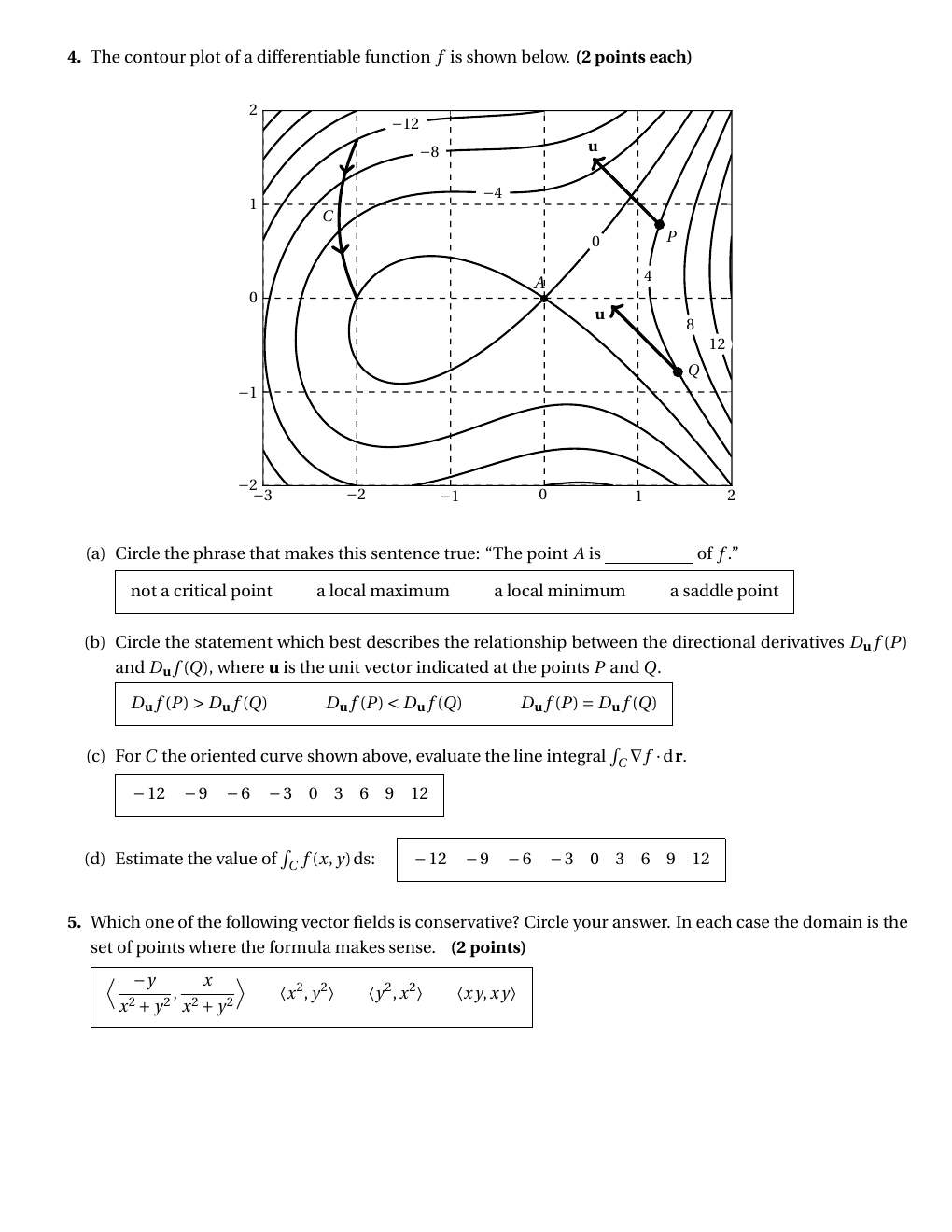
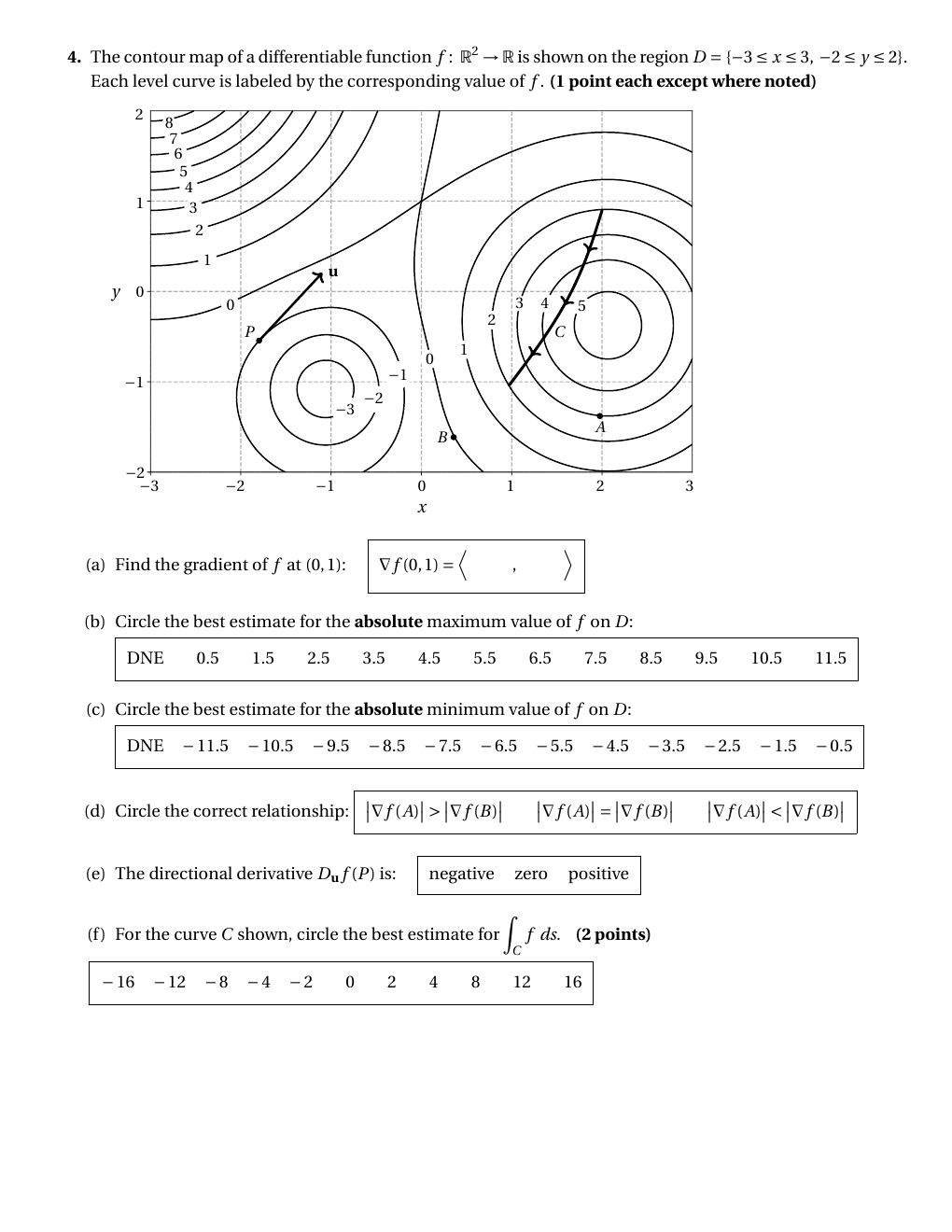
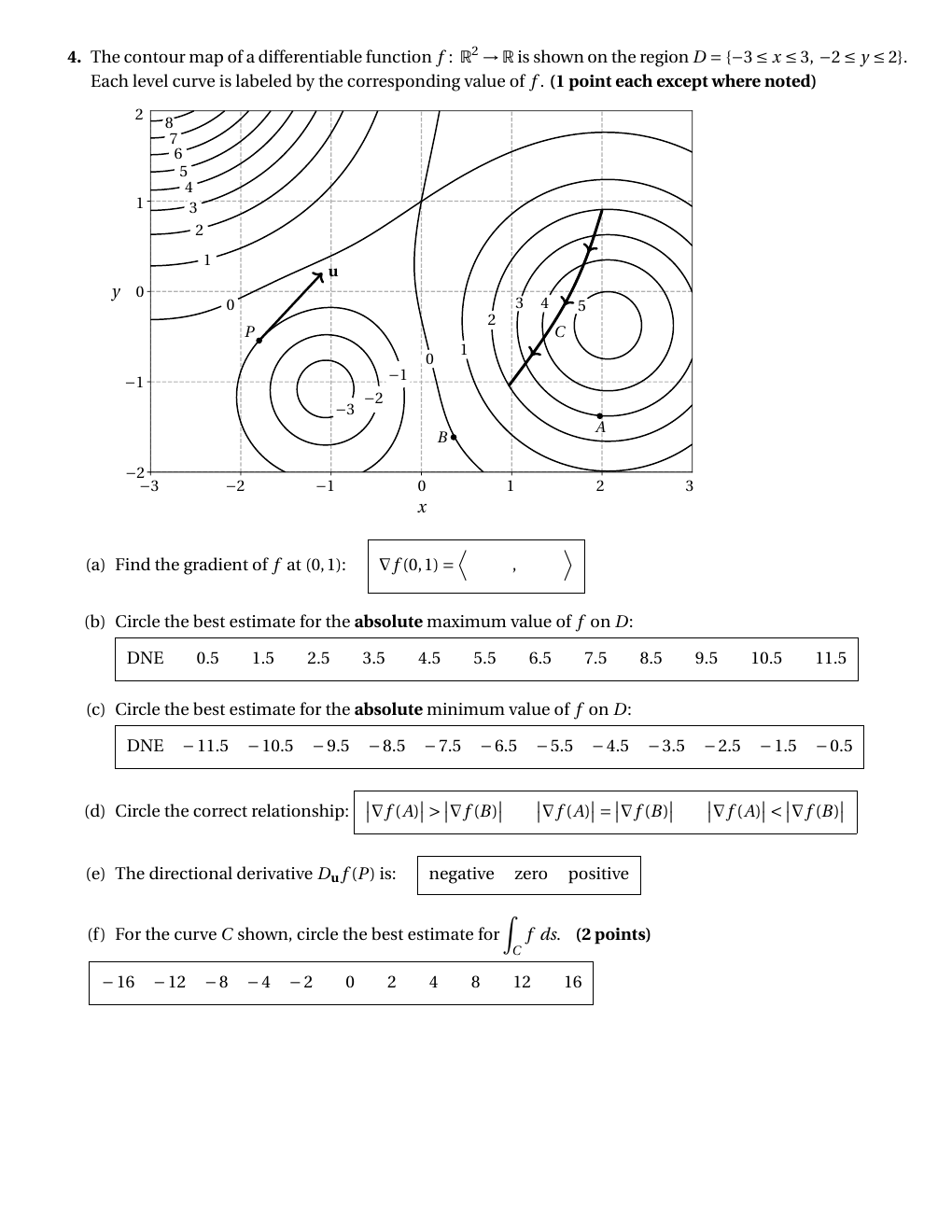
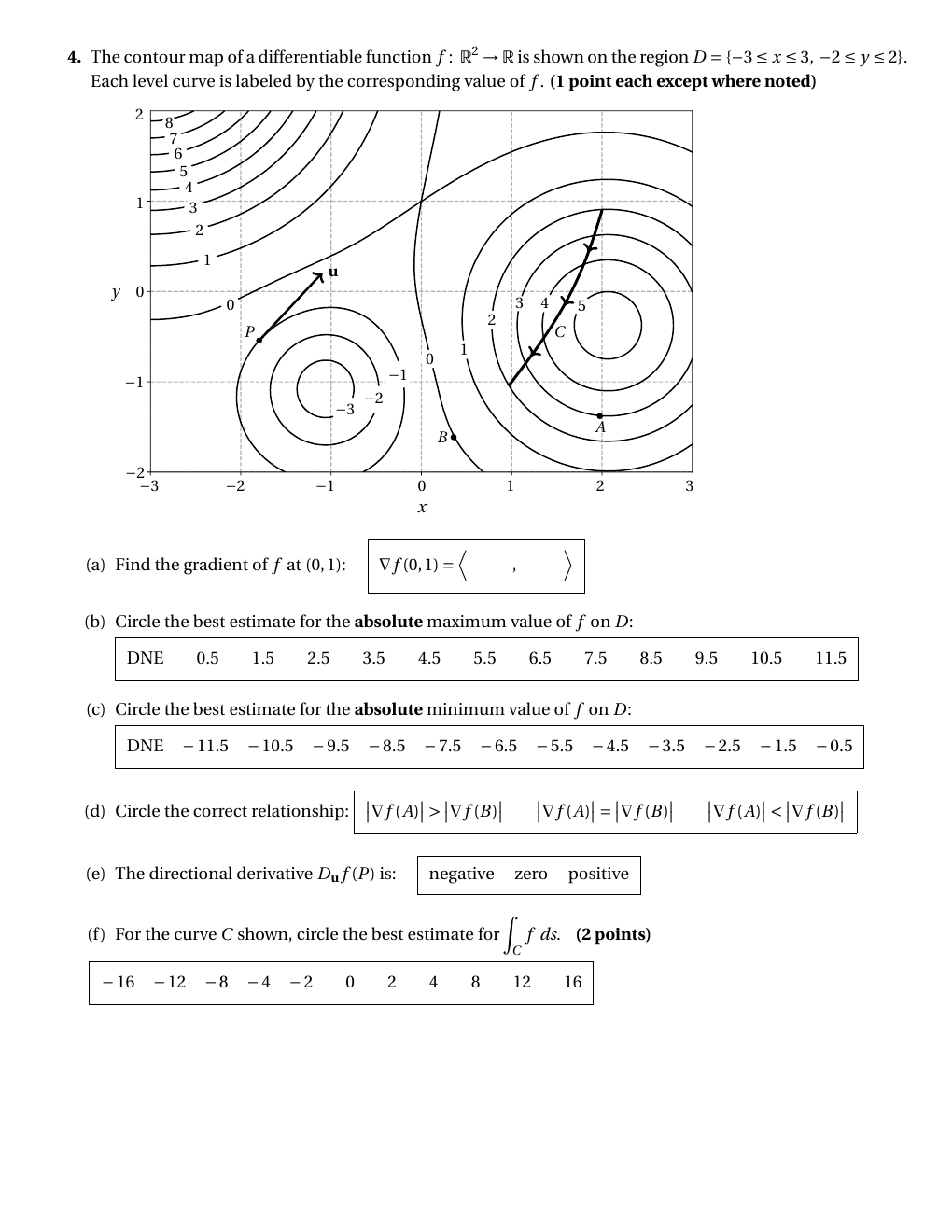
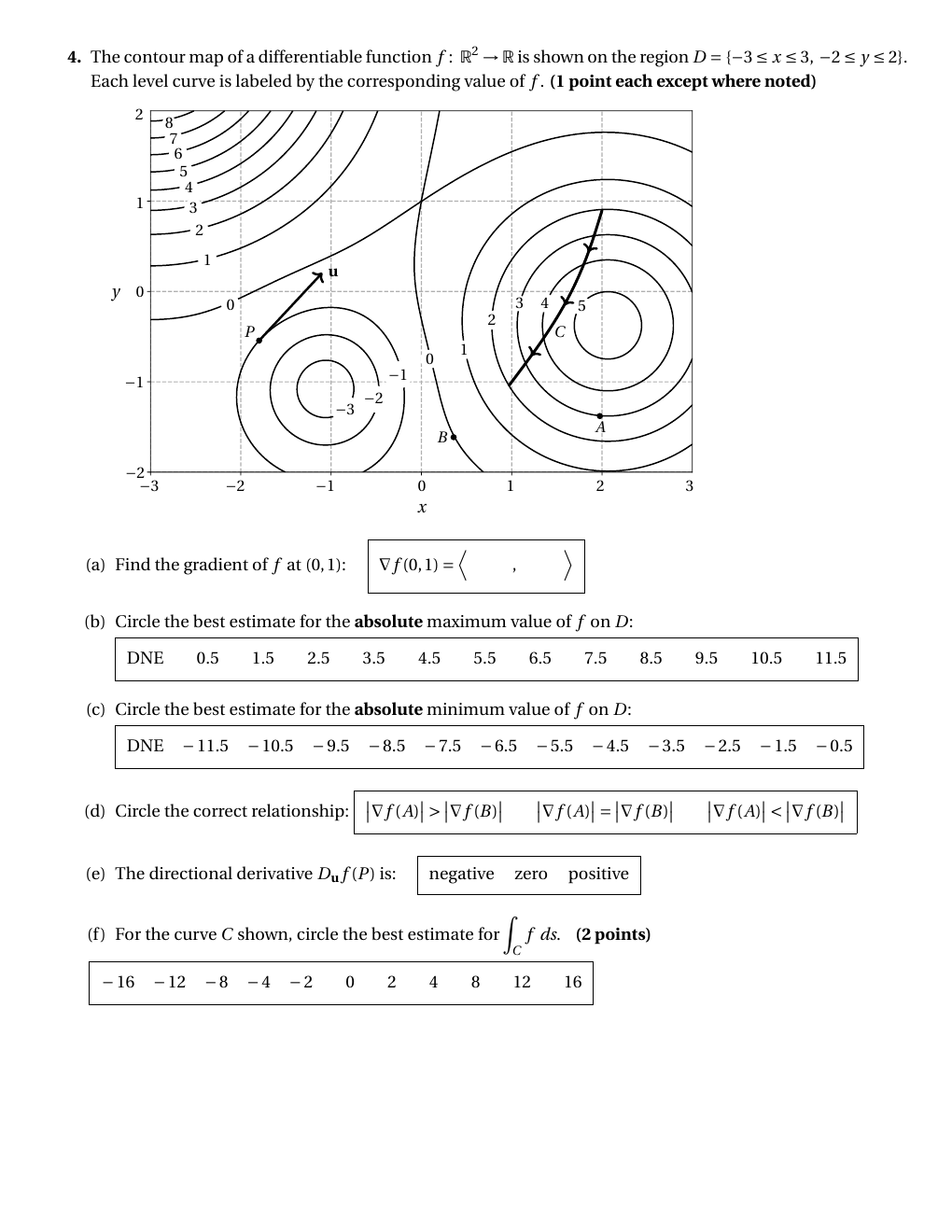
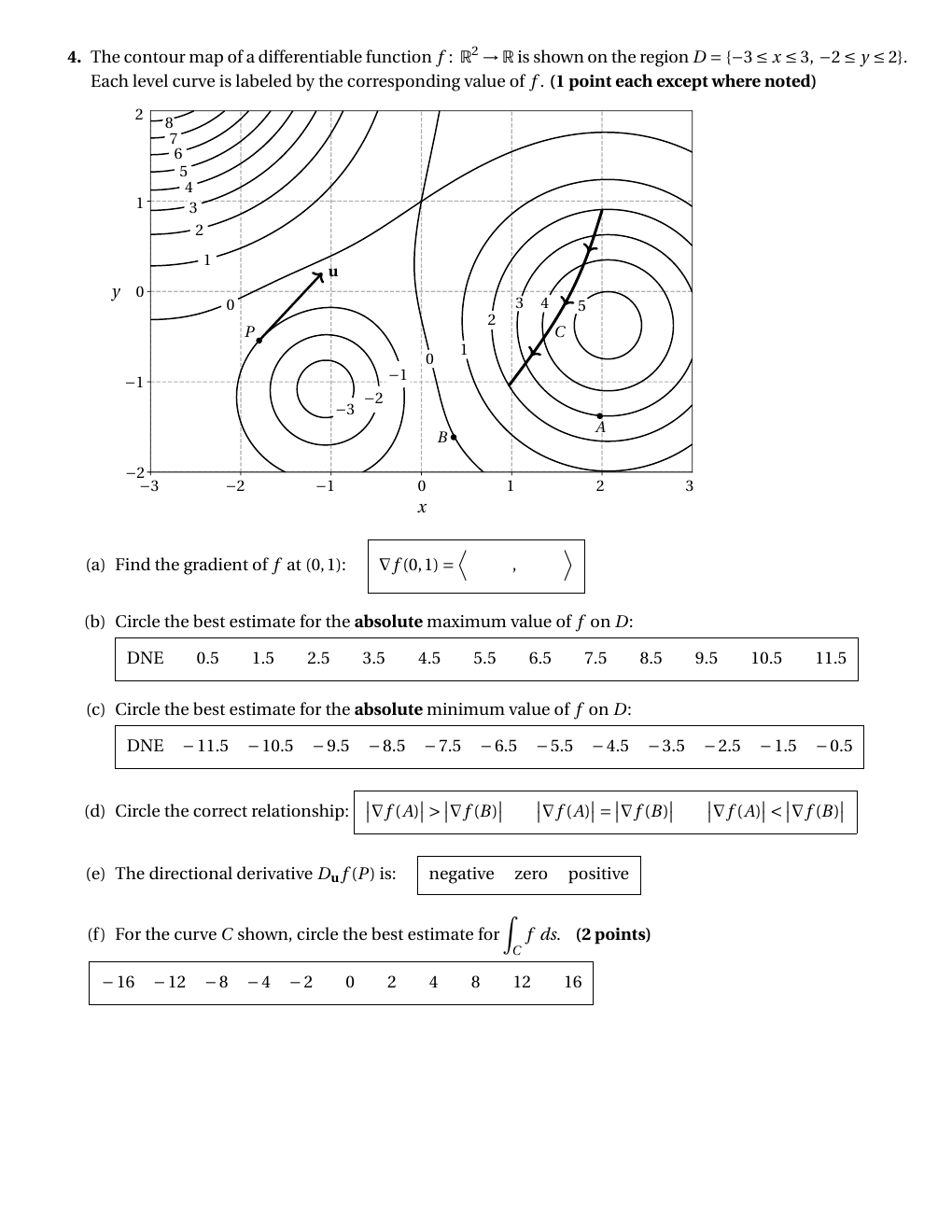
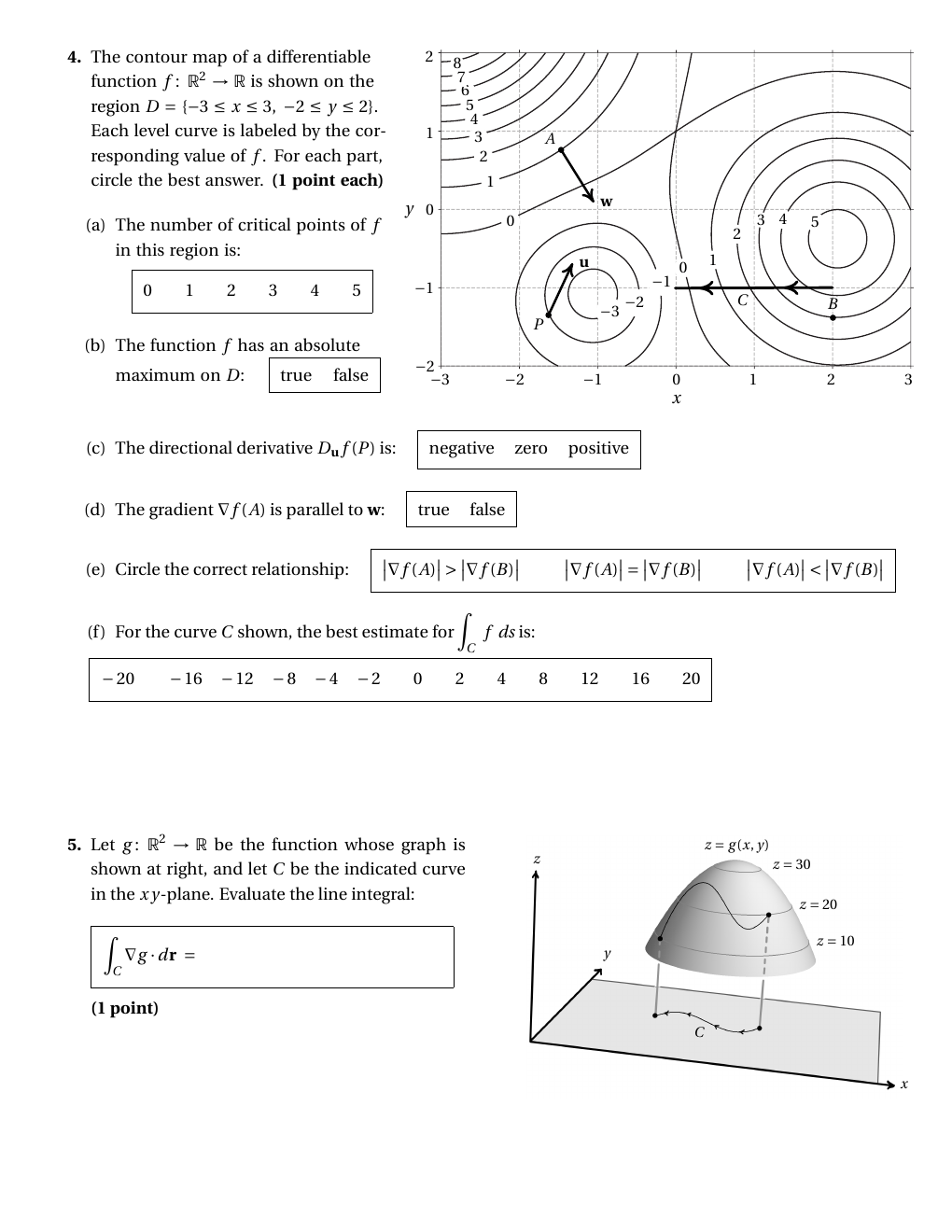
Spot it: A contour map (level curves labeled with values) with points, arrows u and w, and a curve C. Many short parts: count critical points, sign of D_u f, is ∇f parallel to w, compare |∇f|, estimate ∫ f ds.
Recipe
Gradient: ∇f is perpendicular to the level curve and points uphill (toward bigger labels).
|∇f| is big where level curves are packed tightly, small where they are far apart.
D_u f: does u point toward higher labels (positive), lower (negative), or along the level curve (zero)?
Critical points: centers of closed loops (max or min) and places where level curves cross like an X (saddle). Count them.
Absolute max exists on a closed bounded region by the EVT (true, if f is continuous).
∫_C f ds ≈ (length of C) × (average f along C). Read f at 4 or 5 evenly spaced points on C, average, multiply by the length.
Pick the answer choice closest to your estimate.
Traps
Thinking ∇f lies ALONG the level curve. It is perpendicular.
Mixing up which of two points has the tighter contours. Tighter = bigger gradient.
Forgetting to multiply the average value by the length of C (or forgetting a negative sign when f is negative).
Worked example (#R25-4f)
Contour map of f on a rectangle, with a curve C. Best estimate for ∫_C f ds? Choices: −20, −16, −12, −8, −4, −2, 0, 2, 4, 8, 12, 16, 20. (Length of C is about 2.)
Show worked solution
Answer: 4
∫_C f ds = length × average value of f on C.
Length of C ≈ 2 (read from the grid).
Sample f at 5 points along C from the labels: about −0.5, 0.5, 2, 3.5, 4.3.
Sum ≈ 9.8, so average ≈ 9.8/5 ≈ 2.
∫_C f ds ≈ 2 · 2 = 4 (choices are far apart, so rough is fine).
Other parts of this same question use the checklist: |∇f| is larger where contours are packed tighter, so |∇f(A)| < |∇f(B)| when B has tighter contours. And ∇f(A) ∥ w when w is drawn perpendicular to the level curve through A.
Say the recipe from memory
Explain how you attack this slot in general. AI scores it against the recipe.
Slot 5 Regions / EVT
Spot it: You must find the absolute max/min on a region, or decide whether one exists. Or you are asked which region is bounded, open, or closed.
Recipe
Check the region is closed AND bounded and f is continuous. If so, the EVT says an absolute max and min exist.
Interior: solve ∇f = 0. Keep points inside the region.
Boundary: use Lagrange (or substitute a parametrization). For a polygon, check each edge and each corner.
Evaluate f at EVERY candidate.
Biggest = absolute max, smallest = absolute min. Do not use the second derivative test here.
Definitions: bounded = fits in a disk. Open = no boundary points included (strict < and >). Closed = includes its boundary (≤, ≥).
Write this on the exam: The region is closed and bounded and f is continuous, so by the Extreme Value Theorem f attains an absolute max and min. They occur at an interior critical point or on the boundary. I compare f at all of these.
Traps
Using the second derivative test to find the absolute max. It only classifies local behavior.
Skipping the boundary or the corners.
Calling a region 'open' when it has even one ≤ or ≥, or 'bounded' when it extends outward forever (like x² + y² ≥ 4).
Worked example (#R25-11b)
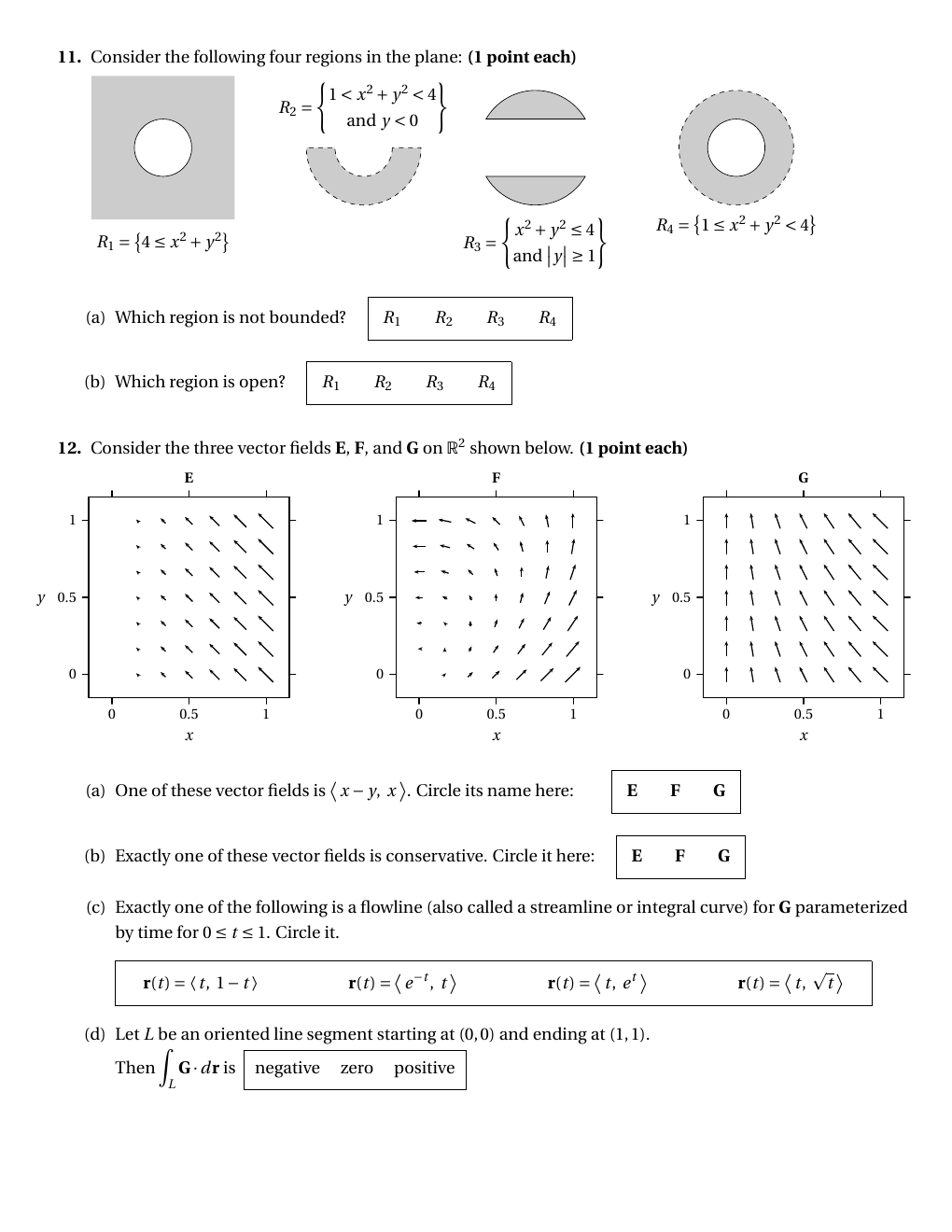
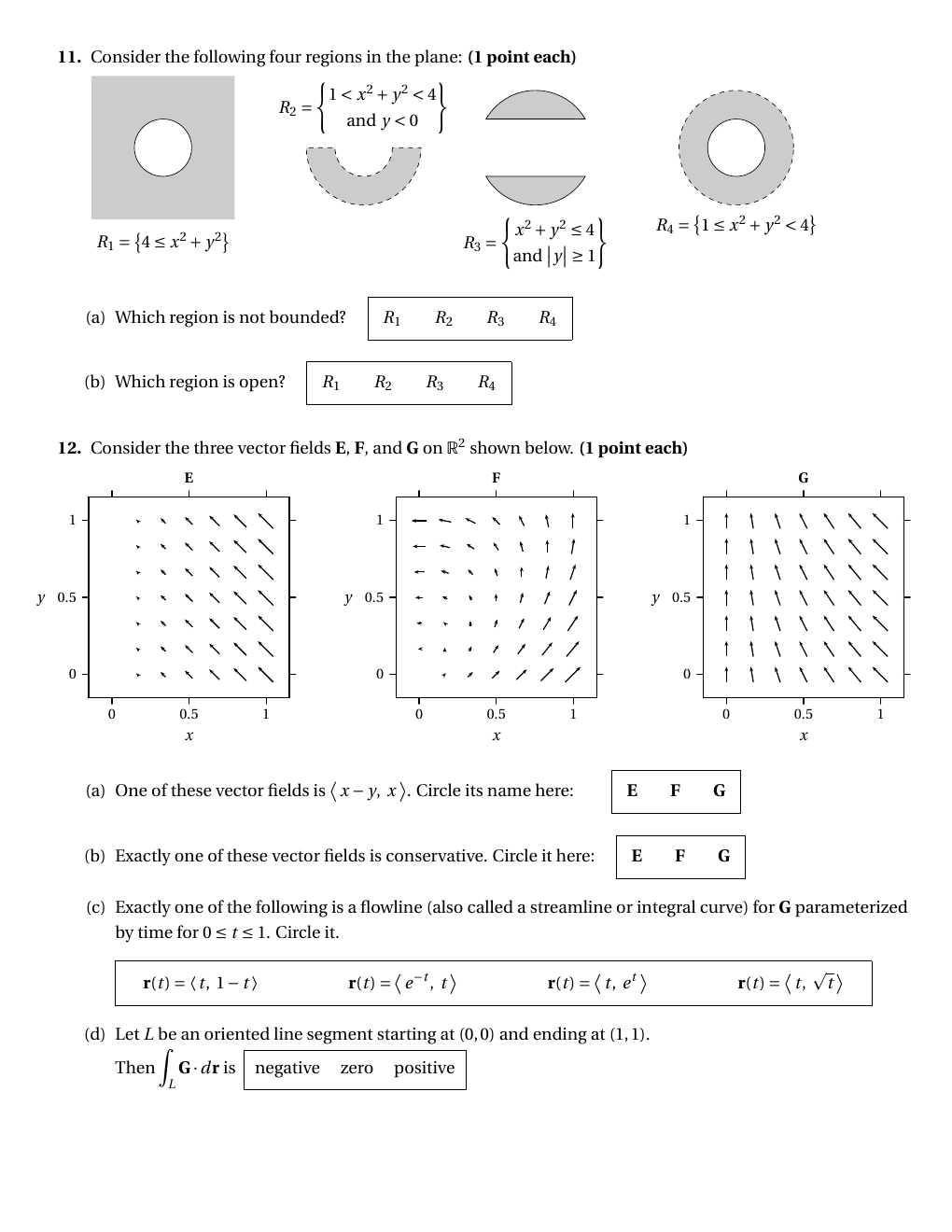
Regions: R1 = {4 ≤ x² + y²}; R2 = {1 < x² + y² < 4 and y < 0}; R3 = {x² + y² ≤ 4 and |y| ≥ 1}; R4 = {1 ≤ x² + y² < 4}. (a) Which is not bounded? (b) Which is open?
Show worked solution
Answer: (a) R1. (b) R2.
(a) Bounded means it fits inside some disk.
R1 is everything outside radius 2, so it goes on forever. Not bounded.
R2, R3, R4 all lie inside the disk of radius 2. Bounded.
(b) Open means every inequality is strict (no boundary points).
R1 uses ≤, so not open. R3 uses ≤ and ≥, not open.
R4 has 1 ≤ x² + y², so it includes the inner circle. Not open.
R2 has only < signs. Open.
Bonus: R3 is closed and bounded, so the EVT applies to a continuous f there.
Say the recipe from memory
Explain how you attack this slot in general. AI scores it against the recipe.
Slot 6 Find a potential
Spot it: 'The vector field F is conservative. Find a potential function f with f(0,0) = 0' (or f(...) = some value).
Recipe
F = ⟨P, Q⟩. Want f with f_x = P and f_y = Q.
Integrate P with respect to x: f = ∫P dx + c(y). The 'constant' can depend on y.
Differentiate that f with respect to y and set it equal to Q.
Solve for c′(y), then integrate to get c(y).
Use the given condition (like f(0,0) = 0) to fix the last constant.
Check: f_x = P and f_y = Q.
In 3D: repeat once more with c(y,z).
Traps
Forgetting the c(y) that appears when you integrate in x.
Writing c(y) = ... with an x left in it. If an x survives, you made an algebra mistake.
Skipping the check ∇f = F.
Worked example (#R25-6)
F(x, y) = ⟨3y², 6xy + 1⟩ on R² is conservative. Find the potential f with f(0, 0) = 0.
Show worked solution
Answer: f(x, y) = 3xy² + y
f_x = 3y². Integrate in x: f = 3y²x + c(y).
f_y = 6xy + c′(y). It must equal Q = 6xy + 1.
So c′(y) = 1, and c(y) = y + D.
f = 3xy² + y + D.
f(0,0) = 0 gives D = 0.
Check: f_x = 3y² and f_y = 6xy + 1.
Say the recipe from memory
Explain how you attack this slot in general. AI scores it against the recipe.
Slot 7 Parametrize an intersection
Spot it: 'Find a vector function r(t) for the curve that is the intersection of a cylinder (or circle) with another surface.' Must give the domain.
Recipe
The cylinder x² + y² = R² is a circle: x = R cos t, y = R sin t.
Plug x and y into the other surface to get z (in terms of t).
Write r(t) = ⟨x(t), y(t), z(t)⟩.
State the domain: 0 ≤ t ≤ 2π for one full trip around.
Quick check: pick t = 0 and see that the point satisfies both equations.
Write this on the exam: r(t) = ⟨…⟩ for 0 ≤ t ≤ 2π. (The domain is part of the answer. Always write it.)
Traps
Forgetting the domain.
Domain too big (goes around twice) or too small (misses part of the circle).
Using R instead of the radius: x² + y² = 4 has radius 2, so x = 2 cos t, not 4 cos t.
Worked example (#R25-7)
C is the intersection of the cylinder x² + y² = 4 and the surface z = (x − y)². Find r(t) that traverses C exactly once, with domain.
Show worked solution
Answer: r(t) = ⟨2 cos t, 2 sin t, 4 − 8 sin t cos t⟩, 0 ≤ t ≤ 2π
x² + y² = 4 is a circle of radius 2: x = 2 cos t, y = 2 sin t.
z = (x − y)² = (2 cos t − 2 sin t)² = 4(cos t − sin t)².
Expand if you like: 4(cos²t + sin²t − 2 sin t cos t) = 4 − 8 sin t cos t.
One full loop: 0 ≤ t ≤ 2π.
Check t = 0: (2, 0, 4). Surface: z = (2 − 0)² = 4. Yes.
Say the recipe from memory
Explain how you attack this slot in general. AI scores it against the recipe.
Slot 8 Pick the picture of r(t)
Spot it: Several pictures of a curve (2D or 3D) and a formula r(t). Pick the picture that matches. Checking by shape alone is unreliable, so use points.
Recipe
Plug in t at the start, middle, and end. Plot those points.
Look at z(t). Does it go up, down, or stay flat? What is its range?
Look at the radius √(x² + y²). Constant (circle/helix)? Growing (spiral opening out)? Shrinking?
Which way does it turn? Check a point just after the start.
Compare with each picture. Throw out any picture that gets even one of start point, end point, radius, or z-range wrong.
Remember the sign tricks: ⟨−2 sin t, 2 cos t⟩ starts at the top (0, 2) and goes counterclockwise toward (−2, 0).
Traps
Picking by a quick glance at the shape. Check the start and end points.
Mixing up clockwise and counterclockwise.
Ignoring the t-range. Half the circle (0 ≤ t ≤ π) is not the whole circle.
Worked example (#R25-8a)
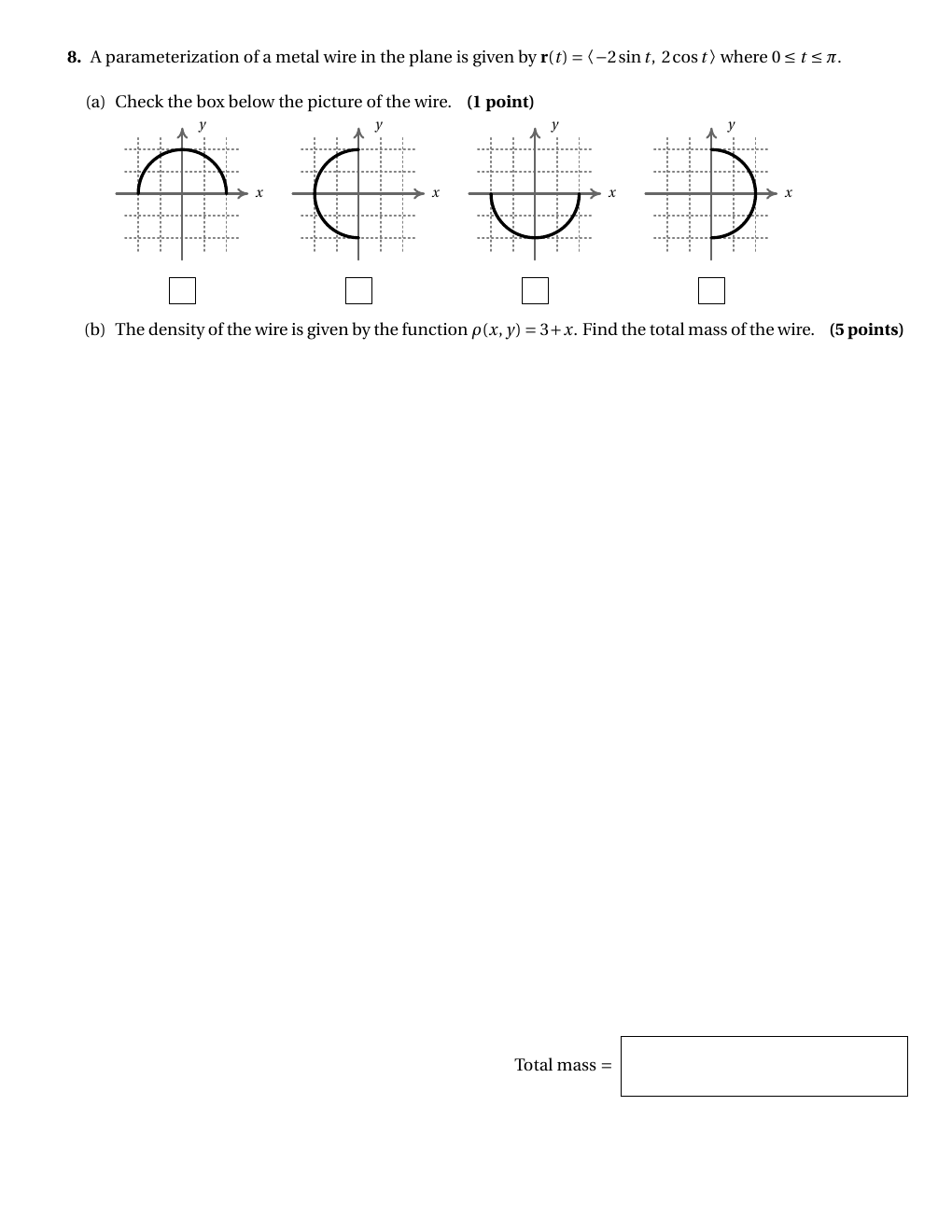
r(t) = ⟨−2 sin t, 2 cos t⟩, 0 ≤ t ≤ π. Which picture shows the wire? (Four pictures: top, left, bottom, right semicircle.)
Show worked solution
Answer: The left semicircle (second picture).
t = 0: r = ⟨0, 2⟩. Start at the top.
t = π/2: r = ⟨−2, 0⟩. Middle is the leftmost point.
t = π: r = ⟨0, −2⟩. End at the bottom.
Radius is √(4 sin²t + 4 cos²t) = 2, so it stays on a circle of radius 2.
Top to left to bottom is the LEFT semicircle.
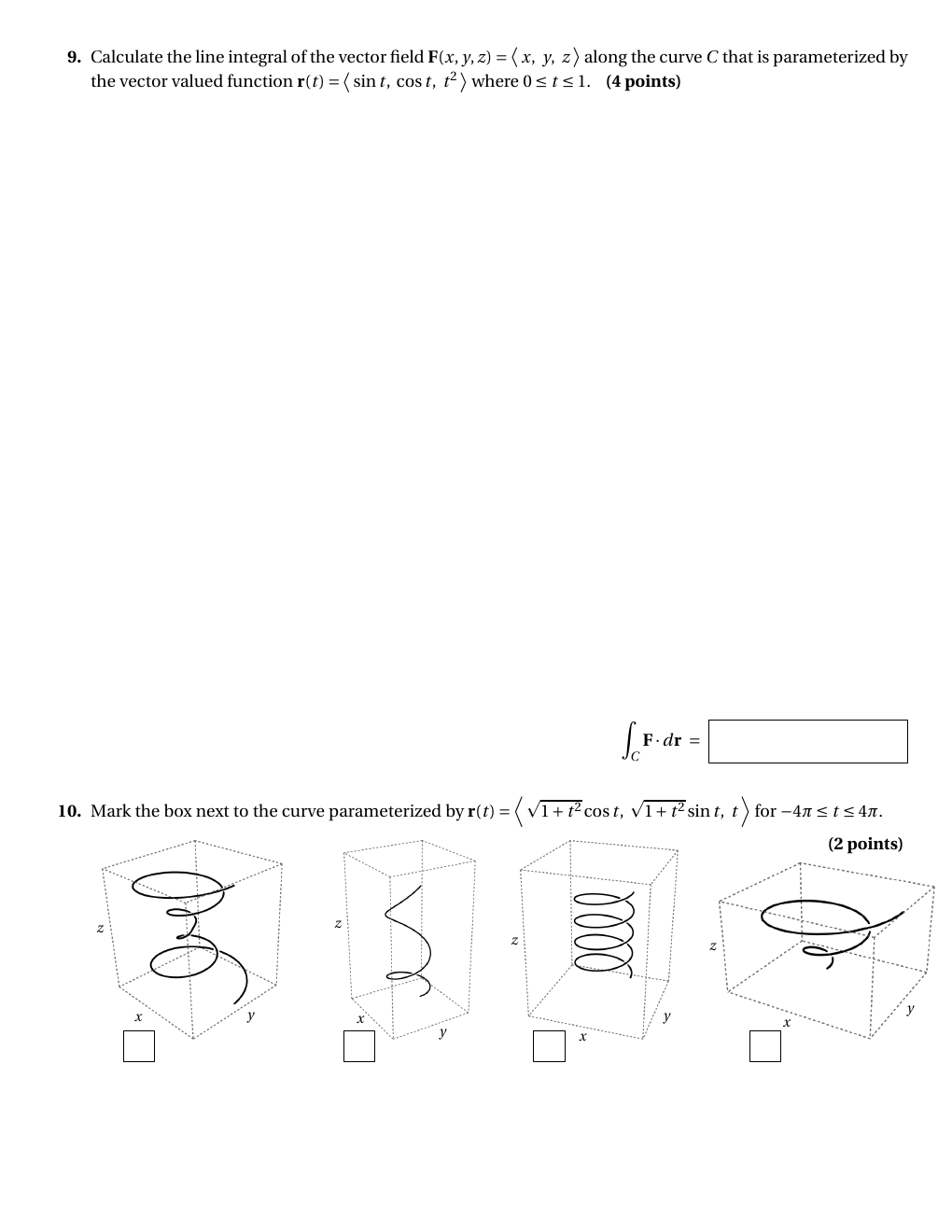
(Same idea for a 3D one like ⟨√(1+t²) cos t, √(1+t²) sin t, t⟩: radius grows as |t| grows, z rises steadily, so it is a spiral widening at both ends.)
Say the recipe from memory
Explain how you attack this slot in general. AI scores it against the recipe.
Slot 9 Mass of a wire ∫ρ ds
Spot it: A wire with a density function ρ. 'Find the total mass.' It is a line integral of a FUNCTION (a number at each point), so use ∫ρ ds.
Recipe
Compute r′(t).
Compute the speed |r′(t)| (look for a perfect square or a constant).
Plug x(t), y(t) into ρ to get ρ(r(t)).
Mass = ∫ ρ(r(t)) |r′(t)| dt over the t-range.
Integrate. Keep exact values (π, not 3.14).
Traps
Forgetting |r′(t)| (the ds factor).
Using the dot product F·r′. That is for vector fields, not density.
Plugging in x, y without substituting x(t), y(t) into ρ.
Worked example (#R25-8b)
Wire r(t) = ⟨−2 sin t, 2 cos t⟩, 0 ≤ t ≤ π, density ρ(x, y) = 3 + x. Find the total mass.
Show worked solution
Answer: 6π − 8
r′ = ⟨−2 cos t, −2 sin t⟩.
|r′| = √(4 cos²t + 4 sin²t) = 2.
ρ(r(t)) = 3 + x(t) = 3 − 2 sin t.
Mass = ∫₀^π (3 − 2 sin t) · 2 dt = ∫₀^π (6 − 4 sin t) dt.
Antiderivative: 6t + 4 cos t.
At π: 6π + 4(−1) = 6π − 4. At 0: 0 + 4 = 4.
Mass = (6π − 4) − 4 = 6π − 8.
Say the recipe from memory
Explain how you attack this slot in general. AI scores it against the recipe.
Slot 10 Compute ∫F·dr
Spot it: 'Calculate the line integral of the vector field F along the curve r(t).' F gives a vector at each point, so this is work: ∫F·dr.
Recipe
Compute r′(t).
Substitute x(t), y(t), z(t) into F to get F(r(t)).
Dot: F(r(t)) · r′(t). Simplify. Cancellations are common.
Integrate over the t-range.
Shortcut: if F is conservative, use FTLI: f(end) − f(start).
Traps
Forgetting to substitute r(t) into F.
Using |r′| (that is the scalar integral).
Reversing the direction. Going the other way flips the sign.
Worked example (#R25-9)
Evaluate ∫_C F·dr where F(x, y, z) = ⟨x, y, z⟩ and r(t) = ⟨sin t, cos t, t²⟩, 0 ≤ t ≤ 1.
Show worked solution
Answer: 1/2
r′ = ⟨cos t, −sin t, 2t⟩.
F(r(t)) = ⟨sin t, cos t, t²⟩.
F · r′ = sin t cos t − cos t sin t + 2t³ = 2t³.
∫₀¹ 2t³ dt = t⁴/2 from 0 to 1 = 1/2.
Shortcut check: F = ∇(½(x²+y²+z²)). Potential at end t = 1: ½(sin²1 + cos²1 + 1) = 1. At start t = 0: ½(0 + 1 + 0) = ½. Difference = 1 − ½ = 1/2. It matches.
Say the recipe from memory
Explain how you attack this slot in general. AI scores it against the recipe.
Slot 11 Vector field pictures E/F/G
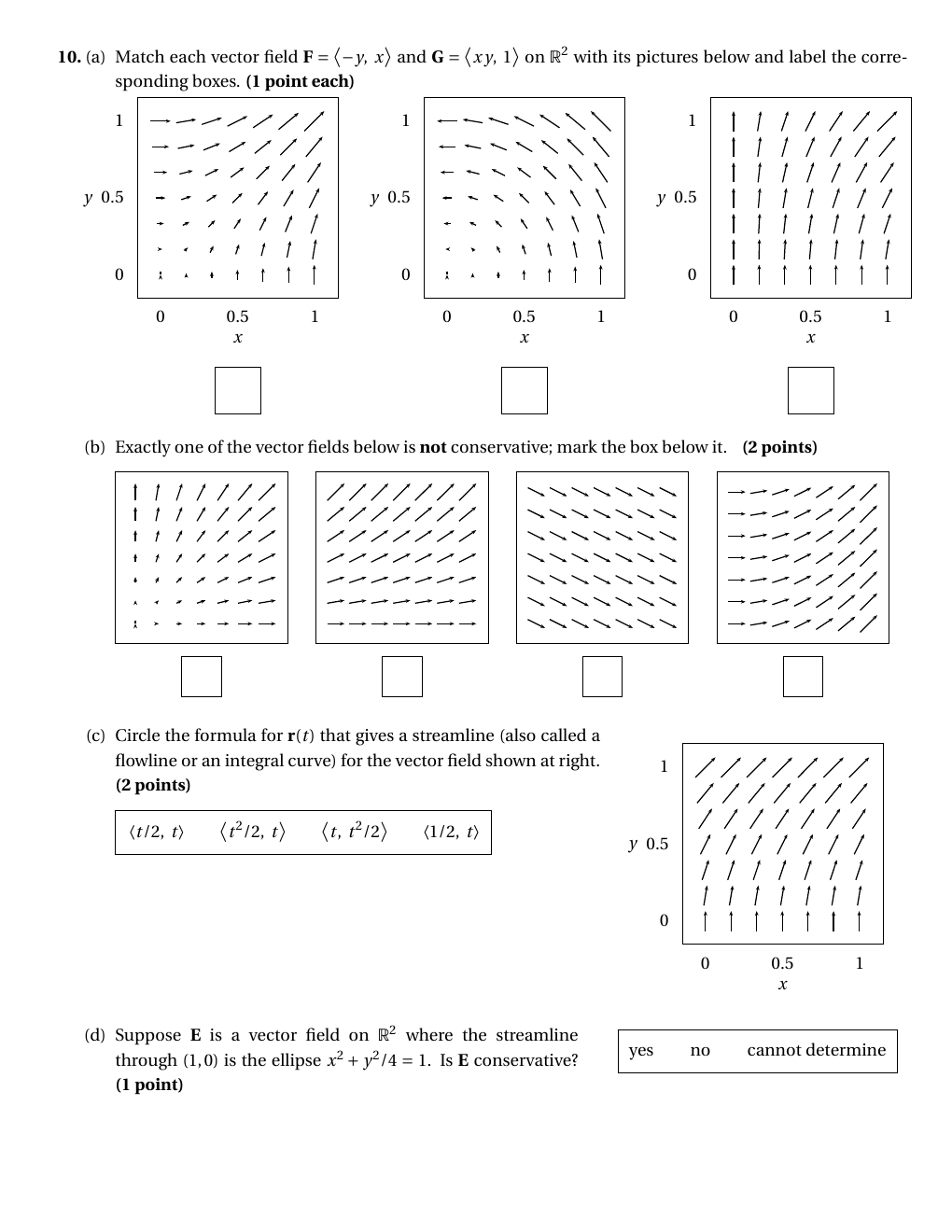
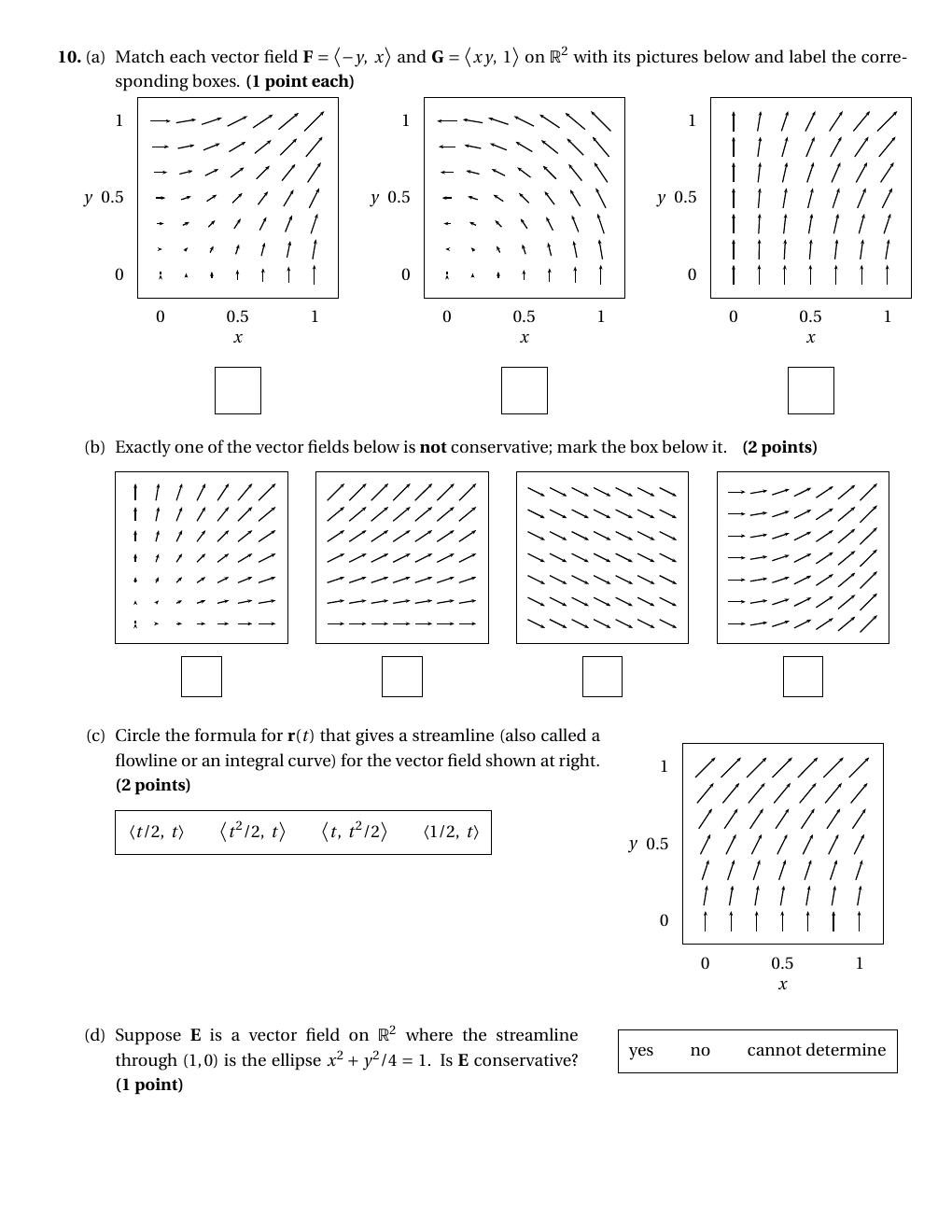
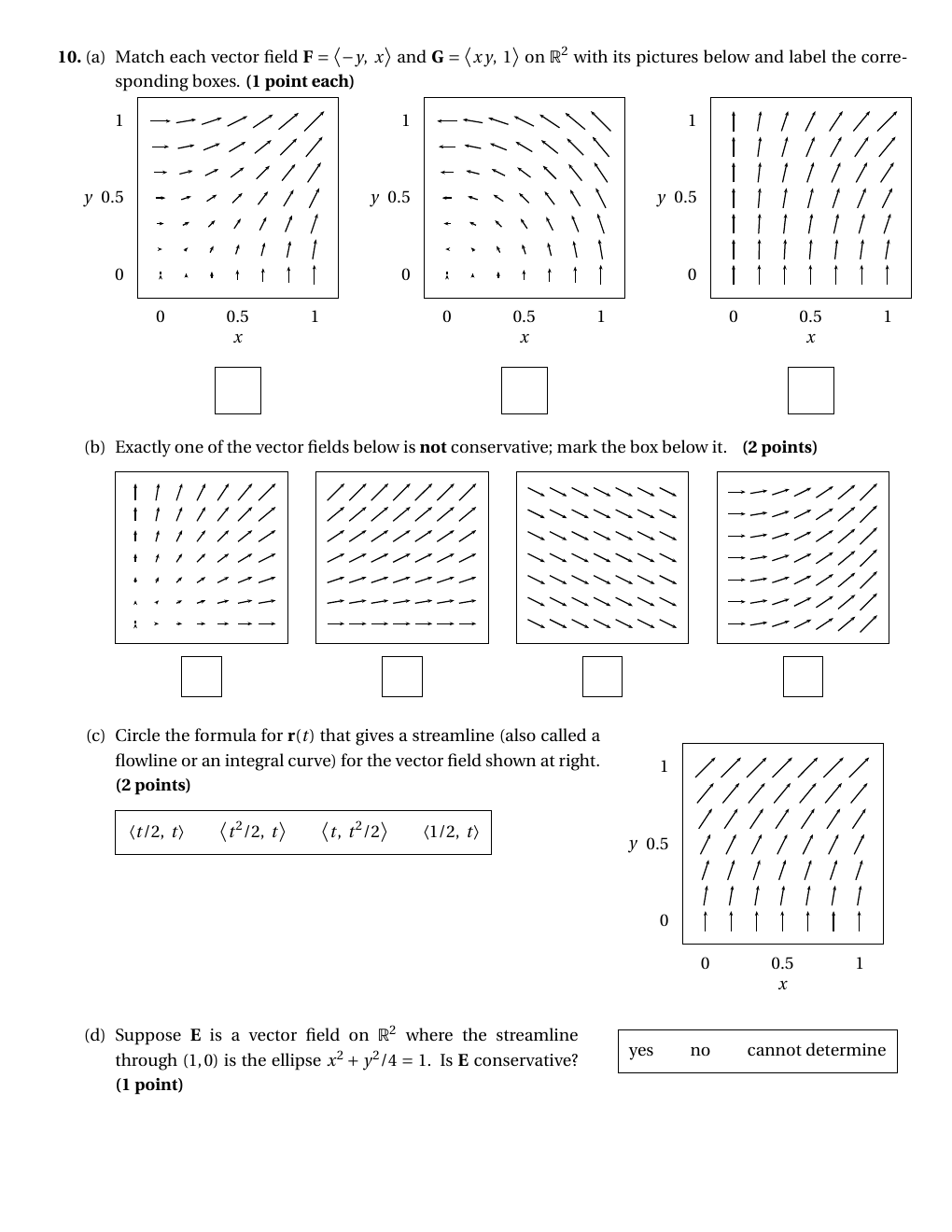
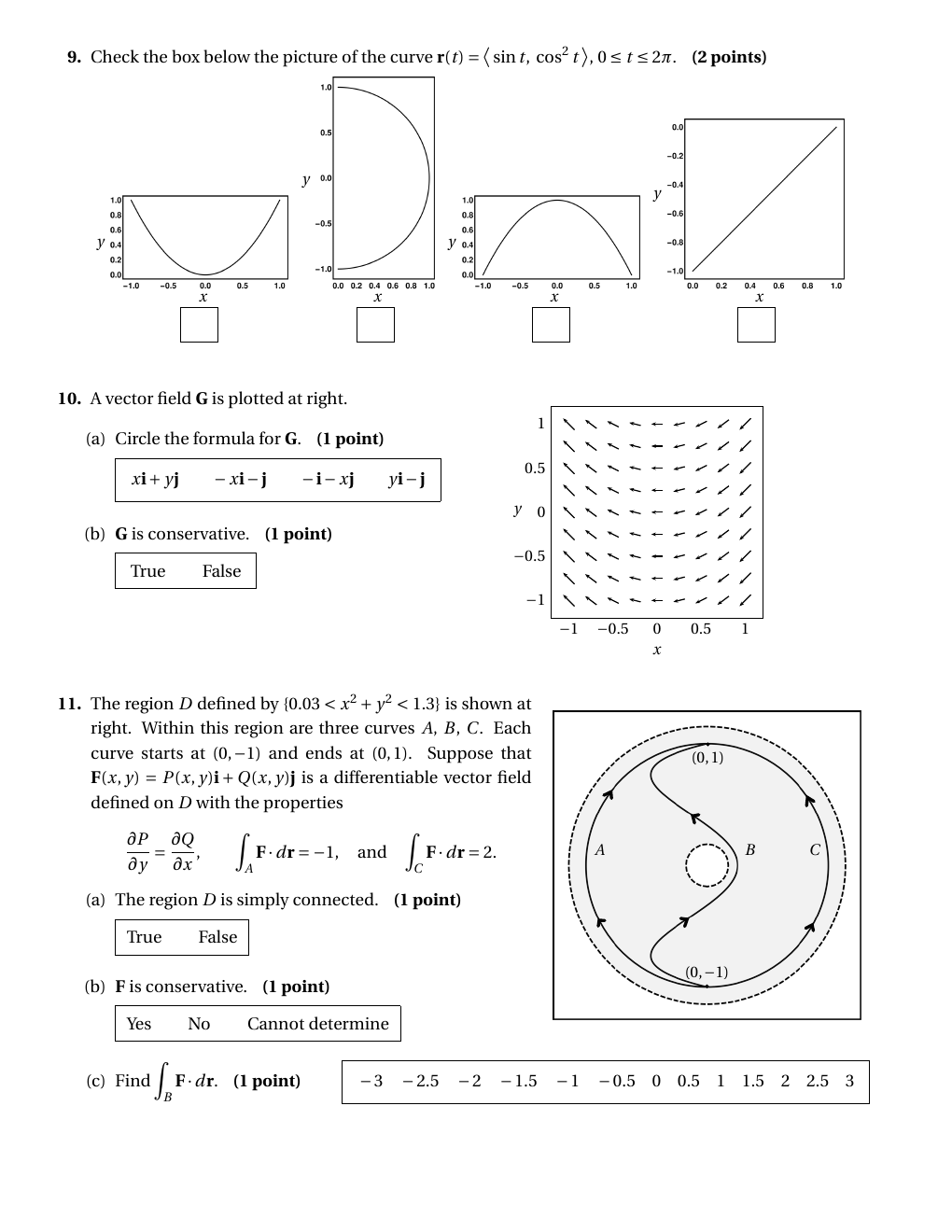
Spot it: Three vector field pictures (E, F, G). Match a formula to a picture, say which is conservative, or pick a flowline or the sign of ∫F·dr along a segment.
Recipe
Match a formula: plug in easy points like (x, 0) and (0, y). Draw the arrow direction there. Keep only pictures that agree at ALL the test points.
Flowline: velocity r′(t) must equal the arrow F(r(t)) at each point. Check that the curve moves the same direction as the arrows, at the same speed.
Conservative: look for a closed loop where the field circulates along the path. Then ∮ ≠ 0, so NOT conservative. Or test P_y = Q_x from the formula.
Sign of ∫F·dr along a segment: are arrows pointing along the direction of travel (positive), against (negative), or sideways (zero)?
Pure rotation fields like ⟨−y, x⟩ are never conservative.
Traps
Parallel is not equal. A flowline needs r′ = F, not just r′ ∥ F.
Checking only one point. Check two or three before you commit.
Forgetting the segment's direction. From (0,0) to (1,1) the tangent is ⟨1,1⟩.
Worked example (#R25-12a)
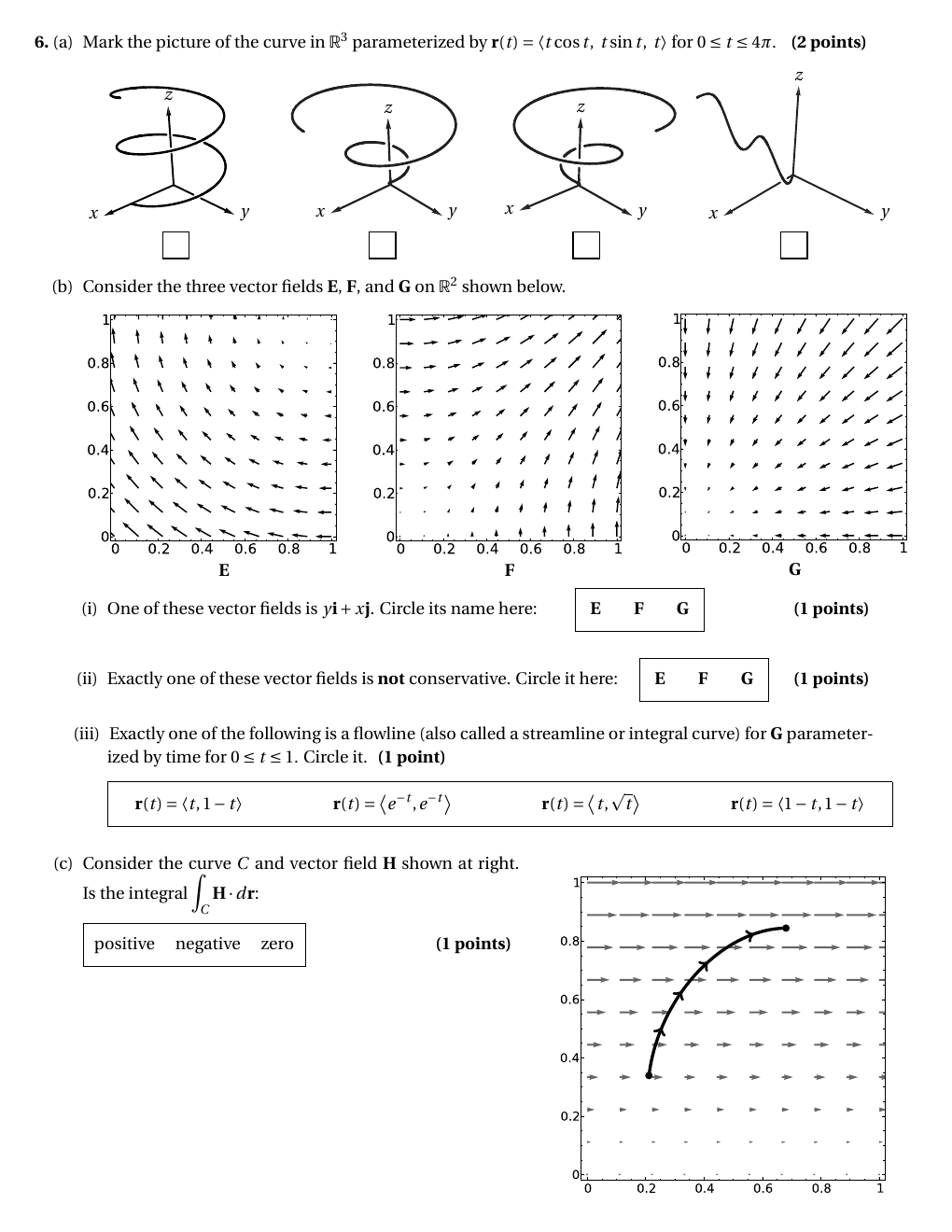
One of the three vector fields E, F, G (on [0,1]×[0,1]) is ⟨x − y, x⟩. Which one?
Show worked solution
Answer: F
Test the left edge x = 0: ⟨0 − y, 0⟩ = ⟨−y, 0⟩. That points LEFT (zero at the corner).
Test the bottom edge y = 0: ⟨x, x⟩. That points up and to the right.
Look at the pictures: only F has arrows pointing left along the left edge and up-right along the bottom.
So the field is F.
Bonus: P = x − y, Q = x. P_y = −1 but Q_x = 1. Not equal, so this field is NOT conservative.
Say the recipe from memory
Explain how you attack this slot in general. AI scores it against the recipe.
Slot 12 Picture-based conservative/FTLI
Spot it: A picture of a function g (graph, heights, or contour map) with a curve C from A to B, and you are asked for ∫_C ∇g · dr. Or: is a plotted field conservative?
Recipe
Is the field a gradient ∇g? Then FTLI applies: ∫_C ∇g·dr = g(B) − g(A).
Read g at the end point B and at the start point A from the picture.
Answer = g(B) − g(A). The path in between does not matter.
Closed curve (A = B)? Answer is 0.
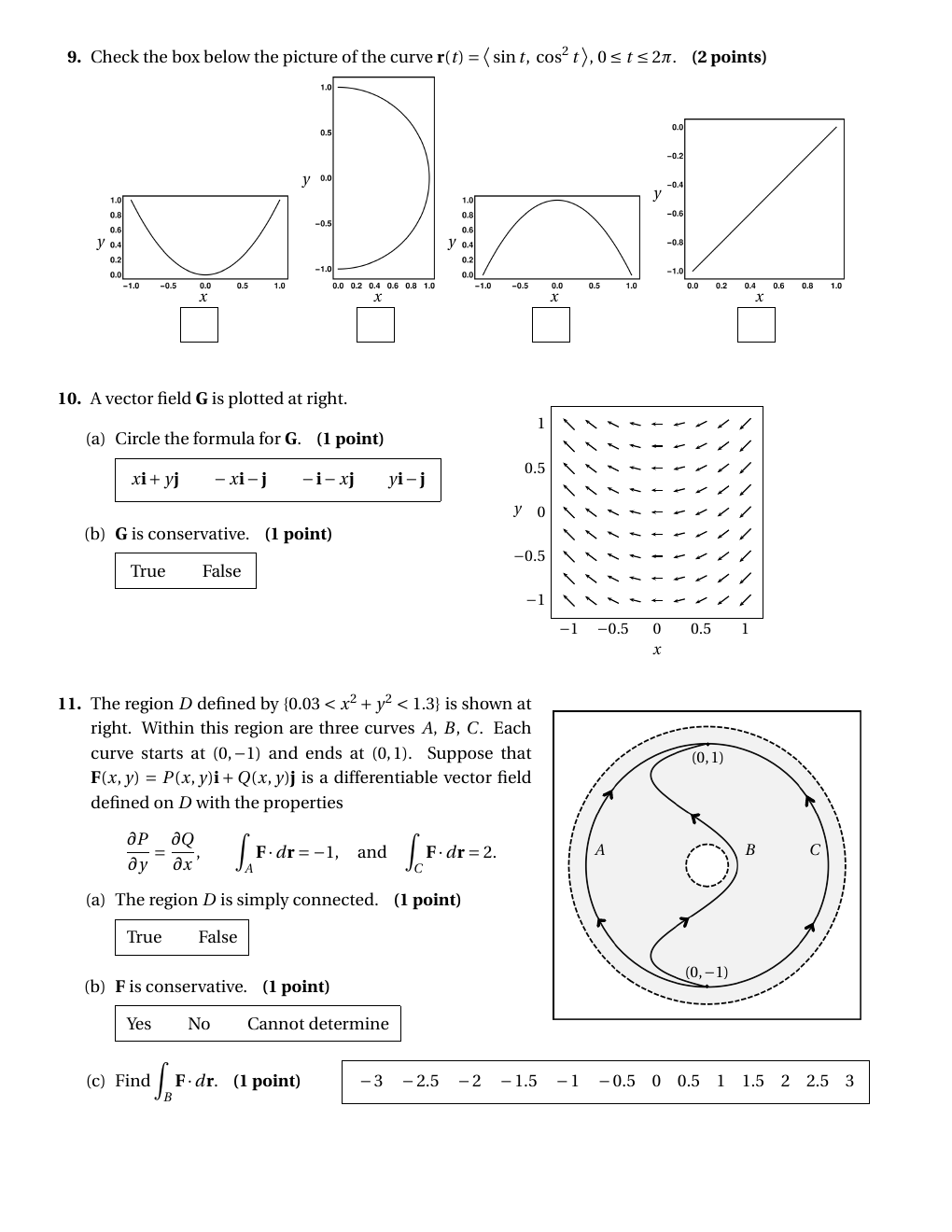
To show a plotted field is NOT conservative: find a loop where the arrows point along the direction of travel the whole way (circulation is not 0).
From a formula: P_y = Q_x on a simply connected region (no holes) means conservative.
Write this on the exam: By the Fundamental Theorem for Line Integrals, ∫_C ∇g · dr = g(B) − g(A), since ∇g is a gradient field.
Traps
Doing g(A) − g(B). It is end minus start.
Trying to integrate along the path when FTLI makes it instant.
Concluding conservative from P_y = Q_x when the domain has a hole (like the origin removed).
Worked example (#R25-5)
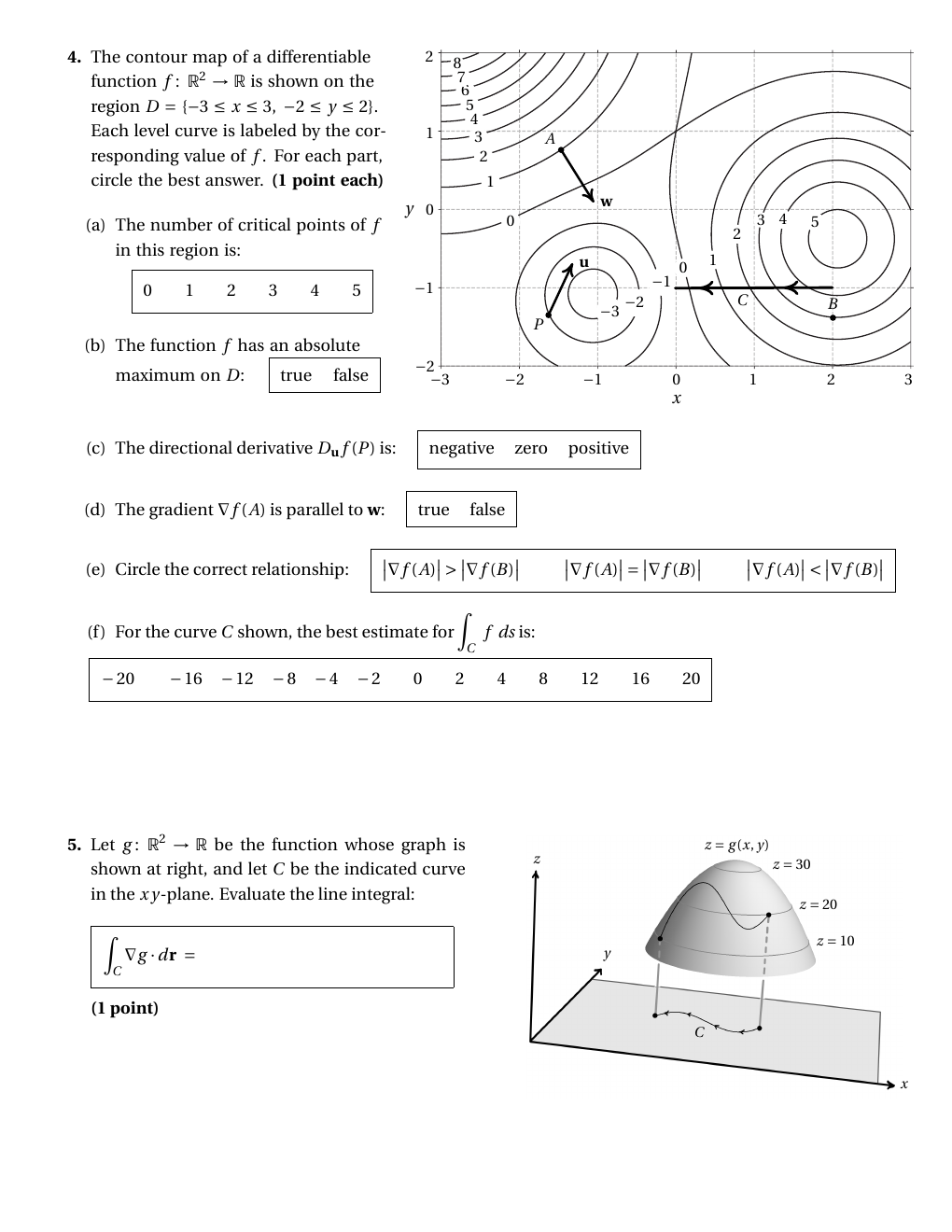
g: R² → R has the graph shown (level heights 10, 20, 30), and C goes from A to B in the xy-plane. Evaluate ∫_C ∇g · dr.
Show worked solution
Answer: −10
∇g is a gradient field, so FTLI applies.
∫_C ∇g · dr = g(B) − g(A).
From the picture, the height above B is 10 and the height above A is 20.
10 − 20 = −10.
Sanity check: the surface goes DOWN from A to B, so the integral should be negative. It is.
Say the recipe from memory
Explain how you attack this slot in general. AI scores it against the recipe.
Instructor FAQ tips
Which method: use the second derivative test on an open region; use Lagrange for an equation constraint g = C. For g ≤ C: do critical points inside plus Lagrange on the boundary, then compare values. On a closed and bounded region, skip the second derivative test: list the interior critical points (∇f = 0) and the boundary candidates, evaluate f at all of them, and the extreme value theorem guarantees the max and min are in that list.
Lagrange algebra: never divide by a variable that could be 0. Split into cases (x = 0 / x ≠ 0) or you'll lose solutions.
Line integrals: ∫_C f ds = ∫ f(r(t))|r′(t)| dt, which is length × the average of f. ∫_C F·dr = ∫ F(r(t))·r′(t) dt. To estimate ∫ g ds from a contour plot, chop the curve into pieces and sum gᵢ · lengthᵢ.
Conservative test: P_y = Q_x on a simply connected domain. ∮ = 0 for every closed loop only if F is conservative. Counterexample: ⟨−y,x⟩/(x²+y²) on ℝ² minus the origin has P_y = Q_x, but ∮ around the unit circle is 2π.
Conservative from a picture: find a closed loop where the field clearly circulates (∮ ≠ 0 means not conservative), or compare how the x-components change going up with how the y-components change going right.
Formula sheet
A. Gradient, directional derivative, optimization (14.6-14.8)
∇f = ⟨f_x, f_y⟩ (or ⟨f_x, f_y, f_z⟩). Directional derivative in the direction of a UNIT vector u: D_u f(P) = ∇f(P)·u.
Max rate of increase at P is |∇f(P)|, in the direction ∇f(P)/|∇f(P)|. Min rate −|∇f|, direction −∇f. D_u f = 0 for u ⟂ ∇f.
∇f(P) ⟂ the level curve/surface of f through P. Tangent plane to F(x,y,z) = k at P: ∇F(P)·⟨x−x0, y−y0, z−z0⟩ = 0. Tangent line to a level curve f(x,y) = k: ∇f(P)·⟨x−x0, y−y0⟩ = 0.
Graph z = f(x,y) tangent plane: z = f(a,b) + f_x(a,b)(x−a) + f_y(a,b)(y−b).
Critical point: ∇f = 0 (or undefined). Local extrema occur only at critical points.
Second derivative test at a critical point: D = f_xx f_yy − (f_xy)².
D > 0 and f_xx > 0: local min. D > 0 and f_xx < 0: local max.
D < 0: saddle. D = 0: test fails (undetermined).
Absolute extrema of continuous f on a closed bounded set: (1) critical points in the interior, (2) max/min on the boundary (parametrize each boundary piece, or use Lagrange), (3) compare values. Extreme Value Theorem guarantees they exist on closed and bounded sets; on non-closed or unbounded sets they may not.
Lagrange: extrema of f subject to g = k occur where ∇f = λ∇g and g = k (also check points where ∇g = 0). Solve the system, evaluate f at every solution, largest is max, smallest is min.
Bounded: contained in some disk. Open: every point has a small disk inside the set (boundary not included). Closed: contains its boundary.
Tangent line at t0: L(s) = r(t0) + s r′(t0). Unit tangent T = r′/|r′|.
Arc length from t = a to b: L = ∫_a^b |r′(t)| dt. Arc length function s(t) = ∫_a^t |r′(u)| du, ds = |r′(t)| dt.
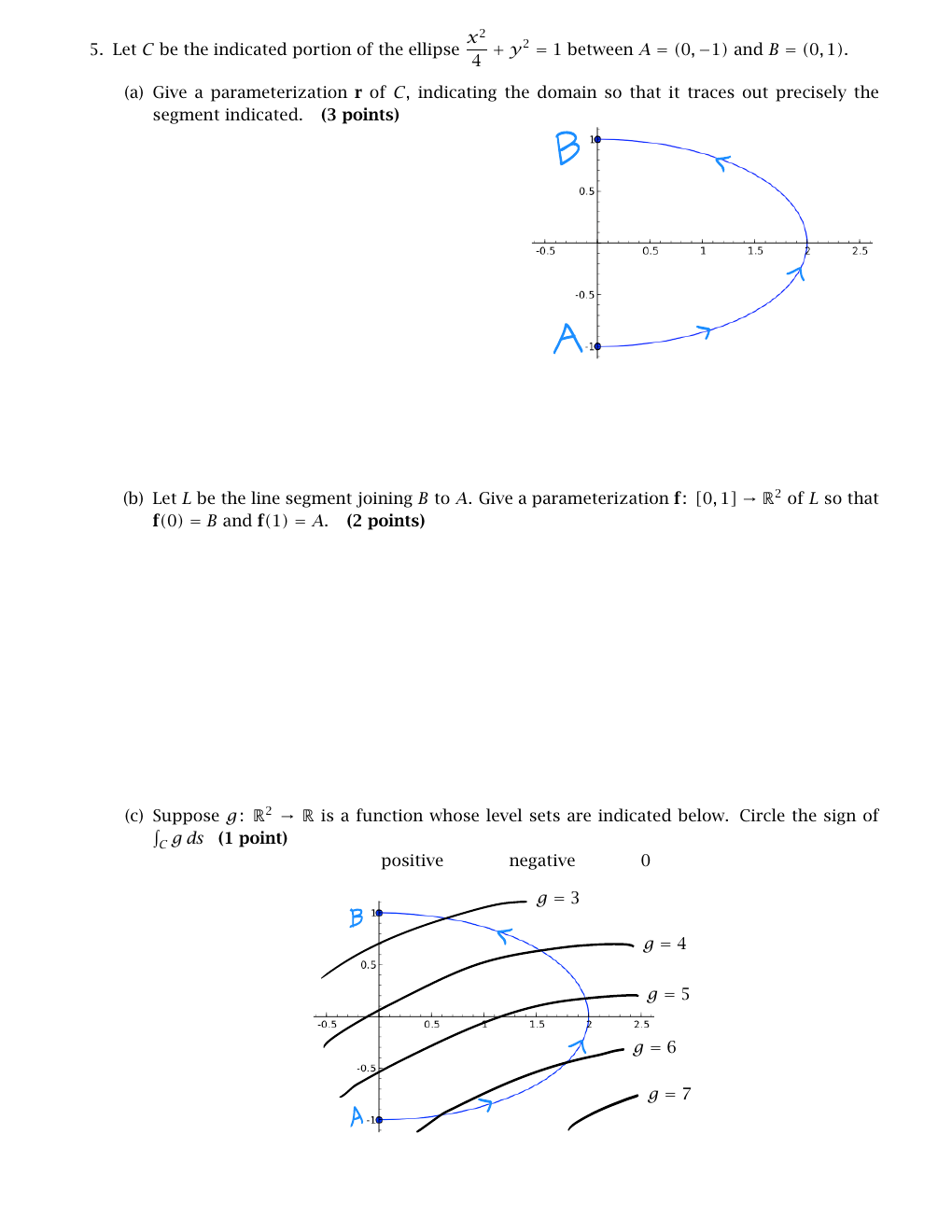
Parametrize standard curves: circle radius R: ⟨R cos t, R sin t⟩, 0 ≤ t ≤ 2π. Segment A to B: A + t(B − A), 0 ≤ t ≤ 1. Intersection of surfaces: parametrize the cylinder/circle part, then plug into the other surface to get z. Helix: ⟨cos t, sin t, t⟩.
C. Line integrals and vector fields (16.1-16.3)
Function integral (scalar): ∫_C f ds = ∫_a^b f(r(t)) |r′(t)| dt. Mass of a wire with density ρ: ∫_C ρ ds. Arc length: ∫_C 1 ds. Does NOT depend on direction.
Vector field integral (work): ∫_C F·dr = ∫_a^b F(r(t))·r′(t) dt = ∫ P dx + Q dy + R dz. DOES flip sign when direction is reversed: ∫_{−C} = −∫_C.
Flowline of F: curve p(t) with p′(t) = F(p(t)) exactly (not just parallel).
Conservative: F = ∇f (f = potential). FTLI: ∫_C ∇f·dr = f(end) − f(start). Conservative ⇒ path independent ⇒ ∮ = 0 for every closed curve.
Test: F = ⟨P,Q⟩ conservative ⇒ P_y = Q_x. R³: P_y = Q_x, P_z = R_x, Q_z = R_y. Converse holds on an open simply connected domain (no holes), e.g. all of R² or R³. Hole example: ⟨−y,x⟩/(x²+y²) has P_y = Q_x but ∮ over the unit circle = 2π, not conservative.
Find potential: f = ∫P dx + C(y); match f_y = Q; solve for C′; integrate; check ∇f = F. 3D: repeat with g(y,z).
Energy: F = −∇φ, m r″ = F ⇒ ½m|v|² + φ(r) is constant. Gravity: F = −GM r/|r|³.
Closed flowlines cannot exist for a conservative field.
Tap the card to flip. "Again" brings it back in a few cards; 4+ correct in a row = mastered.
Per slot: the 2025 problem → new variants (same type, new numbers) → older real exams. 2024 is hidden (it's your mock).
#R25-11 Lagrange on a circle/ellipse · real exam · 2025 M2 #1 · 5 pt
Find the absolute maximum and minimum values of f(x, y) = 2x − y on the circle C where x² + y² = 5. Give the absolute max and min and the point(s) where each occurs.
Stuck? Tell Claude: #R25-1
Set g = x² + y² and solve ∇f = λ∇g.
Answer: Absolute max = 5 at (2, −1); absolute min = −5 at (−2, 1).
g = x² + y², C = {g = 5}. ∇f = ⟨2, −1⟩ = λ∇g = λ⟨2x, 2y⟩.
2 = 2λx and −1 = 2λy, so λ, x, y are all nonzero: x = 1/λ, y = −1/(2λ), hence x = −2y.
Plug into g = 5: 4y² + y² = 5, y = ±1, so critical points (−2, 1) and (2, −1).
C is closed and bounded and f is continuous, so the Extreme Value Theorem says these give the abs max/min: f(2,−1) = 5, f(−2,1) = −5.
#V1-11 Lagrange on a circle/ellipse · new variant · 5 pt
Find the absolute maximum and minimum values of f(x, y) = 3x + y on the circle C where x² + y² = 10. Give the absolute max and min and the point(s) where each occurs.
Stuck? Tell Claude: #V1-1
Set g = the constraint expression and solve ∇f = λ∇g together with g = constant.
Answer: Absolute max = 10 at (3, 1); absolute min = −10 at (−3, −1).
g = x² + y², C = {g = 10}. ∇f = ⟨3, 1⟩ = λ∇g = λ⟨2x, 2y⟩.
3 = 2λx and 1 = 2λy, so λ, x, y are all nonzero: x = 3/(2λ), y = 1/(2λ), hence x = 3y.
Plug into g = 10: 9y² + y² = 10, y = ±1, so critical points (3, 1) and (−3, −1).
C is closed and bounded and f is continuous, so the Extreme Value Theorem says these give the abs max/min: f(3,1) = 10, f(−3,−1) = −10.
#V1-21 Lagrange on a circle/ellipse · new variant · 5 pt
Find the maximum and minimum values of f(x, y) = 2x + y on the ellipse x² + 2y² = 18. Give the point(s) where each occurs.
Stuck? Tell Claude: #V1-2
Set g = x² + 2y² and solve ∇f = λ∇g together with g = constant.
Answer: Maximum = 9 at (4, 1); minimum = −9 at (−4, −1).
g = x² + 2y². ∇f = ⟨2, 1⟩ = λ∇g = λ⟨2x, 4y⟩.
2 = 2λx and 1 = 4λy, so λ ≠ 0 and x = 1/λ, y = 1/(4λ), i.e. x = 4y.
Plug into g = 18: 16y² + 2y² = 18y² = 18, y = ±1. Points (4, 1) and (−4, −1).
The ellipse is closed and bounded, so by the EVT: f(4,1) = 9 is the max and f(−4,−1) = −9 is the min.
#V1-31 Lagrange on a circle/ellipse · new variant · 5 pt
Find the absolute maximum and minimum values of f(x, y) = 4x − 3y on the circle C where x² + y² = 25. Give the absolute max and min and the point(s) where each occurs.
Stuck? Tell Claude: #V1-3
Set g = the constraint expression and solve ∇f = λ∇g together with g = constant.
Answer: Absolute max = 25 at (4, −3); absolute min = −25 at (−4, 3).
g = x² + y², C = {g = 25}. ∇f = ⟨4, −3⟩ = λ⟨2x, 2y⟩.
4 = 2λx and −3 = 2λy, so x = 2/λ and y = −3/(2λ), hence y = −3x/4.
Plug into g = 25: x² + 9x²/16 = 25x²/16 = 25, x = ±4. Critical points (4, −3) and (−4, 3).
C is closed and bounded and f is continuous, so by the EVT: f(4,−3) = 25 is the max, f(−4,3) = −25 is the min.
#R14-11 Lagrange on a circle/ellipse · real exam · 2014 M2 #1 · 6 pt
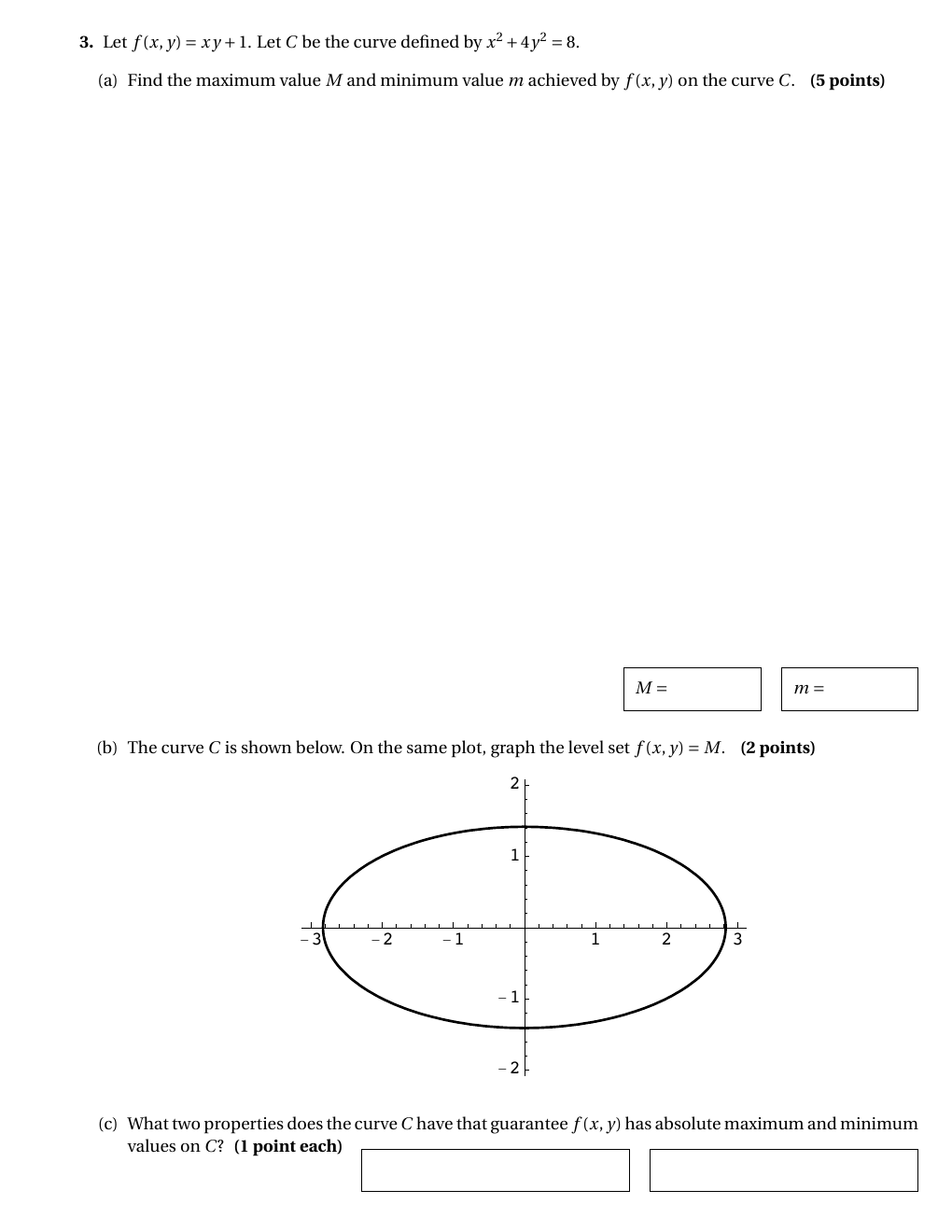
Find the points on the curve x² + 4y² = 8 where f(x,y) = −x + 2y attains its maximum and minimum, and say what the max and min are.
Stuck? Tell Claude: #R14-1
Lagrange with g = x² + 4y²; the curve is closed and bounded.
Answer: max = 4 at (−2, 1); min = −4 at (2, −1).
∇f = ⟨−1, 2⟩ = λ∇g = λ⟨2x, 8y⟩, so −1 = 2λx and 2 = 8λy, together with x² + 4y² = 8.
λ ≠ 0 (λ = 0 would give −1 = 0). Solve both for 1/λ: 1/λ = −2x and 1/λ = 4y, so x = −2y.
Substitute: 8 = x² + 4y² = 4y² + 4y² = 8y², so y = ±1 and x = −2y.
Critical points (−2, 1) and (2, −1). The ellipse is closed and bounded, so the Extreme Value Theorem guarantees a max and min occur at these.
f(−2,1) = 2 + 2 = 4; f(2,−1) = −2 − 2 = −4.
#R16-11 Lagrange on a circle/ellipse · real exam · 2016 M2 #1 · 5 pt
Find the maximum value of the function f(x,y) = 3x + y on the curve x² + y² = 10.
Stuck? Tell Claude: #R16-1
Lagrange: ∇f = λ∇g, g = x² + y².
Answer: Max value = 10
3 = 2λx, 1 = 2λy so x = 3y.
9y² + y² = 10, y = ±1, giving (3,1) and (−3,−1).
f(3,1) = 10, f(−3,−1) = −10.
#R18-41 Lagrange on a circle/ellipse · real exam · 2018 M2 #4 · 5 pt
Find the maximum and minimum values of f(x,y) = −x + 2y on the curve x² + 2y² = 3.
Stuck? Tell Claude: #R18-4
Lagrange multipliers with g = x² + 2y² = 3.
Answer: Minimum value = −3, maximum value = 3
∇f = ⟨−1, 2⟩ = λ⟨2x, 4y⟩ gives −1 = 2λx and 2 = 4λy, so λ ≠ 0 and x = −1/(2λ), y = 1/(2λ), i.e. y = −x.
Constraint: x² + 2x² = 3, x = ±1. Points (1,−1) and (−1,1).
f(1,−1) = −3, f(−1,1) = 3. The ellipse is closed and bounded, so these are the absolute min and max.
#R19-31 Lagrange on a circle/ellipse · real exam · 2019 M2 #3 · 5 pt
Use Lagrange multipliers to find the maximum area of a rectangle in the first quadrant with two sides contained in the x and y axes and one corner on the line 2x + y = 12. (No credit unless you use Lagrange multipliers.)
Stuck? Tell Claude: #R19-3
Maximize f = xy subject to g = 2x + y = 12; set ∇f = λ∇g.
Answer: Maximum area = 18
f(x,y) = xy (area), g(x,y) = 2x + y = 12.
∇f = ⟨y, x⟩ = λ⟨2, 1⟩ gives y = 2λ and x = λ, so y = 2x.
Constraint: 2x + 2x = 12, so x = 3, y = 6.
Only critical point is (3,6); area = 3·6 = 18.
#R25-22 Tangent plane to level surface · real exam · 2025 M2 #2 · 4 pt
Find the tangent plane to the surface x² + y² − 3z² = 2 at the point P = (1, 2, 1). Write the equation in the form __x + __y + __z = __.
Stuck? Tell Claude: #R25-2
Treat the surface as a level set f = 2 and use ∇f(P) as the normal.
Answer: x + 2y − 3z = 2
f = x² + y² − 3z², surface is f = 2. ∇f = ⟨2x, 2y, −6z⟩, so ∇f(1,2,1) = ⟨2, 4, −6⟩, parallel to n = ⟨1, 2, −3⟩.
#R16-112 Tangent plane to level surface · real exam · 2016 M2 #11 · 4 pt
Consider the surface S defined by x³ + y³ + z³ = −8. Find an equation for the plane tangent to S at the point (1, −1, −2). Form: __x + __y + __z = __.
Stuck? Tell Claude: #R16-11
S is a level set of g = x³ + y³ + z³; normal = ∇g.
Answer: 1x + 1y + 4z = −8
∇g = ⟨3x², 3y², 3z²⟩ = ⟨3, 3, 12⟩ at (1,−1,−2); use n = ⟨1,1,4⟩.
(x − 1) + (y + 1) + 4(z + 2) = 0, so x + y + 4z = −8.
#R18-8a2 Tangent plane to level surface · real exam · 2018 M2 #8a · 4 pt
Let S₁ be the surface x = 2z² + y² (elliptic paraboloid). Find an equation for the tangent plane to S₁ at the point (3, −1, 1). Form: __x + __y + __z = __.
Stuck? Tell Claude: #R18-8a
Write S₁ as f = 0 with f = −x + y² + 2z² and use ∇f as the normal.
∇F = ⟨y² − 2xz, 2xy + z², 2yz − x²⟩; at (0,1,−1) this is ⟨1, 1, −2⟩.
1(x − 0) + 1(y − 1) − 2(z + 1) = 0, so x + y − 2z = 3.
#R25-3a3 Table → 2nd derivative test · real exam · 2025 M2 #3a · 1 pt
f(x, y) is differentiable with continuous second order partials, with values:
(x,y)
f
fx
fy
fxx
fyy
fxy
(0,0)
0
0
0
4
1
2
(0,1)
−1
0
−5
2
1
1
(1,0)
0
0
0
1
3
4
(1,1)
5
0
0
−2
−1
1
Circle the best description of the point (0,0): not critical / local minimum / local maximum / saddle point / undetermined.
Stuck? Tell Claude: #R25-3a
First check fx = fy = 0, then compute D = fxx·fyy − fxy².
Answer: Undetermined.
D = fxx·fyy − fxy² = 4·1 − 2² = 0, test fails.
#R25-3b3 Table → 2nd derivative test · real exam · 2025 M2 #3b · 1 pt
f(x, y) is differentiable with continuous second order partials, with values:
(x,y)
f
fx
fy
fxx
fyy
fxy
(0,0)
0
0
0
4
1
2
(0,1)
−1
0
−5
2
1
1
(1,0)
0
0
0
1
3
4
(1,1)
5
0
0
−2
−1
1
Circle the best description of the point (0,1): not critical / local minimum / local maximum / saddle point / undetermined.
Stuck? Tell Claude: #R25-3b
First check fx = fy = 0, then compute D = fxx·fyy − fxy².
Answer: Not critical.
fy = −5 ≠ 0, so not a critical point.
#R25-3c3 Table → 2nd derivative test · real exam · 2025 M2 #3c · 1 pt
f(x, y) is differentiable with continuous second order partials, with values:
(x,y)
f
fx
fy
fxx
fyy
fxy
(0,0)
0
0
0
4
1
2
(0,1)
−1
0
−5
2
1
1
(1,0)
0
0
0
1
3
4
(1,1)
5
0
0
−2
−1
1
Circle the best description of the point (1,0): not critical / local minimum / local maximum / saddle point / undetermined.
Stuck? Tell Claude: #R25-3c
First check fx = fy = 0, then compute D = fxx·fyy − fxy².
Answer: Saddle point.
D = 1·3 − 4² = −13 < 0.
#R25-3d3 Table → 2nd derivative test · real exam · 2025 M2 #3d · 1 pt
f(x, y) is differentiable with continuous second order partials, with values:
(x,y)
f
fx
fy
fxx
fyy
fxy
(0,0)
0
0
0
4
1
2
(0,1)
−1
0
−5
2
1
1
(1,0)
0
0
0
1
3
4
(1,1)
5
0
0
−2
−1
1
Circle the best description of the point (1,1): not critical / local minimum / local maximum / saddle point / undetermined.
Stuck? Tell Claude: #R25-3d
First check fx = fy = 0, then compute D = fxx·fyy − fxy².
Answer: Local maximum.
D = (−2)(−1) − 1² = 1 > 0 and fxx = −2 < 0.
#V3-13 Table → 2nd derivative test · new variant · 4 pt
f(x, y) is differentiable with continuous second order partials, with values:
(x,y)
f
fx
fy
fxx
fyy
fxy
(0,0)
0
0
0
3
2
1
(0,1)
2
2
0
1
1
0
(1,0)
0
0
0
2
8
4
(1,1)
3
0
0
−1
2
3
For each of the four points, circle the best description: not critical / local minimum / local maximum / saddle point / undetermined.
Stuck? Tell Claude: #V3-1
At each point, first check fx = fy = 0, then compute D = fxx·fyy − fxy².
Answer: (0,0): local minimum; (0,1): not critical; (1,0): undetermined; (1,1): saddle point.
(0,0): D = 3·2 − 1² = 5 > 0 and fxx = 3 > 0, local minimum.
(0,1): fx = 2 ≠ 0, not critical.
(1,0): fx = fy = 0, D = 2·8 − 4² = 0, test fails, undetermined.
(1,1): D = (−1)(2) − 3² = −11 < 0, saddle.
#V3-23 Table → 2nd derivative test · new variant · 4 pt
f(x, y) is differentiable with continuous second order partials, with values:
(x,y)
f
fx
fy
fxx
fyy
fxy
(0,0)
0
0
0
1
−4
0
(0,1)
1
0
−3
2
2
1
(1,0)
0
0
0
−3
−2
1
(1,1)
−2
0
0
2
2
2
For each of the four points, circle the best description: not critical / local minimum / local maximum / saddle point / undetermined.
Stuck? Tell Claude: #V3-2
At each point, first check fx = fy = 0, then compute D = fxx·fyy − fxy².
Answer: (0,0): saddle point; (0,1): not critical; (1,0): local maximum; (1,1): undetermined.
(0,0): D = 1·(−4) − 0² = −4 < 0, saddle.
(0,1): fy = −3 ≠ 0, not critical.
(1,0): D = (−3)(−2) − 1² = 5 > 0 and fxx = −3 < 0, local maximum.
(1,1): fx = fy = 0, D = 2·2 − 2² = 0, undetermined.
#V3-33 Table → 2nd derivative test · new variant · 4 pt
f(x, y) is differentiable with continuous second order partials, with values:
(x,y)
f
fx
fy
fxx
fyy
fxy
(0,0)
0
0
0
5
2
3
(0,1)
−1
0
−3
2
1
1
(1,0)
4
0
0
0
2
1
(1,1)
3
0
0
−2
−5
3
For each of the four points, circle the best description: not critical / local minimum / local maximum / saddle point / undetermined.
Stuck? Tell Claude: #V3-3
At each point, first check fx = fy = 0, then compute D = fxx·fyy − fxy².
Answer: (0,0): local minimum; (0,1): not critical; (1,0): saddle point; (1,1): local maximum.
(0,0): D = 5·2 − 3² = 1 > 0 and fxx = 5 > 0, local minimum.
(0,1): fy = −3 ≠ 0, not critical.
(1,0): D = 0·2 − 1² = −1 < 0, saddle.
(1,1): D = (−2)(−5) − 3² = 1 > 0 and fxx = −2 < 0, local maximum.
#R10-1a3 Table → 2nd derivative test · real exam · 2010 M2 #1a · 4 pt
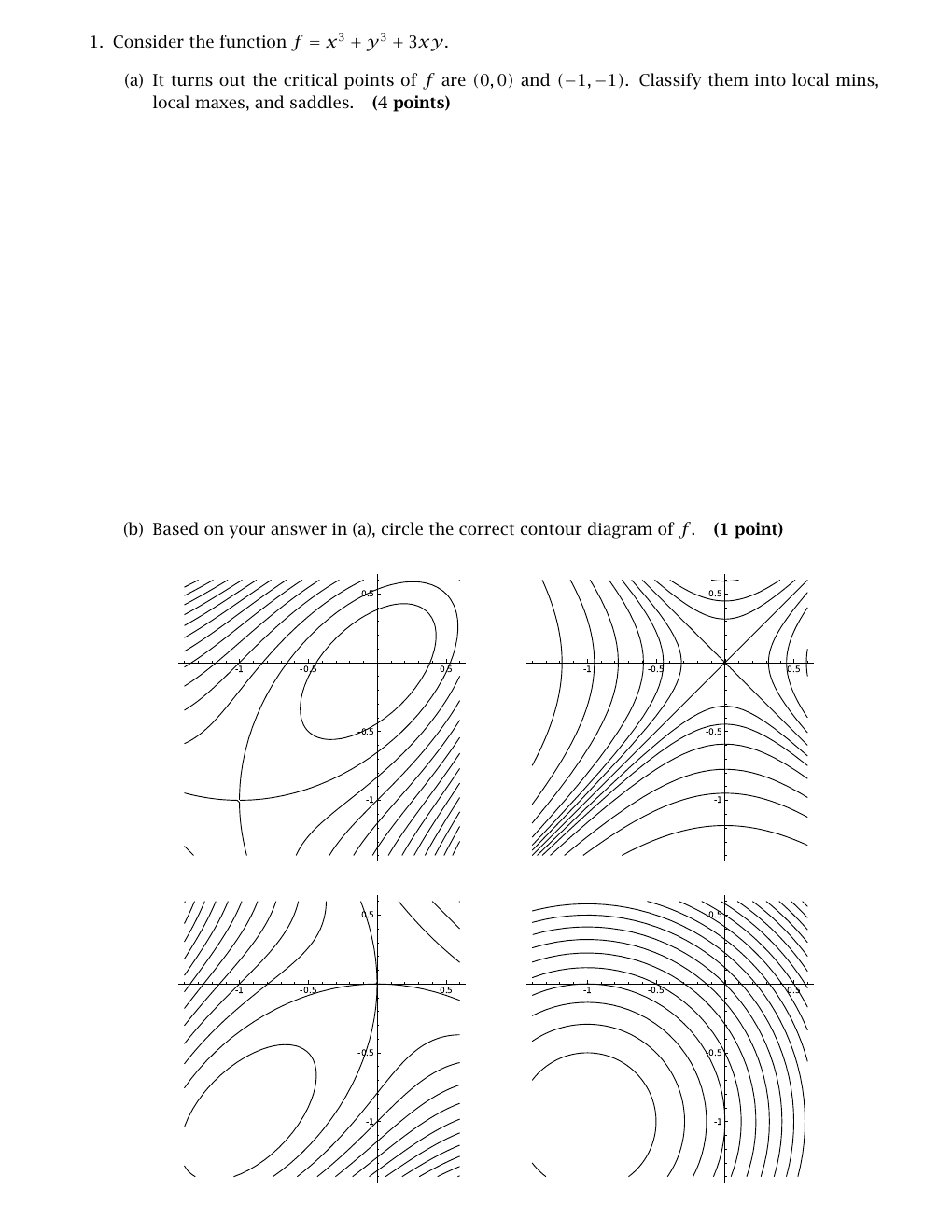
Consider f = x³ + y³ + 3xy. The critical points of f are (0,0) and (−1,−1). Classify them as local mins, local maxes, or saddles.
Stuck? Tell Claude: #R10-1a
fxx = 6x, fyy = 6y, fxy = 3.
Answer: (0,0) is a saddle; (−1,−1) is a local max.
At (0,0): D = fxx·fyy − fxy² = 0·0 − 9 = −9 < 0, saddle.
At (−1,−1): fxx = fyy = −6, D = 36 − 9 = 27 > 0, fxx < 0: local max.
#R11-13 Table → 2nd derivative test · real exam · 2011 M2 #1 · 3 pt
Suppose f(x,y) has values and partial derivatives as in the table. Find all the critical points you can and classify them.
(x,y)
f
fx
fy
fxx
fxy
fyy
(0,0)
0
0
0
−2
1
−3
(1,0)
2
−1
1
1
0
2
(2,1)
5
0
0
1
3
2
Stuck? Tell Claude: #R11-1
Only points with fx = fy = 0 are critical.
Answer: Local mins: none. Local maxes: (0,0). Saddles: (2,1).
Critical: (0,0) and (2,1). (1,0) is not (fx = −1, fy = 1).
(0,0): D = (−2)(−3) − 1² = 5 > 0, fxx = −2 < 0: local max.
(2,1): D = (1)(2) − 3² = −7 < 0: saddle.
#R12-1a3 Table → 2nd derivative test · real exam · 2012 M2 #1a · 3 pt
Suppose f(x,y) has values and partial derivatives as in the table. Find all the critical points you can from the data and classify them as local mins, local maxes, and saddles.
(x,y)
f
fx
fy
fxx
fxy
fyy
(1,0)
2
0
1
1
0
2
(0,1)
3
0
0
−3
1
−2
(2,0)
0
−1
1
1
0
2
(1,2)
5
0
0
−1
3
2
Stuck? Tell Claude: #R12-1a
Critical means fx = fy = 0. Then D = fxx·fyy − fxy².
Answer: Local mins: none. Local maxes: (0,1). Saddles: (1,2).
Critical points need ∇f = 0: only (0,1) and (1,2). (1,0) has fy = 1 and (2,0) has fx = −1, so they are not critical.
(0,1): D = (−3)(−2) − 1² = 5 > 0 and fxx = −3 < 0, so local max.
(1,2): D = (−1)(2) − 3² = −11 < 0, so saddle.
#R14-23 Table → 2nd derivative test · real exam · 2014 M2 #2 · 3 pt
Let f: R² → R have continuous second order partial derivatives. Assume f(0,0) = 1, fx(0,0) = 0, fy(0,0) = 0, fxx(0,0) = 5, fxy(0,0) = 2, fyx(0,0) = 2, fyy(0,0) = −1. Determine whether (0,0) is critical and, if so, whether it is a local min, local max, or saddle. Choices: Not a critical point / A local min / A local max / A saddle / We do not have enough information.
Stuck? Tell Claude: #R14-2
Critical since ∇f = 0; then compute D = fxx·fyy − fxy².
Answer: A saddle (D = −9 < 0).
∇f(0,0) = (fx, fy) = (0,0), so (0,0) is a critical point.
D = fxx·fyy − (fxy)² = 5(−1) − 2² = −9.
D < 0, so the second derivative test says saddle.
#R16-2a3 Table → 2nd derivative test · real exam · 2016 M2 #2 (−2,0) · 1 pt
The table contains data about a differentiable function g(x,y):
(x,y)
g
gx
gy
gxx
gyy
gxy
(−2,0)
−16
0
0
12
2
0
(0,0)
0
12
0
0
2
0
(2,0)
16
0
0
−12
2
0
The point (−2,0) is ___ of g. Choices: not a critical point / a local minimum / a local maximum / a saddle point.
Stuck? Tell Claude: #R16-2a
Gradient first, then D.
Answer: a local minimum
gx = gy = 0; D = 12·2 − 0 = 24 > 0 and gxx = 12 > 0.
#R16-2b3 Table → 2nd derivative test · real exam · 2016 M2 #2 (0,0) · 1 pt
The table contains data about a differentiable function g(x,y):
(x,y)
g
gx
gy
gxx
gyy
gxy
(−2,0)
−16
0
0
12
2
0
(0,0)
0
12
0
0
2
0
(2,0)
16
0
0
−12
2
0
The point (0,0) is ___ of g. Choices: not a critical point / a local minimum / a local maximum / a saddle point.
Stuck? Tell Claude: #R16-2b
Gradient first.
Answer: not a critical point
gx(0,0) = 12 ≠ 0.
#R16-2c3 Table → 2nd derivative test · real exam · 2016 M2 #2 (2,0) · 1 pt
The table contains data about a differentiable function g(x,y):
(x,y)
g
gx
gy
gxx
gyy
gxy
(−2,0)
−16
0
0
12
2
0
(0,0)
0
12
0
0
2
0
(2,0)
16
0
0
−12
2
0
The point (2,0) is ___ of g. Choices: not a critical point / a local minimum / a local maximum / a saddle point.
Stuck? Tell Claude: #R16-2c
Gradient first, then D.
Answer: a saddle point
gx = gy = 0; D = (−12)(2) − 0 = −24 < 0.
#R18-3a3 Table → 2nd derivative test · real exam · 2018 M2 #3 (−1,0) · 1 pt
Suppose f(x,y) is differentiable with continuous second-order partials and values:
(x,y)
f
fx
fy
fxx
fyy
fxy
(−1,0)
4
0
0
−2
−3
2
(0,1)
0
0
1
1
2
0
(2,1)
−2
0
0
1
1
3
Describe the point (−1,0). Choices: not critical / local minimum / local maximum / saddle point / undetermined.
Stuck? Tell Claude: #R18-3a
Critical? Then D = fxxfyy − fxy².
Answer: local maximum
Critical (fx = fy = 0).
D = (−2)(−3) − 2² = 2 > 0 and fxx = −2 < 0.
#R18-3b3 Table → 2nd derivative test · real exam · 2018 M2 #3 (0,1) · 1 pt
Suppose f(x,y) is differentiable with continuous second-order partials and values:
(x,y)
f
fx
fy
fxx
fyy
fxy
(−1,0)
4
0
0
−2
−3
2
(0,1)
0
0
1
1
2
0
(2,1)
−2
0
0
1
1
3
Describe the point (0,1). Choices: not critical / local minimum / local maximum / saddle point / undetermined.
Stuck? Tell Claude: #R18-3b
Check the gradient.
Answer: not critical
fy(0,1) = 1 ≠ 0.
#R18-3c3 Table → 2nd derivative test · real exam · 2018 M2 #3 (2,1) · 1 pt
Suppose f(x,y) is differentiable with continuous second-order partials and values:
(x,y)
f
fx
fy
fxx
fyy
fxy
(−1,0)
4
0
0
−2
−3
2
(0,1)
0
0
1
1
2
0
(2,1)
−2
0
0
1
1
3
Describe the point (2,1). Choices: not critical / local minimum / local maximum / saddle point / undetermined.
Stuck? Tell Claude: #R18-3c
Critical? Then D.
Answer: saddle point
Critical (fx = fy = 0).
D = (1)(1) − 3² = −8 < 0.
#R19-1a-i3 Table → 2nd derivative test · real exam · 2019 M2 #1a (0,0) · 1 pt
Suppose f(x,y) is a differentiable function with continuous second-order partial derivatives and values given in the table:
(x,y)
f
fx
fy
fxx
fyy
fxy
(0,0)
0
0
0
2
1
4
(1,0)
5
0
−1
0
0
3
(0,1)
−3
0
0
−1
−2
1
(1,1)
0
−2
1
−1
5
6
For the point (0,0), circle the best description. Choices: local max / local min / saddle / not a critical point / cannot determine (from the information given).
Stuck? Tell Claude: #R19-1a-i
Check whether fx = fy = 0, then compute D = fxx·fyy − fxy².
Answer: saddle
fx = fy = 0, so (0,0) is critical.
D = fxx·fyy − fxy² = 2·1 − 4² = −14 < 0 (the official scratch work writes −13, an arithmetic slip; the sign is what matters).
#R19-1a-ii3 Table → 2nd derivative test · real exam · 2019 M2 #1a (1,0) · 1 pt
Suppose f(x,y) is a differentiable function with continuous second-order partial derivatives and values given in the table:
(x,y)
f
fx
fy
fxx
fyy
fxy
(0,0)
0
0
0
2
1
4
(1,0)
5
0
−1
0
0
3
(0,1)
−3
0
0
−1
−2
1
(1,1)
0
−2
1
−1
5
6
For the point (1,0), circle the best description. Choices: local max / local min / saddle / not a critical point / cannot determine (from the information given).
Stuck? Tell Claude: #R19-1a-ii
Check fx and fy first.
Answer: not a critical point
fy(1,0) = −1 ≠ 0, so the gradient is not zero.
#R19-1a-iii3 Table → 2nd derivative test · real exam · 2019 M2 #1a (0,1) · 1 pt
Suppose f(x,y) is a differentiable function with continuous second-order partial derivatives and values given in the table:
(x,y)
f
fx
fy
fxx
fyy
fxy
(0,0)
0
0
0
2
1
4
(1,0)
5
0
−1
0
0
3
(0,1)
−3
0
0
−1
−2
1
(1,1)
0
−2
1
−1
5
6
For the point (0,1), circle the best description. Choices: local max / local min / saddle / not a critical point / cannot determine (from the information given).
Stuck? Tell Claude: #R19-1a-iii
Check fx = fy = 0, then D.
Answer: local max
fx = fy = 0, so critical.
D = (−1)(−2) − 1² = 1 > 0, and fxx = −1 < 0, so concave down in every direction.
#R19-1b3 Table → 2nd derivative test · real exam · 2019 M2 #1b · 1 pt
Suppose f(x,y) is a differentiable function with continuous second-order partial derivatives and values given in the table:
(x,y)
f
fx
fy
fxx
fyy
fxy
(0,0)
0
0
0
2
1
4
(1,0)
5
0
−1
0
0
3
(0,1)
−3
0
0
−1
−2
1
(1,1)
0
−2
1
−1
5
6
For u = ⟨1/√2, −1/√2⟩, circle the value of D_u f(1,1). Choices: −7/√2, −3/√2, 0, 3/√2, 7/√2.
Stuck? Tell Claude: #R19-1b
D_u f = ∇f · u, with ∇f(1,1) = ⟨fx, fy⟩ from the table.
Question 4 (top left of the page with the contour map of a differentiable f on D = {−3 ≤ x ≤ 3, −2 ≤ y ≤ 2}, level curves labeled by value of f, points P, A, B, vectors u, w, curve C). (a) The number of critical points of f in this region is: 0 1 2 3 4 5.
Stuck? Tell Claude: #R25-4a
Critical points show up as centers of closed contours and saddle crossings.
Answer: 3
Local min near P (inside the 0/−1/−2/−3 loops), local max inside the 5 loop on the right, and one saddle where level curves cross between them.
Question 4 (top left of the page with the contour map of a differentiable f on D = {−3 ≤ x ≤ 3, −2 ≤ y ≤ 2}, level curves labeled by value of f, points P, A, B, vectors u, w, curve C). (b) The function f has an absolute maximum on D: true / false.
Stuck? Tell Claude: #R25-4b
Closed and bounded domain.
Answer: True
f is differentiable (continuous) and D is closed and bounded, so the Extreme Value Theorem applies.
Question 4 (top left of the page with the contour map of a differentiable f on D = {−3 ≤ x ≤ 3, −2 ≤ y ≤ 2}, level curves labeled by value of f, points P, A, B, vectors u, w, curve C). (c) The directional derivative D_u f(P) is: negative / zero / positive.
Stuck? Tell Claude: #R25-4c
Compare direction of u with the way f increases at P.
Answer: Negative
P sits in the low region with contours increasing outward (toward the saddle/upper levels); u points toward lower values, so f decreases along u.
Question 4 (top left of the page with the contour map of a differentiable f on D = {−3 ≤ x ≤ 3, −2 ≤ y ≤ 2}, level curves labeled by value of f, points P, A, B, vectors u, w, curve C). (d) The gradient ∇f(A) is parallel to w: true / false.
Stuck? Tell Claude: #R25-4d
Gradient is perpendicular to the level curve.
Answer: True
w is drawn perpendicular to the level curve through A, so it is parallel to ∇f(A).
Question 4 (top left of the page with the contour map of a differentiable f on D = {−3 ≤ x ≤ 3, −2 ≤ y ≤ 2}, level curves labeled by value of f, points P, A, B, vectors u, w, curve C). (e) Circle the correct relationship: |∇f(A)| > |∇f(B)|, |∇f(A)| = |∇f(B)|, |∇f(A)| < |∇f(B)|.
Stuck? Tell Claude: #R25-4e
Closer level curves means bigger gradient.
Answer: |∇f(A)| < |∇f(B)|
Level curves are packed more tightly near B than near A, so the gradient is larger at B.
Question 4 (top left of the page with the contour map of a differentiable f on D = {−3 ≤ x ≤ 3, −2 ≤ y ≤ 2}, level curves labeled by value of f, points P, A, B, vectors u, w, curve C). (f) For the curve C shown, the best estimate for ∫_C f ds is: −20, −16, −12, −8, −4, −2, 0, 2, 4, 8, 12, 16, 20.
Stuck? Tell Claude: #R25-4f
∫ f ds = length × average value of f on C.
Answer: 4
Length of C is about 2. Sample f at 5 points along C: about −0.5, 0.5, 2, 3.5, 4.3 (sum 9.8), average ≈ 9.8/5.
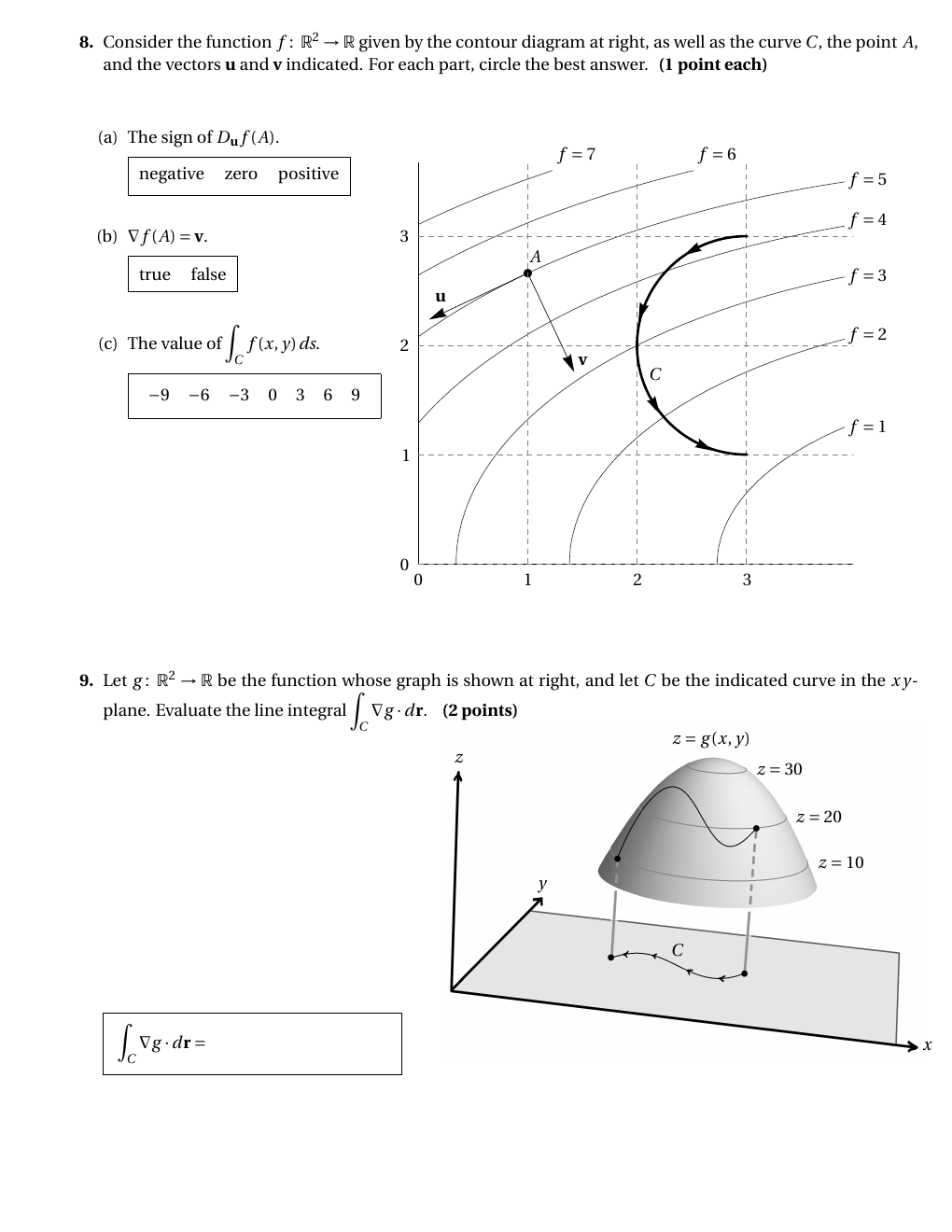
Figure: Question 4 on the page shown (contour plot of f with labeled levels, points A, P, Q, unit vectors u at P and Q, and oriented curve C). (a) Point A is ___ of f: not a critical point / a local maximum / a local minimum / a saddle point.
Stuck? Tell Claude: #R16-4a
What does the level set f = 0 do at A?
Answer: a saddle point
The f = 0 level curve crosses itself at A: a saddle. (f decreases up and down from A, so fyy < 0, but increases left to right so fxx > 0; D < 0.)
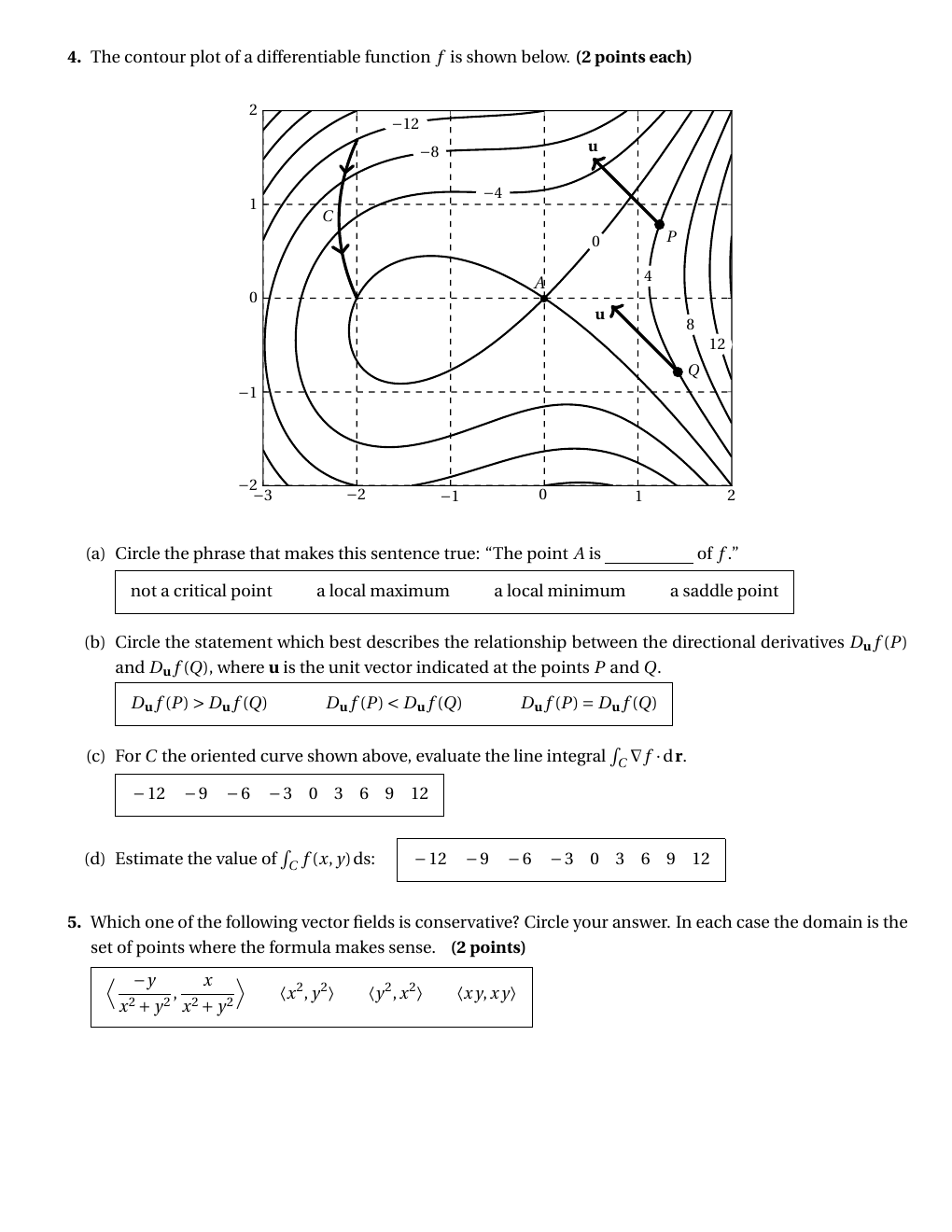
Figure: Question 4 on the page shown (contour plot of f with labeled levels, points A, P, Q, unit vectors u at P and Q, and oriented curve C). (b) Compare D_u f(P) and D_u f(Q) for the unit vector u shown at P and Q: D_u f(P) > D_u f(Q), <, or =.
Stuck? Tell Claude: #R16-4b
Both are negative; which drops faster?
Answer: D_u f(P) < D_u f(Q)
At both points f decreases in the direction u, from level 4 to level 0.
The level curves are closer together at P, so f drops faster there and D_u f(P) is more negative.
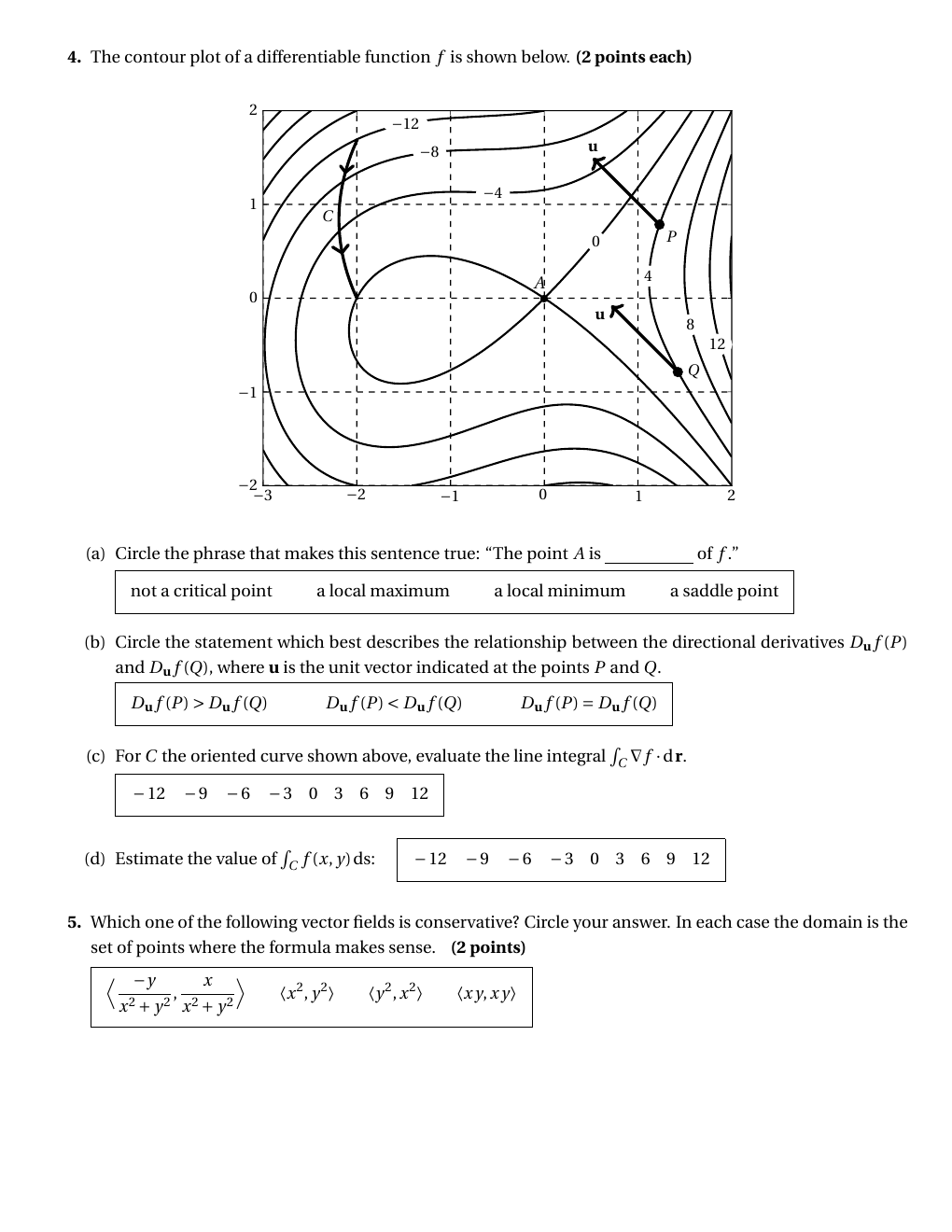
Figure: Question 4 on the page shown (contour plot of f with labeled levels, points A, P, Q, unit vectors u at P and Q, and oriented curve C). (c) For C the oriented curve shown, evaluate ∫_C ∇f · dr. Choices: −12, −9, −6, −3, 0, 3, 6, 9, 12.
Stuck? Tell Claude: #R16-4c
Fundamental Theorem of Line Integrals.
Answer: 12
∫_C ∇f · dr = f(end) − f(start) = 0 − (−12) = 12 (C starts on the −12 level curve and ends on the 0 level curve).
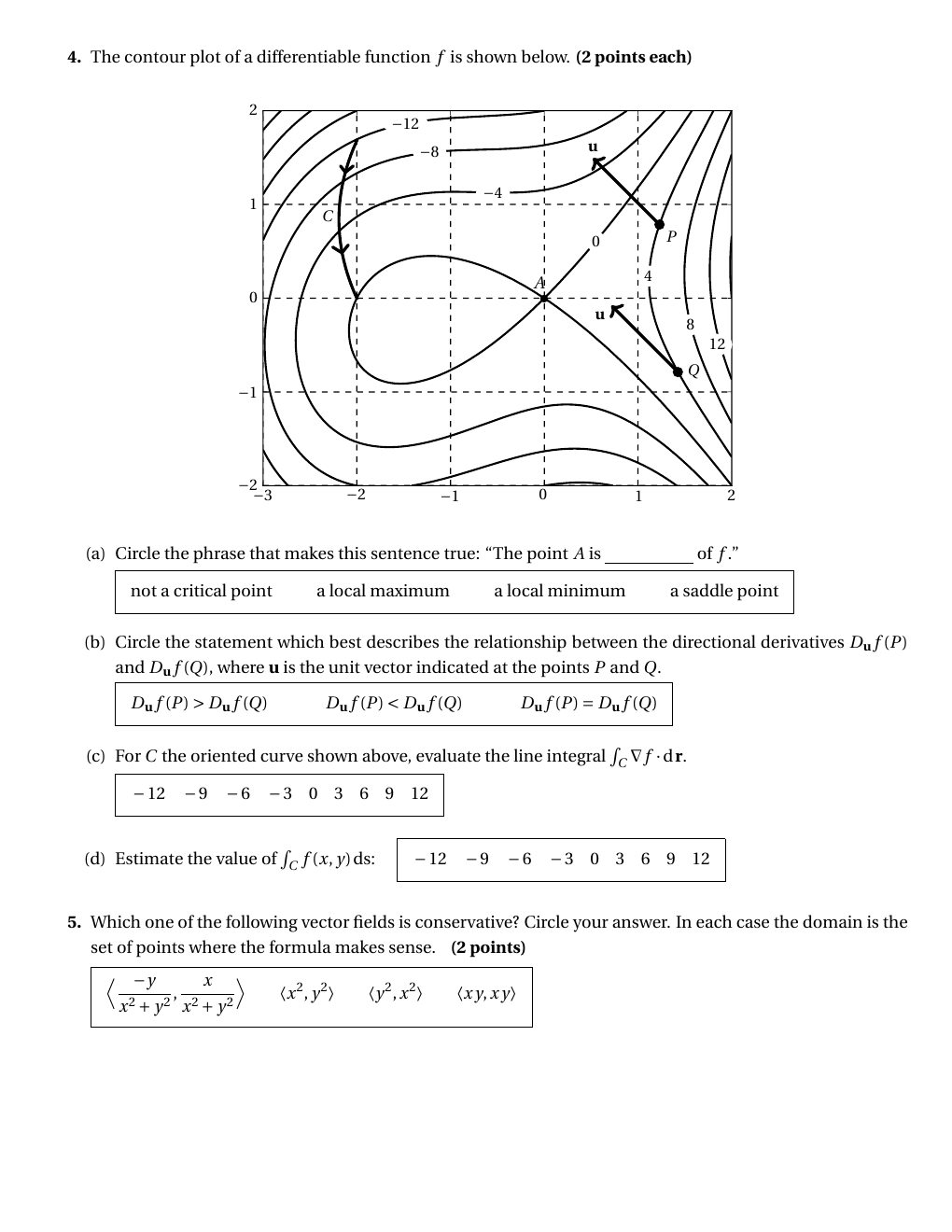
Figure: Question 4 on the page shown (contour plot of f with labeled levels, points A, P, Q, unit vectors u at P and Q, and oriented curve C). (d) Estimate ∫_C f(x,y) ds. Choices: −12, −9, −6, −3, 0, 3, 6, 9, 12.
Stuck? Tell Claude: #R16-4d
Break C into pieces between adjacent level curves; sum (length × average f).
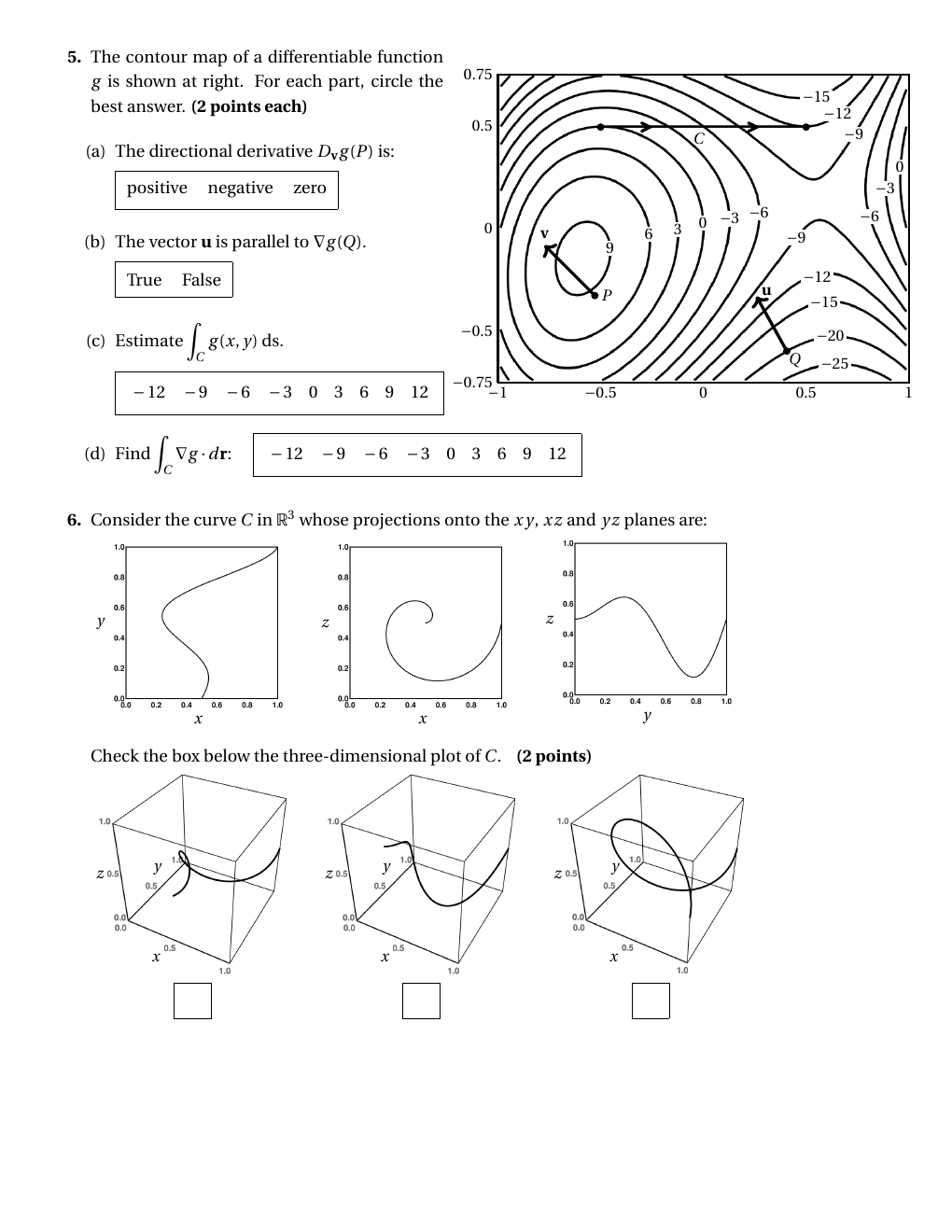
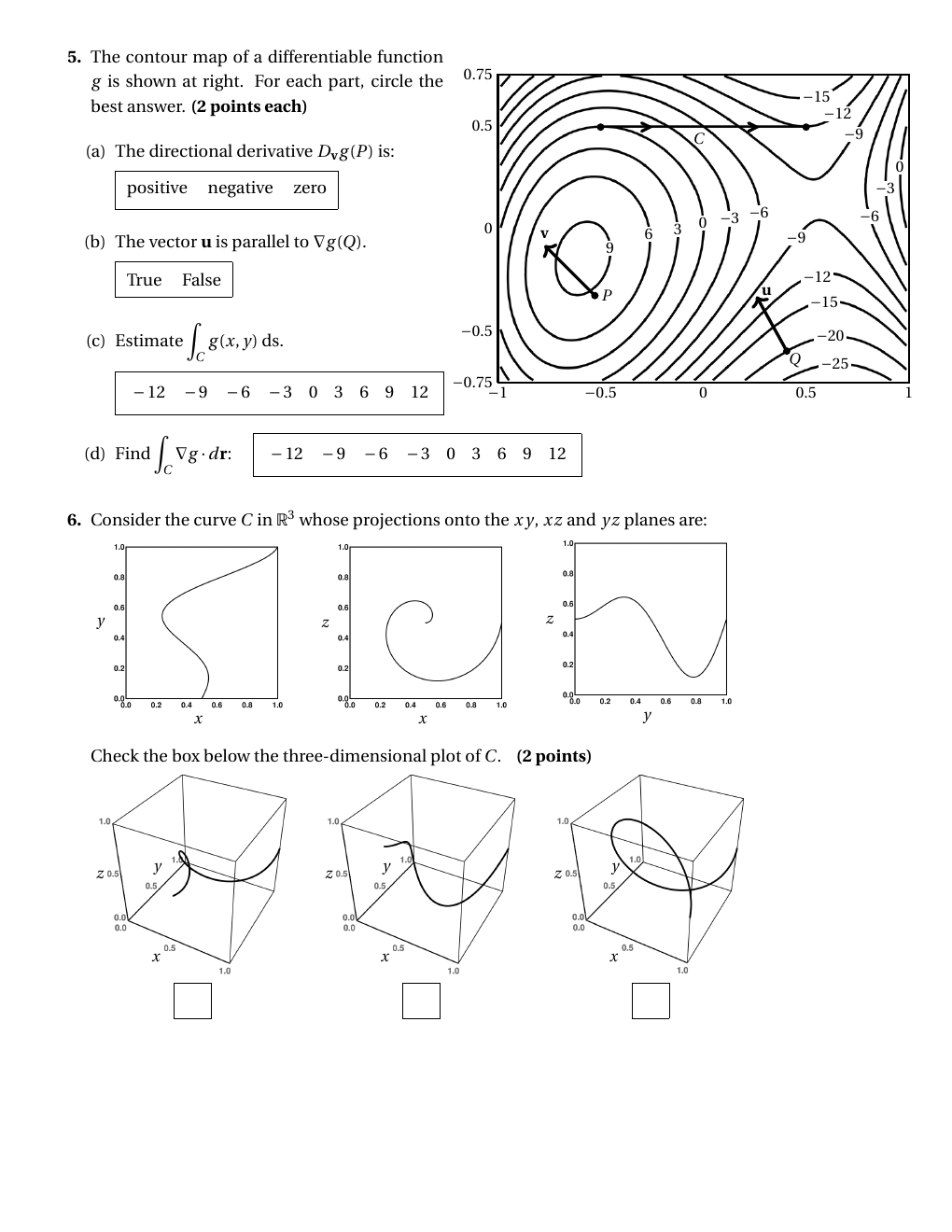
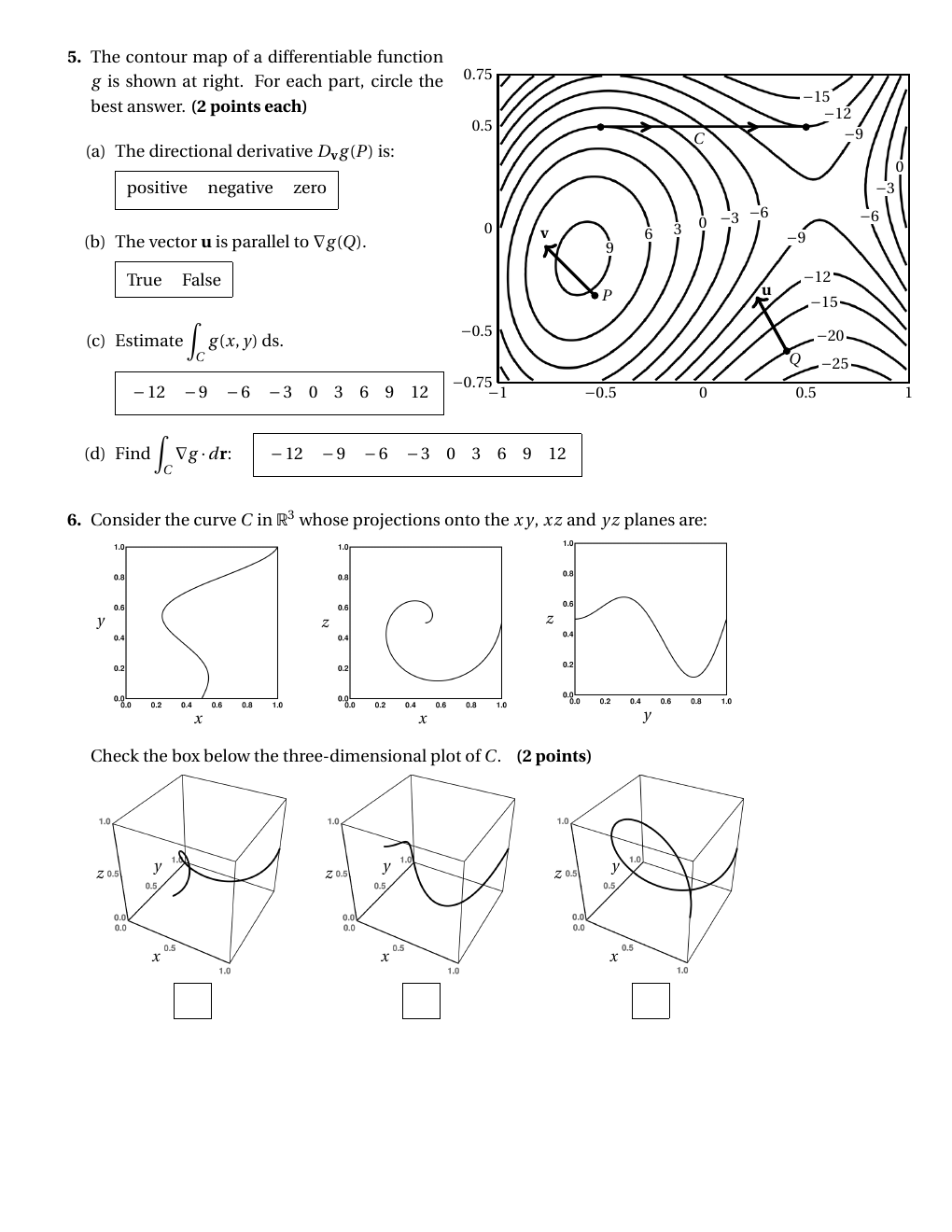
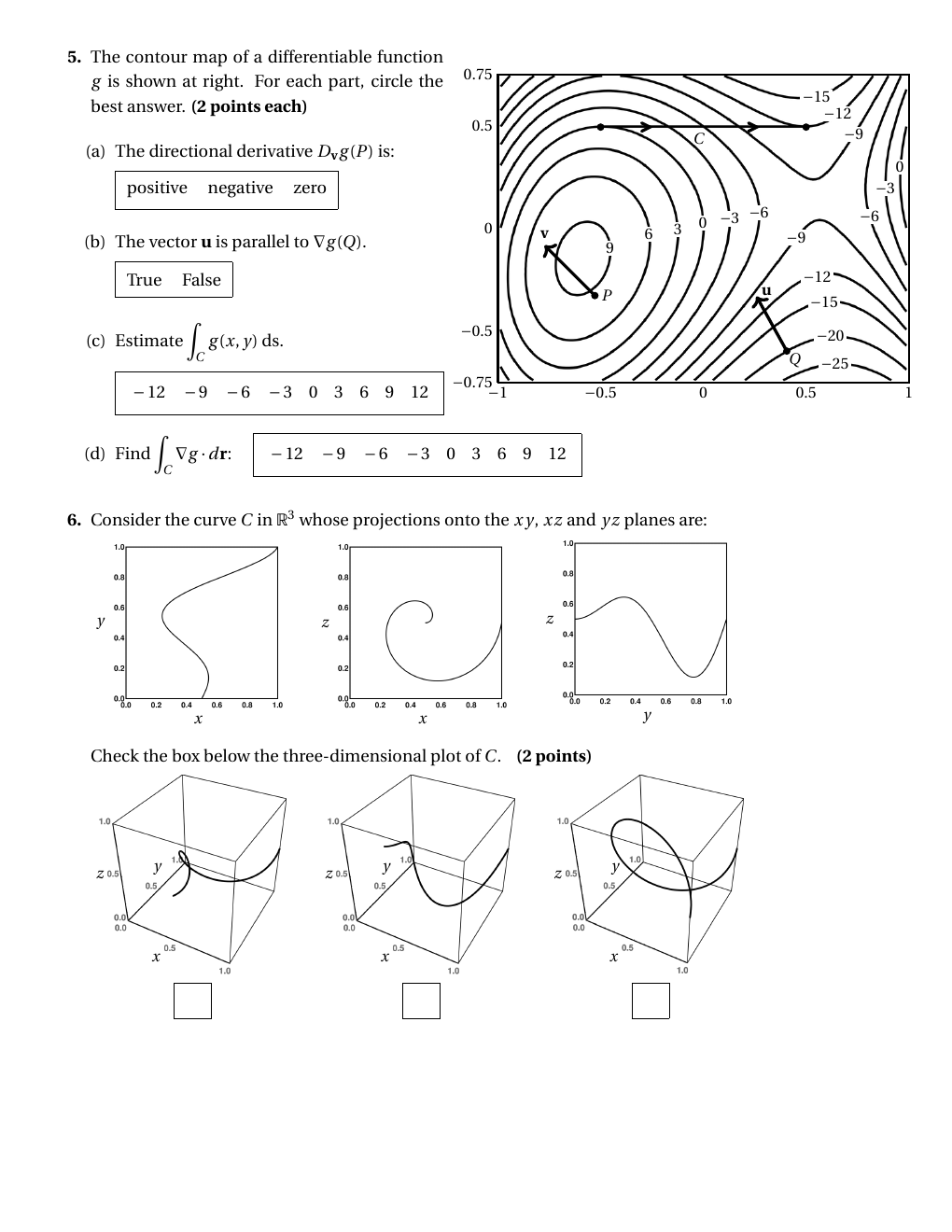
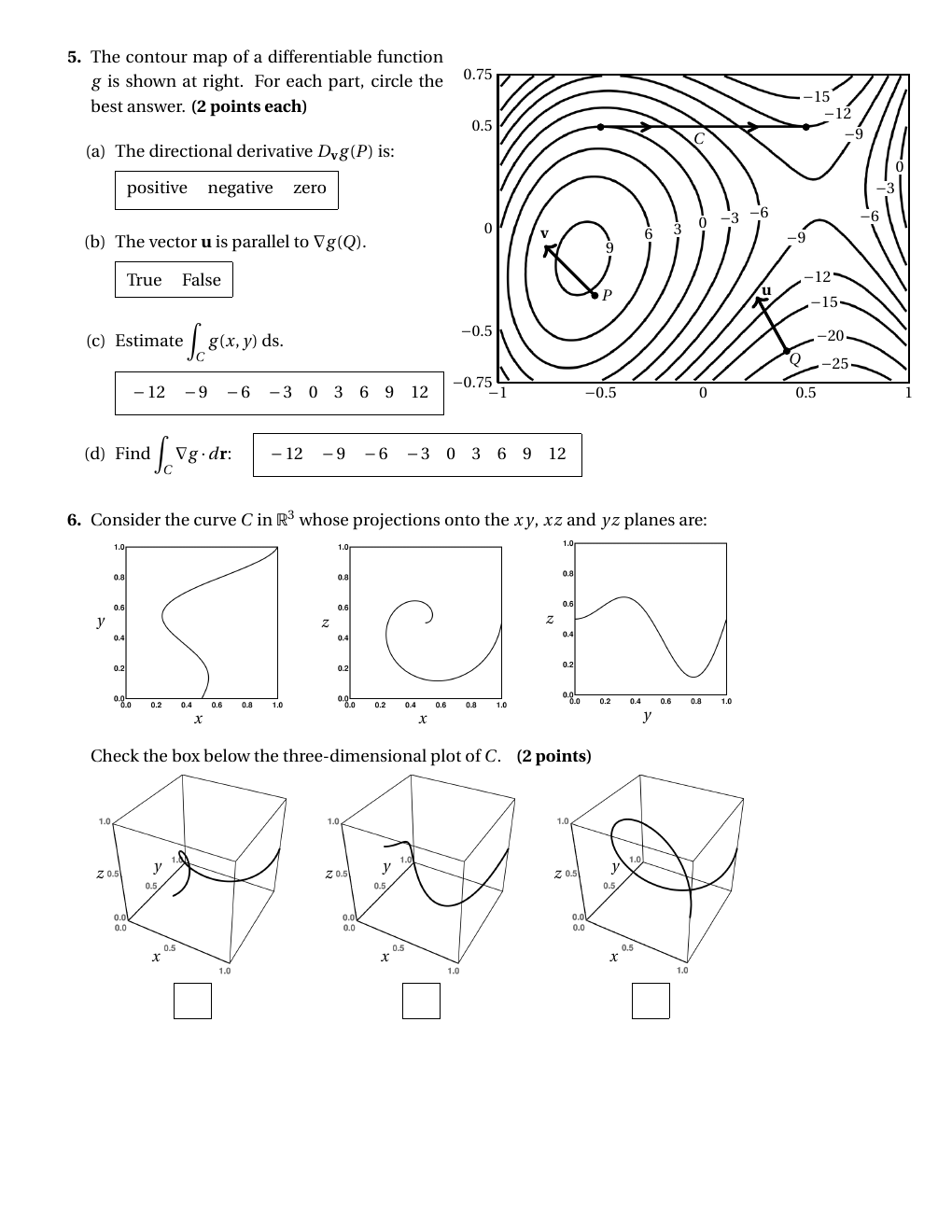
Figure: Question 5 on the page shown (contour map of g with points P, Q, vectors v, u, and horizontal curve C). (a) The directional derivative D_v g(P) is: positive / negative / zero.
Stuck? Tell Claude: #R18-5a
Does g increase in the direction v from P?
Answer: positive
From the contour labels, g increases in the direction v at P.
Figure: Question 5 on the page shown (contour map of g with points P, Q, vectors v, u, and horizontal curve C). (b) The vector u is parallel to ∇g(Q). True or False?
Stuck? Tell Claude: #R18-5b
Gradient is perpendicular to level curves.
Answer: True
u is drawn perpendicular to the level curve at Q, and the gradient is also perpendicular to it.
Figure: Question 5 on the page shown (contour map of g with points P, Q, vectors v, u, and horizontal curve C). (c) Estimate ∫_C g(x,y) ds. Choices: −12, −9, −6, −3, 0, 3, 6, 9, 12.
Stuck? Tell Claude: #R18-5c
Length times average value of g along C.
Answer: −6
C is a horizontal segment of length 1 along which g decreases at roughly constant rate from 0 to −12, so the average is about −6.
Figure: Question 5 on the page shown (contour map of g with points P, Q, vectors v, u, and horizontal curve C). (d) Find ∫_C ∇g · dr. Choices: −12, −9, −6, −3, 0, 3, 6, 9, 12.
Stuck? Tell Claude: #R18-5d
Fundamental Theorem of Line Integrals.
Answer: −12
∫_C ∇g · dr = g(end) − g(start) = −12 − 0 (reading the endpoint levels off the contour map).
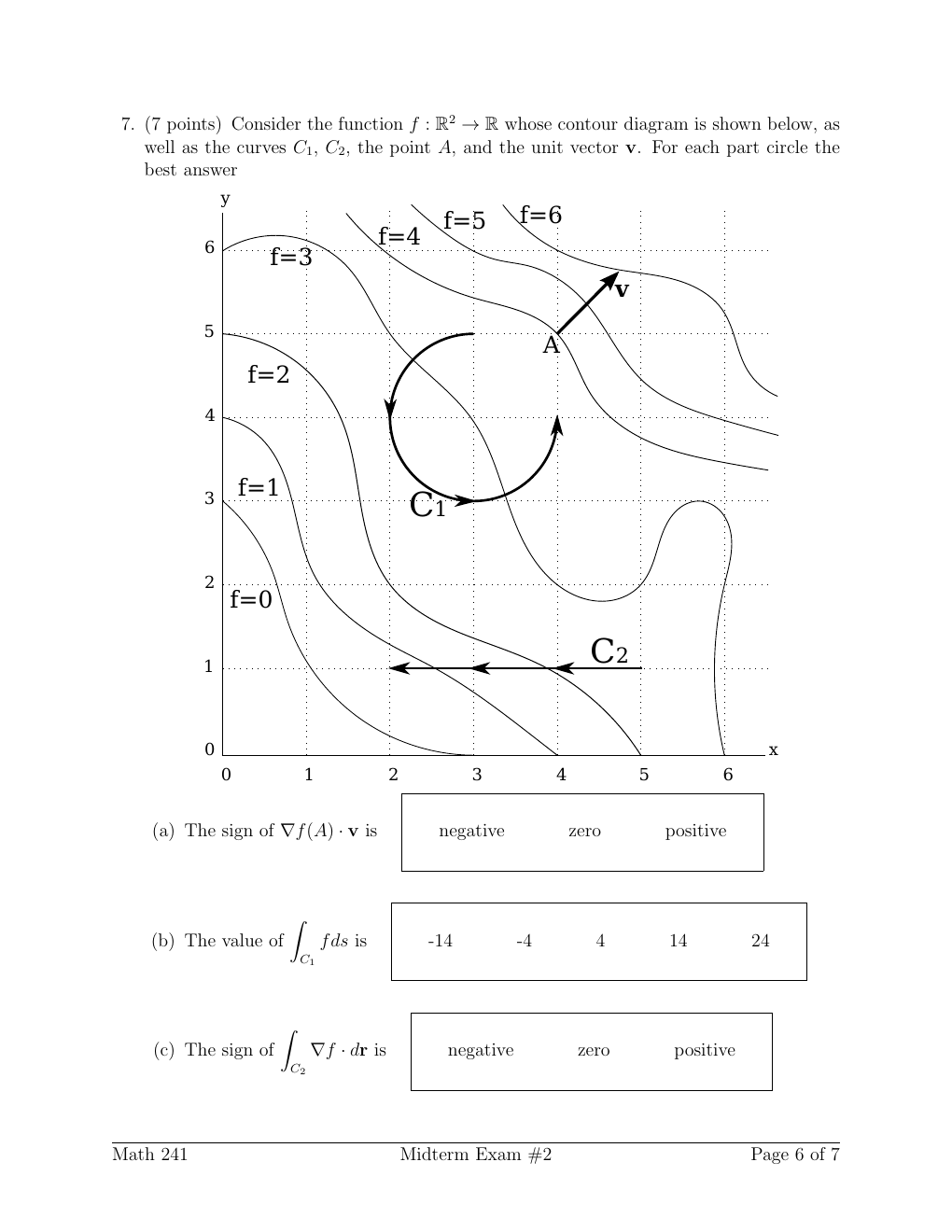
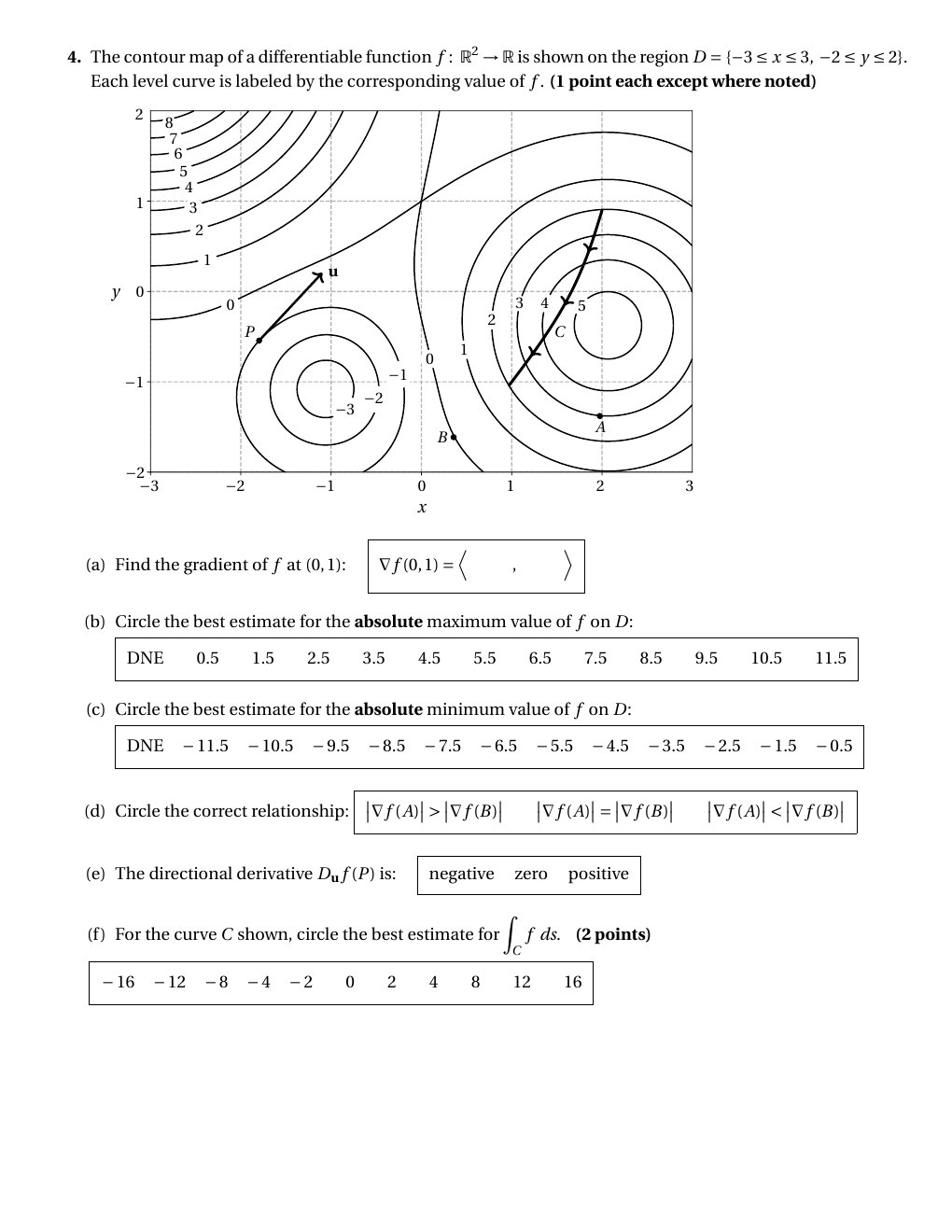
Figure: Question 4 on the page shown (contour map of f on D = {−3 ≤ x ≤ 3, −2 ≤ y ≤ 2}, level curves labeled; points A, B, P, curve C and vector u marked). Find the gradient of f at (0,1): ∇f(0,1) = ⟨ __ , __ ⟩.
Stuck? Tell Claude: #R19-4a
What does the contour picture look like at (0,1)?
Answer: ∇f(0,1) = ⟨0, 0⟩
Level curves cross at (0,1) (the level-0 curve crosses itself), so it is a saddle, hence a critical point.
Figure: Question 4 on the page shown (contour map of f on D = {−3 ≤ x ≤ 3, −2 ≤ y ≤ 2}, level curves labeled; points A, B, P, curve C and vector u marked). Circle the best estimate for the absolute maximum value of f on D. Choices: DNE, 0.5, 1.5, 2.5, 3.5, 4.5, 5.5, 6.5, 7.5, 8.5, 9.5, 10.5, 11.5.
Stuck? Tell Claude: #R19-4b
Compact region, so check critical points and the boundary; look for the highest level labeled.
Answer: 8.5
D is closed and bounded, so a max exists. The labels rise toward the upper-left corner (levels 7, 8 and beyond).
Max occurs at the corner (−3, 2), estimated about 8.5.
Figure: Question 4 on the page shown (contour map of f on D = {−3 ≤ x ≤ 3, −2 ≤ y ≤ 2}, level curves labeled; points A, B, P, curve C and vector u marked). Circle the best estimate for the absolute minimum value of f on D. Choices: DNE, −11.5, −10.5, −9.5, −8.5, −7.5, −6.5, −5.5, −4.5, −3.5, −2.5, −1.5, −0.5.
Stuck? Tell Claude: #R19-4c
Find the lowest closed level curve (the bowl).
Answer: −3.5
Minimum is at the center of the closed curves around (−1, −1), inside the −3 level curve, so about −3.5.
Figure: Question 4 on the page shown (contour map of f on D = {−3 ≤ x ≤ 3, −2 ≤ y ≤ 2}, level curves labeled; points A, B, P, curve C and vector u marked). Circle the correct relationship: |∇f(A)| > |∇f(B)|, |∇f(A)| = |∇f(B)|, or |∇f(A)| < |∇f(B)|.
Stuck? Tell Claude: #R19-4d
Gradient magnitude is large where level curves are close together.
Answer: |∇f(A)| > |∇f(B)|
Compare spacing of level curves near A and near B: they are more tightly packed at A.
Figure: Question 4 on the page shown (contour map of f on D = {−3 ≤ x ≤ 3, −2 ≤ y ≤ 2}, level curves labeled; points A, B, P, curve C and vector u marked). The directional derivative D_u f(P) is: negative, zero, or positive?
Stuck? Tell Claude: #R19-4e
Which way does u point relative to the level curve through P?
Answer: zero
u is tangent to the level curve through P, so f does not change in that direction (u ⟂ ∇f).
Figure: Question 4 on the page shown (contour map of f on D = {−3 ≤ x ≤ 3, −2 ≤ y ≤ 2}, level curves labeled; points A, B, P, curve C and vector u marked). For the curve C shown, circle the best estimate for ∫_C f ds. Choices: −16, −12, −8, −4, −2, 0, 2, 4, 8, 12, 16.
Stuck? Tell Claude: #R19-4f
∫ f ds ≈ (length of C)(average value of f on C).
Answer: 8
C is close to a straight segment from (1,−1) to (2,1), so length ≈ √5 ≈ 2.2.
f values along C (between the level curves): about 2.5, 3.5, 4.5, 4.5, 3.5, 2.5; average = 21/6 = 3.5.
∫ f ds ≈ 2.2 × 3.5 ≈ 7.7 ≈ 8.
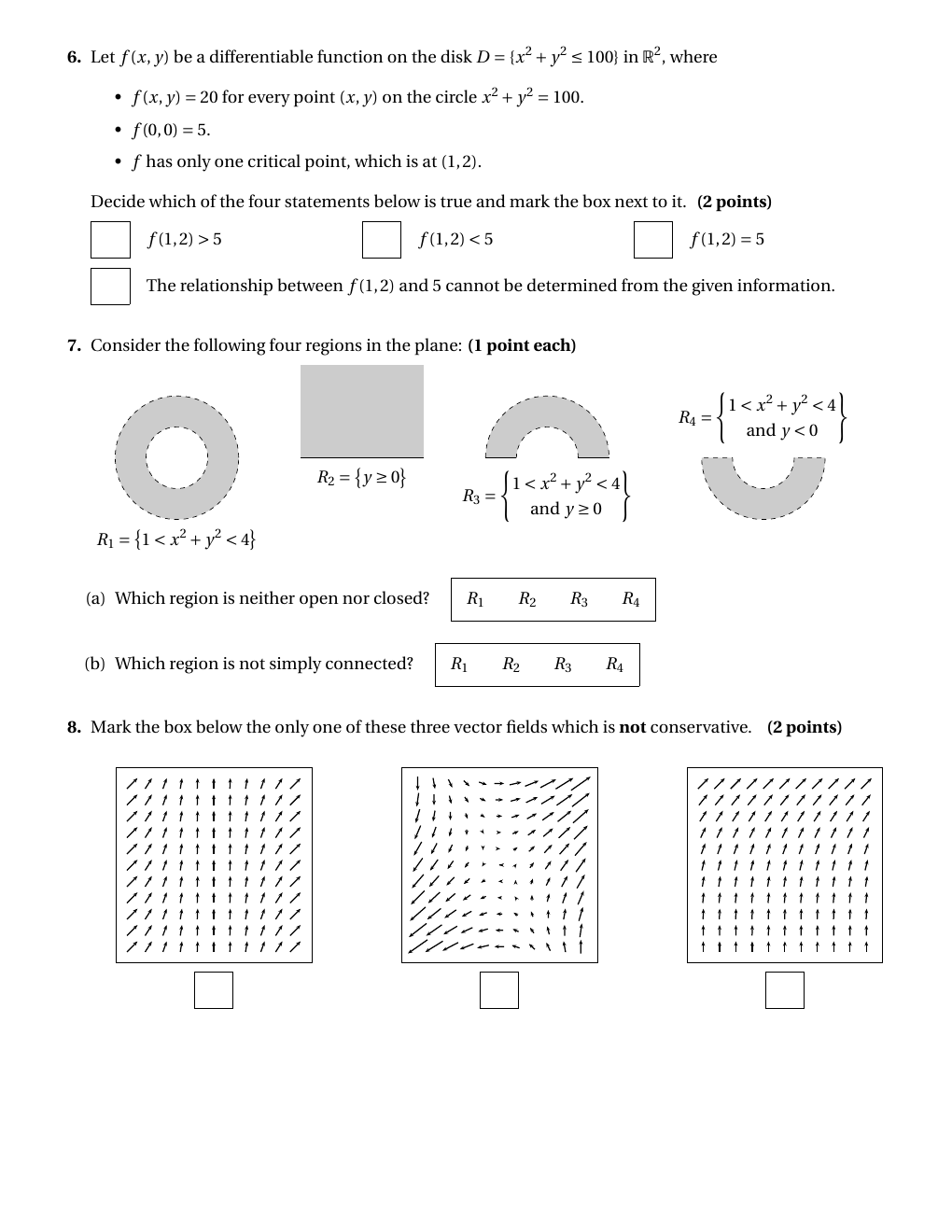
#R25-11a5 Regions / EVT · real exam · 2025 M2 #11a · 1 pt
Consider the following four regions in the plane: R1 = {4 ≤ x² + y²}; R2 = {1 < x² + y² < 4 and y < 0}; R3 = {x² + y² ≤ 4 and |y| ≥ 1}; R4 = {1 ≤ x² + y² < 4}. (a) Which region is not bounded? R1 R2 R3 R4
Stuck? Tell Claude: #R25-11a
Bounded means it fits inside some disk.
Answer: R1
R1 is everything outside radius 2, so it extends to infinity. R2, R3, R4 all lie within radius 2.
#R25-11b5 Regions / EVT · real exam · 2025 M2 #11b · 1 pt
Consider the following four regions in the plane: R1 = {4 ≤ x² + y²}; R2 = {1 < x² + y² < 4 and y < 0}; R3 = {x² + y² ≤ 4 and |y| ≥ 1}; R4 = {1 ≤ x² + y² < 4}. (b) Which region is open? R1 R2 R3 R4
Stuck? Tell Claude: #R25-11b
Open means no boundary points included (all strict inequalities).
Answer: R2
R2 uses only strict inequalities (1 < x²+y² < 4, y < 0), so it contains no boundary points. R1, R3 include boundary (≤, ≥); R4 includes the circle of radius 1.
#V5-15 Regions / EVT · new variant · 4 pt
Consider the following four regions in the plane: R1 = {x² + y² ≤ 9 and x ≥ 1}; R2 = {y ≥ x²}; R3 = {1 < x² + y² ≤ 9}; R4 = {x² + y² < 4 and x > 0}. (a) Which region is not bounded? (b) Which region is open? (c) Which region is not simply connected? (d) A continuous function f is guaranteed to have an absolute max and min on which region? (Answer with R1, R2, R3 or R4; one each.)
Stuck? Tell Claude: #V5-1
Bounded means it fits inside some disk; open means every boundary point is excluded; closed means every boundary point is included. The EVT needs closed AND bounded.
Answer: (a) R2; (b) R4; (c) R3; (d) R1.
(a) R2 is the region on or above a parabola, extending to infinity; the others lie inside the disk of radius 3.
(b) R4 uses only strict inequalities (x² + y² < 4, x > 0), so no boundary point is included. R1 and R2 include their boundaries; R3 includes the circle of radius 3.
(c) R3 is a disk of radius 3 with the closed unit disk removed, so it has a hole. R1, R2, R4 have no holes.
(d) R1 is closed (≤ and ≥) and bounded. R2 is closed but unbounded; R3 is not closed (the circle x² + y² = 1 is missing); R4 is not closed.
#V5-25 Regions / EVT · new variant · 4 pt
Consider the following four regions in the plane: R1 = {x ≥ 0 and y ≥ 0}; R2 = {0 < x < 2 and 0 < y < 2}; R3 = {1 ≤ x² + y² ≤ 4 and y ≥ 0}; R4 = {0 < x² + y² ≤ 4}. (a) Which region is not bounded? (b) Which region is open? (c) Which region is not simply connected? (d) A continuous function f is guaranteed to have an absolute max and min on which region? (Answer with R1, R2, R3 or R4; one each.)
Stuck? Tell Claude: #V5-2
Bounded means it fits inside some disk; open means every boundary point is excluded; closed means every boundary point is included. The EVT needs closed AND bounded.
Answer: (a) R1; (b) R2; (c) R4; (d) R3.
(a) R1 is the closed first quadrant, which extends to infinity. R2, R3, R4 lie within radius 3.
(b) R2 uses only strict inequalities (an open square). R1, R3 include their boundary; R4 includes the circle of radius 2.
(c) R4 is the closed disk of radius 2 with the origin removed (a punctured disk), so a loop around the origin cannot shrink inside it. R3 is a half-annulus with no hole.
(d) R3 is closed and bounded. R1 is closed but unbounded; R2 and R4 are bounded but not closed (R4 is missing the origin).
#V5-35 Regions / EVT · new variant · 4 pt
Consider the following four regions in the plane: R1 = {x² + y² ≥ 1}; R2 = {|x| + |y| ≤ 3}; R3 = {x² + 9y² < 9}; R4 = {1 ≤ x² + y² < 4}. (a) Which region is not bounded? (b) Which region is open? (c) Which region is neither open nor closed? (d) A continuous function f is guaranteed to have an absolute max and min on which region? (Answer with R1, R2, R3 or R4; one each.)
Stuck? Tell Claude: #V5-3
Bounded means it fits inside some disk; open means every boundary point is excluded; closed means every boundary point is included. The EVT needs closed AND bounded.
Answer: (a) R1; (b) R3; (c) R4; (d) R2.
(a) R1 is everything on or outside the unit circle, so it is unbounded. R2 (a diamond), R3 (an ellipse interior), R4 (an annulus) are bounded.
(b) R3 has a strict inequality only, so it is open. R1 and R2 include their boundaries; R4 includes the unit circle.
(c) R4 includes the circle x² + y² = 1 but not x² + y² = 4, so it is neither open nor closed. R1, R2 are closed; R3 is open.
(d) R2 is closed (≤) and bounded. R1 is closed but unbounded; R3 and R4 are bounded but not closed.
#R10-2b5 Regions / EVT · real exam · 2010 M2 #2b · 2 pt
Consider the region D where x² + y² ≤ 8. Explain why f must have a global min and max on D.
Stuck? Tell Claude: #R10-2b
Extreme Value Theorem.
Answer: D is closed and bounded and f is continuous, so the EVT applies.
D is closed (includes the boundary circle) and bounded (inside a disk), and f is continuous (a polynomial), so the Extreme Value Theorem guarantees a global min and max.
#R11-3c5 Regions / EVT · real exam · 2011 M2 #3c · 2 pt
What two properties does the curve C have that guarantee f(x,y) has absolute maximum and minimum values on C? (1 point each)
Stuck? Tell Claude: #R11-3c
Extreme Value Theorem hypotheses on the domain.
Answer: Closed and bounded.
f is continuous, and the EVT needs a closed and bounded domain. The ellipse contains its boundary and fits in a finite disk.
#R14-35 Regions / EVT · real exam · 2014 M2 #3 · 3 pt
Let D be the set of points (x,y) in R² with 1 < x² + y² < 4. Which of the following are properties of D? Circle all that apply: open, connected, simply connected.
Stuck? Tell Claude: #R14-3
D is an open annulus (ring).
Answer: Open and connected (not simply connected).
Open: the boundary circles are not included, so every point has a small disk inside D. Yes.
Connected: any two points can be joined by a path in the ring. Yes.
Simply connected: no, there is a hole in the middle, so a loop around it cannot be shrunk to a point inside D.
#R16-7a5 Regions / EVT · real exam · 2016 M2 #7a · 1 pt
Consider four regions: R₁ = {1 < x²+y² < 4}; R₂ = {y ≥ 0}; R₃ = {1 < x²+y² < 4 and y ≥ 0}; R₄ = {1 < x²+y² < 4 and y < 0}. (a) Which region is neither open nor closed?
Stuck? Tell Claude: #R16-7a
Open: no boundary points included; closed: all included.
Answer: R₃
R₁ and R₄ are open, R₂ is closed, R₃ contains only part of its boundary (the y = 0 edges, not the arcs).
#R16-7b5 Regions / EVT · real exam · 2016 M2 #7b · 1 pt
Consider four regions: R₁ = {1 < x²+y² < 4}; R₂ = {y ≥ 0}; R₃ = {1 < x²+y² < 4 and y ≥ 0}; R₄ = {1 < x²+y² < 4 and y < 0}. (b) Which region is not simply connected?
Stuck? Tell Claude: #R16-7b
Which region has a hole?
Answer: R₁
R₁ is a full annulus with a hole; the others have no holes.
#R18-2a5 Regions / EVT · real exam · 2018 M2 #2a · 1 pt
A continuous function on D = {x² + 4y² ≥ 5} ___ have an absolute maximum. (must / might or might not / must not)
Stuck? Tell Claude: #R18-2a
Is the set closed? Is it bounded?
Answer: might or might not
Closed but not bounded, so the Extreme Value Theorem does not apply.
#R18-2b5 Regions / EVT · real exam · 2018 M2 #2b · 1 pt
A continuous function on D = {x² + 4y² ≤ 5} ___ have an absolute maximum. (must / might or might not / must not)
Stuck? Tell Claude: #R18-2b
Is the set closed? Is it bounded?
Answer: must
Closed and bounded (filled ellipse): Extreme Value Theorem applies.
#R18-2c5 Regions / EVT · real exam · 2018 M2 #2c · 1 pt
A continuous function on D = {x² + 4y² < 5} ___ have an absolute maximum. (must / might or might not / must not)
Stuck? Tell Claude: #R18-2c
Is the set closed? Is it bounded?
Answer: might or might not
Bounded but not closed (open interior), so no guarantee.
#R18-2d5 Regions / EVT · real exam · 2018 M2 #2d · 1 pt
A continuous function on D = {x² + 4y² = 5} ___ have an absolute maximum. (must / might or might not / must not)
Stuck? Tell Claude: #R18-2d
Is the set closed? Is it bounded?
Answer: must
The ellipse itself is closed and bounded.
#R19-1c5 Regions / EVT · real exam · 2019 M2 #1c · 2 pt
The function f is guaranteed to take on an absolute maximum and minimum value on exactly two of the four sets below. Circle those two sets (1 point each).
(i) {(x,y) | x² + y² ≤ 1} (ii) {(x,y) | y ≥ 0} (iii) {(x,y) | x² + y² < 2} (iv) {(x,y) | 0 ≤ x ≤ 1, 0 ≤ y ≤ 1}
Stuck? Tell Claude: #R19-1c
Extreme Value Theorem: continuous function on a closed AND bounded set.
Answer: (i) and (iv)
(i) closed disk: closed and bounded. (ii) upper half-plane: not bounded. (iii) open disk: not closed. (iv) unit square: closed and bounded.
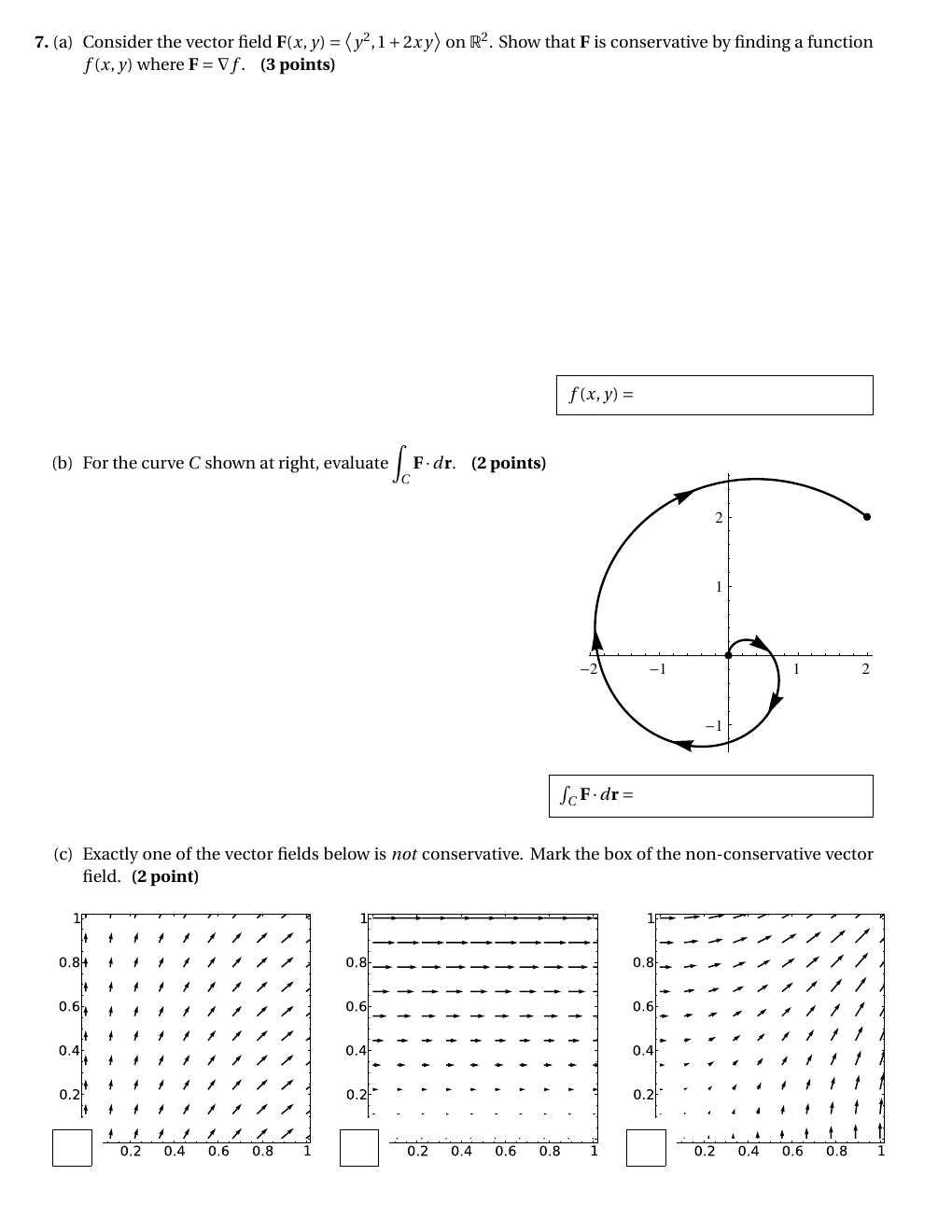
#R25-66 Find a potential · real exam · 2025 M2 #6 · 2 pt
The vector field F(x, y) = ⟨3y², 6xy + 1⟩ on R² is conservative. Find the potential function f(x, y) for F satisfying f(0, 0) = 0.
Stuck? Tell Claude: #R25-6
Integrate P = 3y² in x, then match ∂f/∂y.
Answer: f(x, y) = 3xy² + y
f = ∫ 3y² dx = 3y²x + c(y).
∂f/∂y = 6xy + c'(y) = 6xy + 1, so c' = 1, c = y + D.
f(0,0) = 0 gives D = 0.
#V6-16 Find a potential · new variant · 2 pt
The vector field F(x, y) = ⟨2y³, 6xy² + 4⟩ on R² is conservative. Find the potential function f(x, y) for F satisfying f(0, 0) = 0.
Stuck? Tell Claude: #V6-1
Integrate the first component in x, then fix the y-dependent constant using the second.
Answer: f(x, y) = 2xy³ + 4y
f = ∫ 2y³ dx = 2xy³ + c(y).
∂f/∂y = 6xy² + c'(y) = 6xy² + 4, so c' = 4, c = 4y + D.
f(0,0) = 0 gives D = 0.
#V6-26 Find a potential · new variant · 2 pt
The vector field F = ⟨3x²y + y³ + 2x, x³ + 3xy² − 2y⟩ is conservative. Find a potential function f for F (∇f = F) with f(0, 0) = 0.
Stuck? Tell Claude: #V6-2
Integrate the first component in x, then fix the y-dependent constant using the second.
#R25-77 Parametrize an intersection · real exam · 2025 M2 #7 · 4 pt
Let C be the curve in R³ that is the intersection of the cylinder x² + y² = 4 and the surface described by z = (x − y)². Find a vector function r(t) that parameterizes C, traversing the curve exactly once. Be sure to specify the domain of your parameterization.
Stuck? Tell Claude: #R25-7
Parameterize the circle x² + y² = 4 first.
Answer: r(t) = ⟨2cos t, 2sin t, 4 − 8 sin t cos t⟩ for 0 ≤ t ≤ 2π
Circle of radius 2: x = 2cos t, y = 2sin t, t in [0, 2π].
z = (x−y)² = 4(cos t − sin t)² = 4(cos²t + sin²t − 2 sin t cos t) = 4 − 8 sin t cos t.
#V7-17 Parametrize an intersection · new variant · 4 pt
Let C be the curve in R³ that is the intersection of the cylinder x² + y² = 9 and the surface described by z = (x + y)². Find a vector function r(t) that parameterizes C, traversing the curve exactly once. Be sure to specify the domain of your parameterization.
Stuck? Tell Claude: #V7-1
Parameterize the circle (or ellipse) in the xy- or yz-plane first, then get the remaining coordinate from the other surface.
Answer: r(t) = ⟨3cos(t), 3sin(t), 9 + 18sin(t)cos(t)⟩ for 0 ≤ t ≤ 2π
Circle of radius 3: x = 3cos t, y = 3sin t, t in [0, 2π].
z = (x+y)² = 9(cos t + sin t)² = 9(1 + 2 sin t cos t) = 9 + 18 sin t cos t.
#V7-27 Parametrize an intersection · new variant · 4 pt
Find a vector function r(t) that parameterizes the intersection of the circular cylinder x² + y² = 16 with the parabolic cylinder z = y², traversing the curve exactly once. Be sure to specify the domain.
Stuck? Tell Claude: #V7-2
Parameterize the circle (or ellipse) in the xy- or yz-plane first, then get the remaining coordinate from the other surface.
Answer: r(t) = ⟨4cos(t), 4sin(t), 16sin(t)²⟩ for 0 ≤ t ≤ 2π
The curve lies over the circle of radius 4: x = 4cos t, y = 4sin t.
z = y² = 16sin²t.
#V7-37 Parametrize an intersection · new variant · 4 pt
Let S₁ be the surface x = 2y² + z² and let S₂ be the cylinder 4y² + z² = 4. Find a vector function r(t) that parametrizes the curve of intersection of S₁ and S₂, and specify the range of t so that it traces the curve exactly once.
Stuck? Tell Claude: #V7-3
Parameterize the circle (or ellipse) in the xy- or yz-plane first, then get the remaining coordinate from the other surface.
Answer: r(t) = ⟨2cos(t)² + 4sin(t)², cos(t), 2sin(t)⟩ for 0 ≤ t ≤ 2π
S₂: y² + z²/4 = 1 is an ellipse in the yz-plane: y = cos t, z = 2sin t, 0 ≤ t ≤ 2π.
x = 2y² + z² = 2cos²t + 4sin²t = 2 + 2sin²t.
#R11-67 Parametrize an intersection · real exam · 2011 M2 #6 · 3 pt
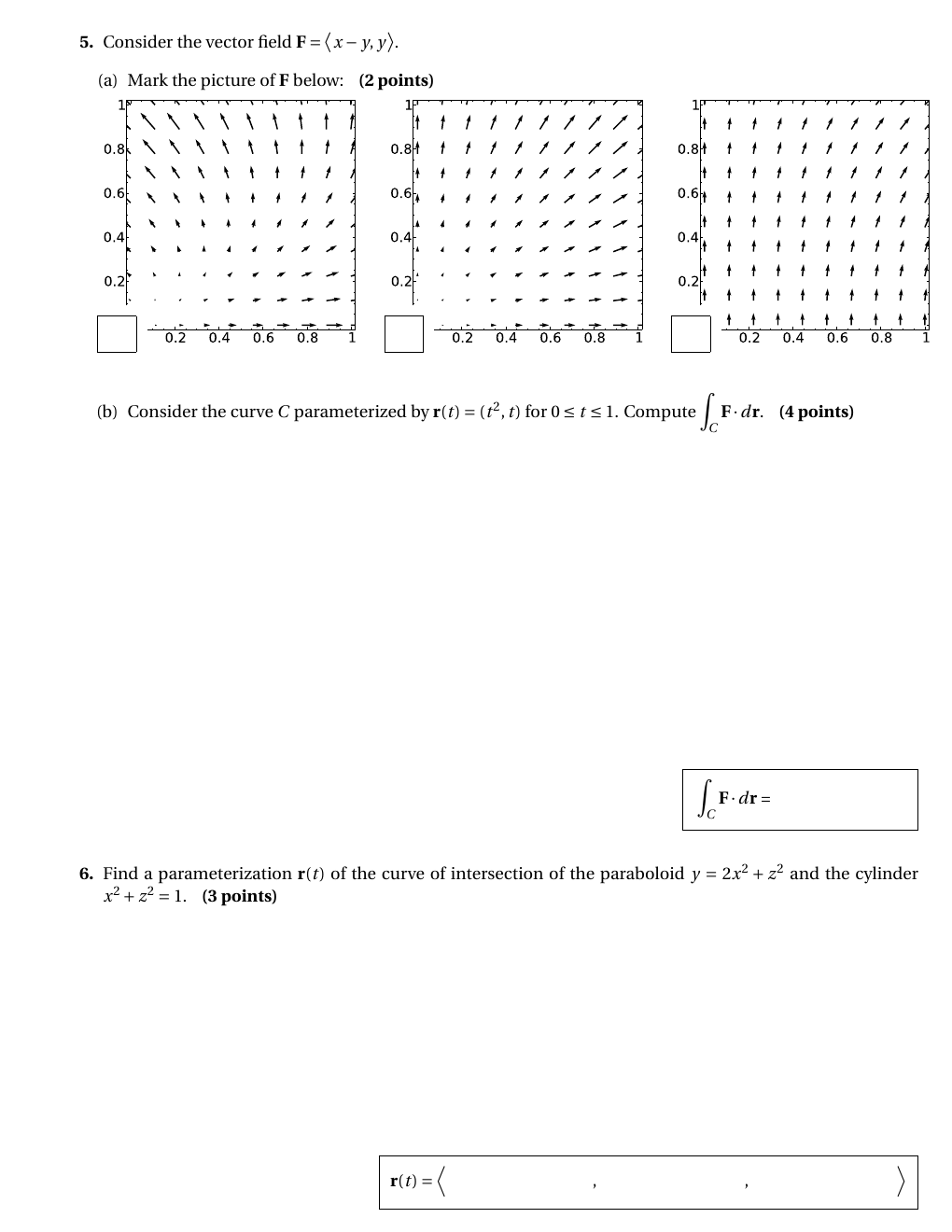
Find a parameterization r(t) of the curve of intersection of the paraboloid y = 2x² + z² and the cylinder x² + z² = 1.
Stuck? Tell Claude: #R11-6
The cylinder gives a circle in the xz-plane.
Answer: r(t) = ⟨cos t, 1 + cos²t, sin t⟩, 0 ≤ t ≤ 2π.
Take x = cos t, z = sin t, 0 ≤ t ≤ 2π.
Then y = 2x² + z² = 2cos²t + sin²t = 1 + cos²t.
#R12-77 Parametrize an intersection · real exam · 2012 M2 #7 · 4 pt
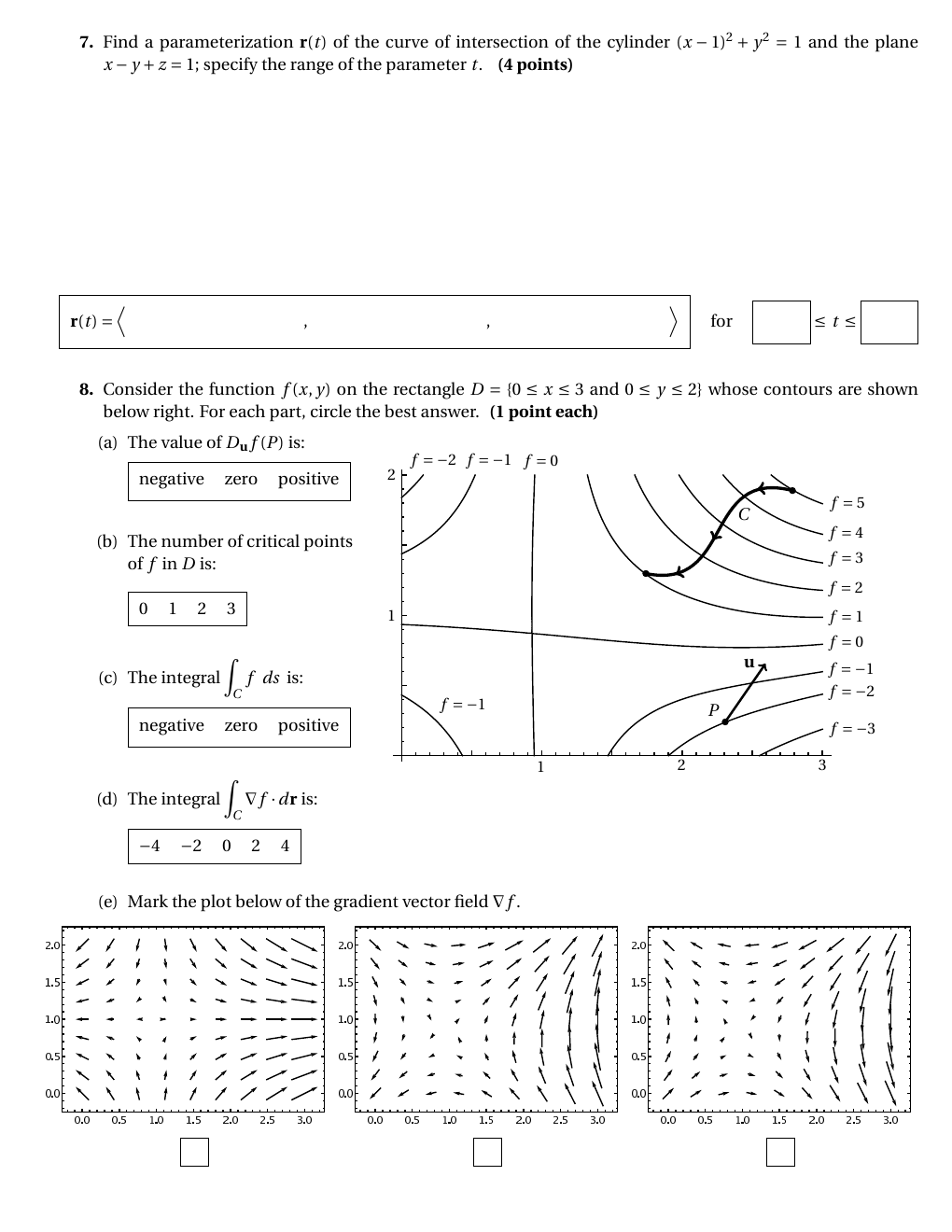
Find a parameterization r(t) of the curve of intersection of the cylinder (x−1)² + y² = 1 and the plane x − y + z = 1; specify the range of the parameter t.
Stuck? Tell Claude: #R12-7
Parameterize the circle in the xy-plane, then get z from the plane.
Answer: r(t) = ⟨1 + cos t, sin t, sin t − cos t⟩, 0 ≤ t ≤ 2π.
The cylinder's circle: x = 1 + cos t, y = sin t.
The plane gives z = 1 − x + y = sin t − cos t.
One full loop: 0 ≤ t ≤ 2π.
#R16-97 Parametrize an intersection · real exam · 2016 M2 #9 · 4 pt
Find a vector function r(t) that represents the curve of intersection of the cylinder y² + z² = 4 and the hyperbolic paraboloid x = z² − y². Specify the range of t so that your answer traces the curve exactly once.
Stuck? Tell Claude: #R16-9
Parametrize the circle in the yz-plane first.
Answer: r(t) = ⟨4sin²t − 4cos²t, 2cos t, 2sin t⟩ for 0 ≤ t ≤ 2π (other valid parametrizations of the circle work)
y = 2cos t, z = 2sin t, 0 ≤ t ≤ 2π.
x = z² − y² = 4sin²t − 4cos²t.
#R18-8b7 Parametrize an intersection · real exam · 2018 M2 #8b · 4 pt
Let S₁ be as in #8a and let S₂ be the cylinder y² + z²/4 = 1. Find a vector function r(t) that parametrizes the curve of intersection of S₁ and S₂, and specify the range of t so that it traces the curve exactly once.
Stuck? Tell Claude: #R18-8b
Parametrize the ellipse y² + z²/4 = 1 in the yz-plane, then get x from S₁.
Answer: r(t) = ⟨7sin²t + 1, cos t, 2sin t⟩ for 0 ≤ t ≤ 2π
y = cos t, z = 2sin t, 0 ≤ t ≤ 2π.
x = 2z² + y² = 8sin²t + cos²t = 7sin²t + 1.
#R19-97 Parametrize an intersection · real exam · 2019 M2 #9 · 4 pt
Find a vector function r(t) that parameterizes the intersection of the circular cylinder x² + y² = 4 with the parabolic cylinder z = x², traversing the curve exactly once. Be sure to specify the domain.
Stuck? Tell Claude: #R19-9
From above the curve is the circle of radius 2; parameterize x, y first, then z = x².
Answer: r(t) = ⟨2cos t, 2sin t, 4cos²t⟩ for 0 ≤ t ≤ 2π
x = 2cos t, y = 2sin t, so z = x² = 4cos²t.
#R25-108 Pick the picture of r(t) · real exam · 2025 M2 #10 · 2 pt
Mark the box next to the curve parameterized by r(t) = ⟨√(1+t²) cos t, √(1+t²) sin t, t⟩ for −4π ≤ t ≤ 4π. (Four 3D pictures, numbered 1–4 from left to right.)
Stuck? Tell Claude: #R25-10
Look at the radius and the z-direction as t grows.
Answer: First picture (spiral widening on both ends)
Radius √(1+t²) grows with |t|, so the helix widens going away from t = 0 in both directions, while z = t rises steadily from −4π to 4π: a spiral that opens up at both ends (the first picture).
#R25-8a8 Pick the picture of r(t) · real exam · 2025 M2 #8a · 1 pt
A parameterization of a metal wire in the plane is r(t) = ⟨−2 sin t, 2 cos t⟩ where 0 ≤ t ≤ π. (a) Check the box below the picture of the wire (four pictures of the xy-plane: top semicircle, left semicircle, bottom semicircle, right semicircle; the second is the left one).
Stuck? Tell Claude: #R25-8a
Evaluate r(0), r(π/2), r(π).
Answer: Second picture: the left semicircle
r(0) = (0, 2), r(π/2) = (−2, 0), r(π) = (0, −2): radius 2, left half of the circle going from top to bottom.
#R10-3a8 Pick the picture of r(t) · real exam · 2010 M2 #3a · 2 pt
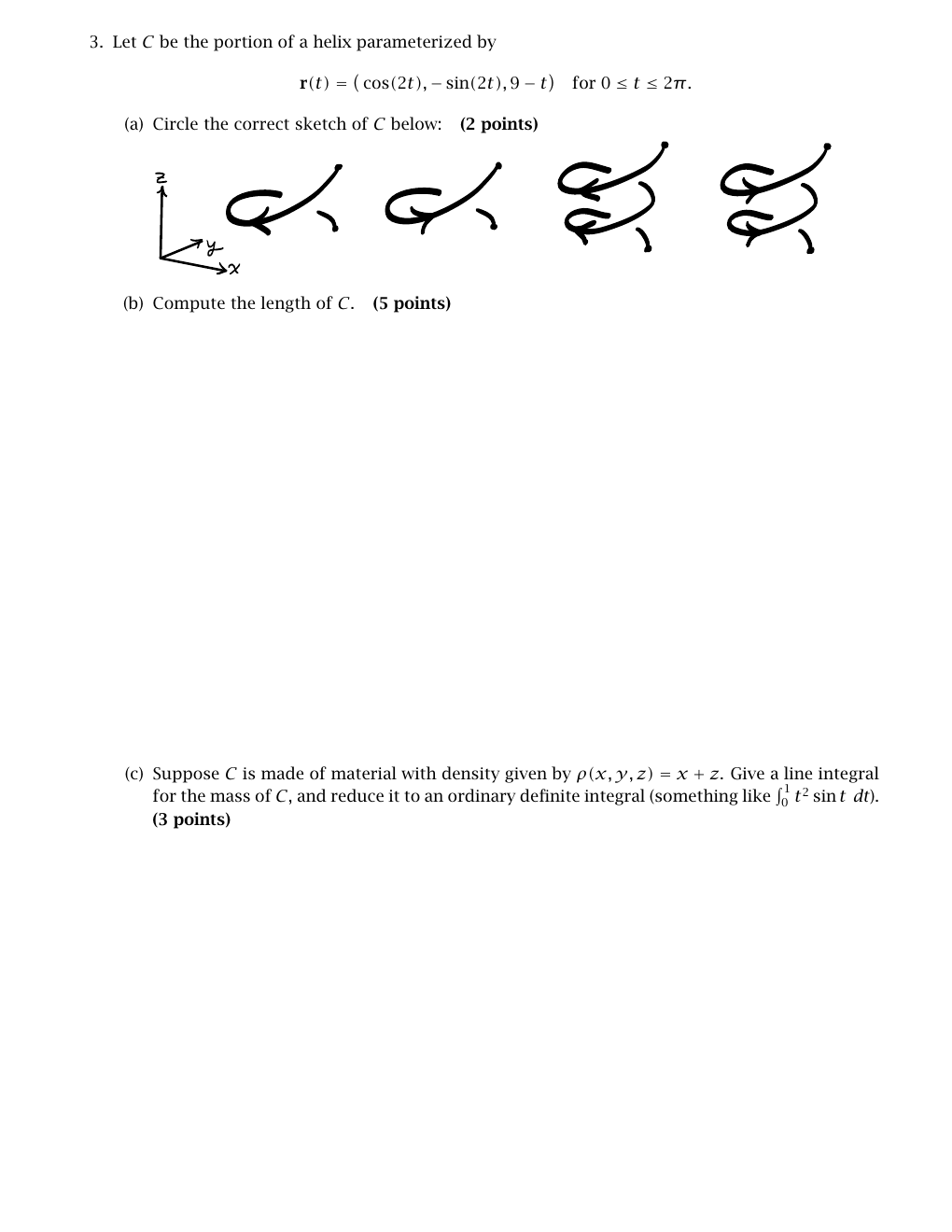
C is the portion of the helix r(t) = ⟨cos 2t, −sin 2t, 9 − t⟩, 0 ≤ t ≤ 2π. Circle the correct sketch (four sketches in the figure, left to right).
Stuck? Tell Claude: #R10-3a
Find the starting point, the z behavior and how many turns.
Answer: The third sketch.
r(0) = (1, 0, 9): the curve starts at (1,0,9) and z decreases as t grows.
x = cos 2t, y = −sin 2t goes around the circle twice (2t reaches 4π), clockwise from above. So the helix has two turns going down.
This is the third sketch.
#R11-4a8 Pick the picture of r(t) · real exam · 2011 M2 #4a · 2 pt
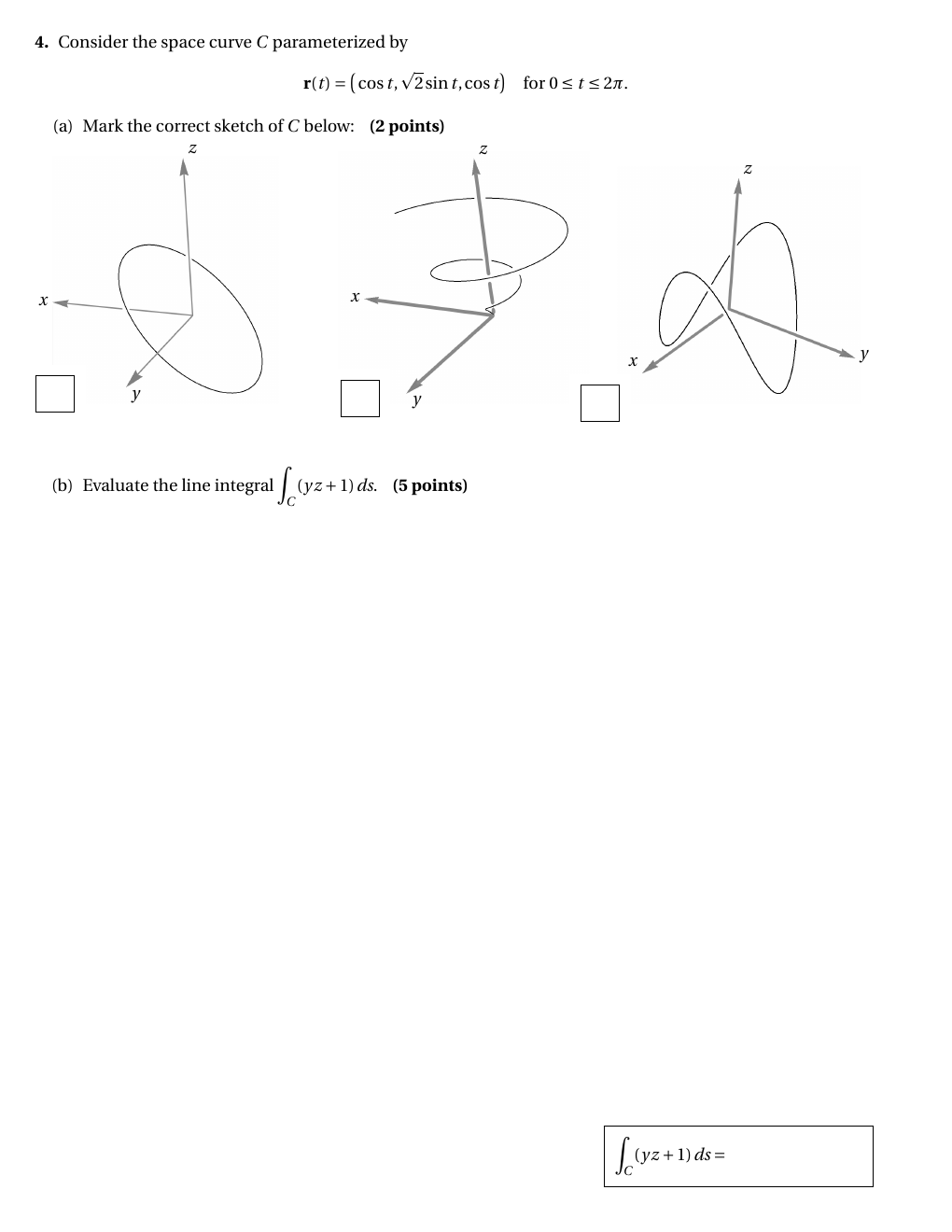
Consider the space curve r(t) = ⟨cos t, √2 sin t, cos t⟩ for 0 ≤ t ≤ 2π. Mark the correct sketch (three 3D sketches left to right in the figure).
Stuck? Tell Claude: #R11-4a
x = z always, so the curve lies in the plane x = z.
Answer: The first sketch.
The projection to the xy-plane is the ellipse x² + y²/2 = 1, and since z = x the curve is a single ellipse tilted in the plane x = z.
The projection to the xz-plane is the line segment z = x. This is the first sketch (one planar ellipse).
#R12-5a8 Pick the picture of r(t) · real exam · 2012 M2 #5a · 1 pt
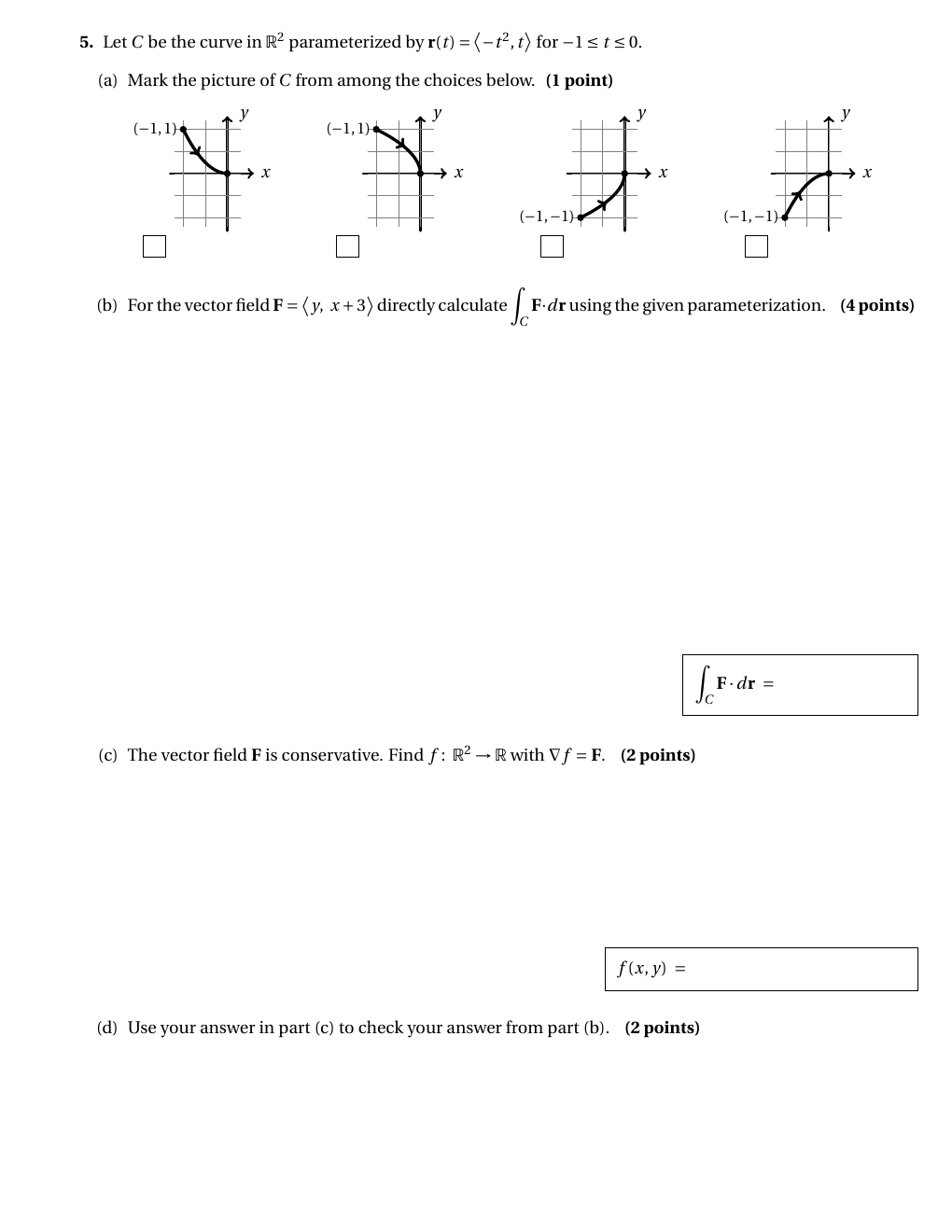
C is the curve in R² parameterized by r(t) = ⟨−t², t⟩ for −1 ≤ t ≤ 0. Mark the picture of C (four choices in the figure, left to right).
Stuck? Tell Claude: #R12-5a
Evaluate r at both endpoints; note x = −y² ≤ 0 and y ≤ 0.
Answer: The third picture.
r(−1) = (−1, −1) and r(0) = (0, 0).
The curve is part of x = −y² with y ≤ 0, going from (−1,−1) up to the origin, curving like the lower half of a left-opening parabola. This is the third picture (starts at (−1,−1)).
#R12-6a8 Pick the picture of r(t) · real exam · 2012 M2 #6a · 2 pt
Mark the picture of the curve in R³ parameterized by r(t) = ⟨t cos t, t sin t, t⟩ for 0 ≤ t ≤ 4π (four 3D sketches left to right in the figure).
Stuck? Tell Claude: #R12-6a
Look at the xy-projection and the z behavior.
Answer: The second picture (outward counterclockwise spiral rising with z).
The xy-projection is (t cos t, t sin t): a counterclockwise spiral going outward from the origin.
z = t increases steadily, so it is a spiral staircase widening upward (a cone-like spiral) starting at the origin.
#R14-6a8 Pick the picture of r(t) · real exam · 2014 M2 #6a · 2 pt
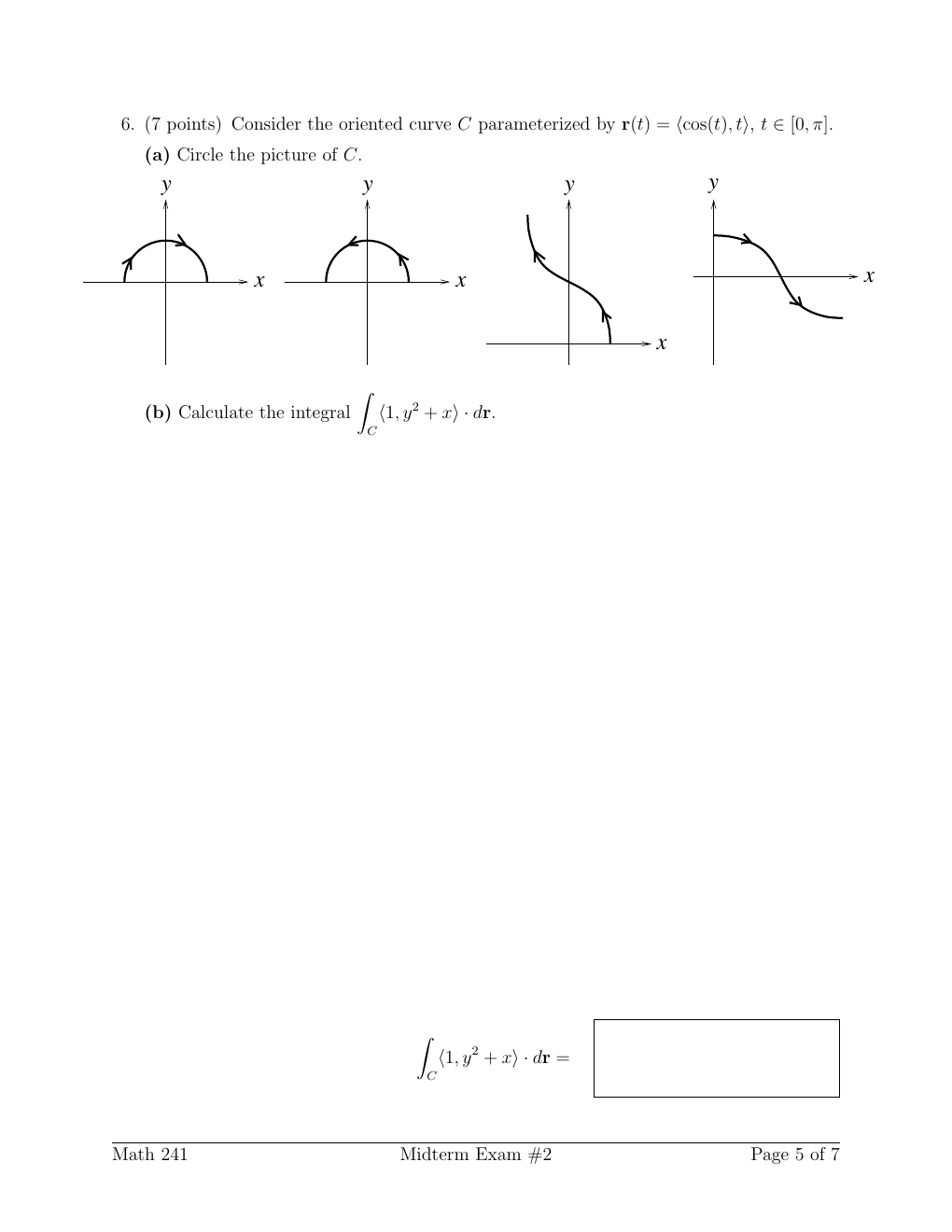
The oriented curve C is parameterized by r(t) = ⟨cos t, t⟩, t ∈ [0, π]. Circle the picture of C (four choices left to right in the figure, first problem on the page: the first two are upper semicircles, the third is a wavy curve going up the page, the fourth is an S-shaped curve going right).
Stuck? Tell Claude: #R14-6a
Here x = cos y, so y is the parameter running up the page.
Answer: The third picture (the curve x = cos y, starting at (1,0), ending at (−1,π)).
Start at t = 0: (cos 0, 0) = (1, 0). End at t = π: (cos π, π) = (−1, π).
The curve is the graph x = cos y, y from 0 to π, so it climbs from (1,0) to (−1,π) with y increasing. This is the third picture (the curve climbing the page, x oscillating through x = 0 at y = π/2).
#R16-10a8 Pick the picture of r(t) · real exam · 2016 M2 #10a · 2 pt
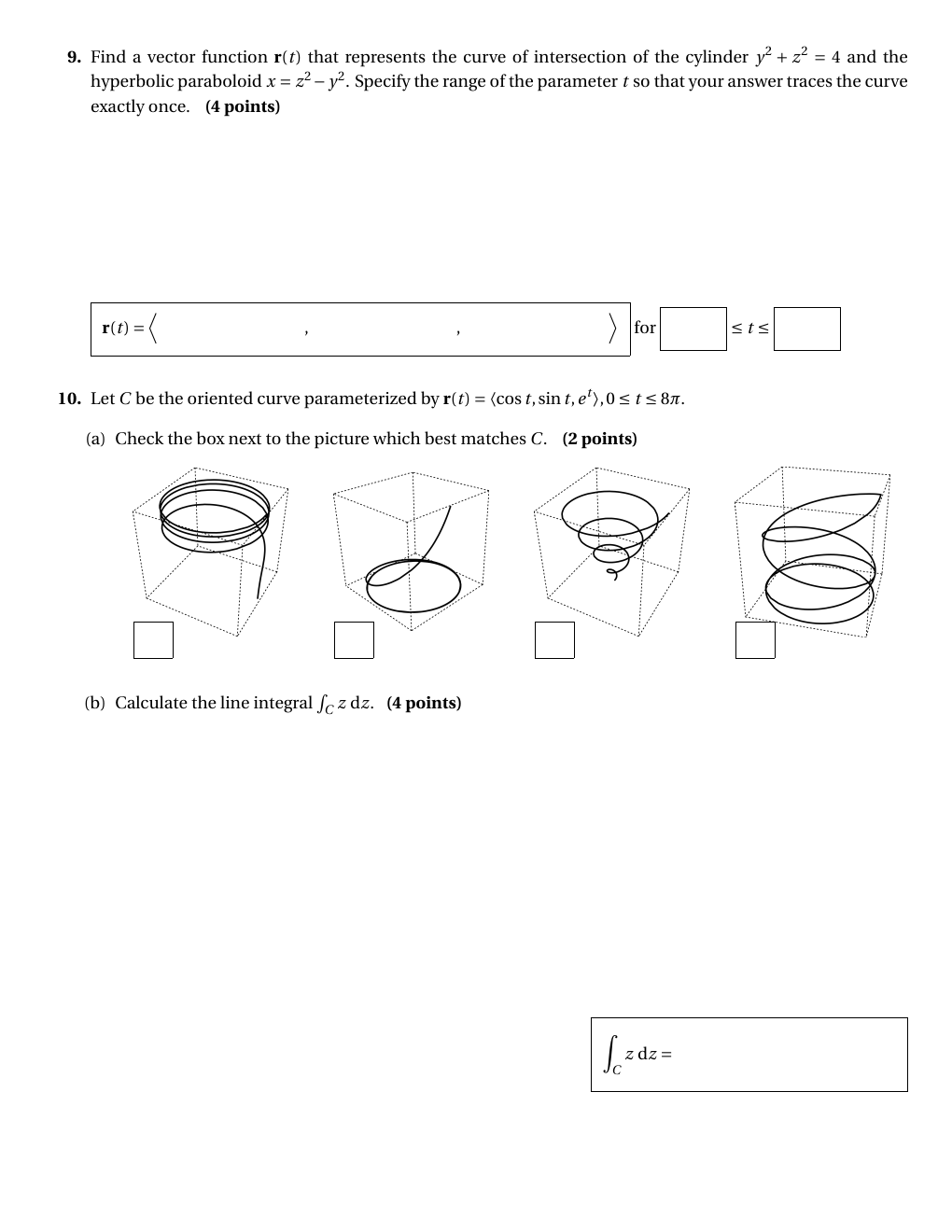
Figure: Question 10 on the page shown (four 3D pictures, left to right). Let C be r(t) = ⟨cos t, sin t, eᵗ⟩, 0 ≤ t ≤ 8π. Check the box next to the picture which best matches C.
Stuck? Tell Claude: #R16-10a
What do cos t, sin t trace, and how does eᵗ behave?
Answer: The second picture
xy-projection is the unit circle traced 4 times, and z = eᵗ grows extremely fast, so the curve spirals slowly at first (near the bottom) and then shoots up.
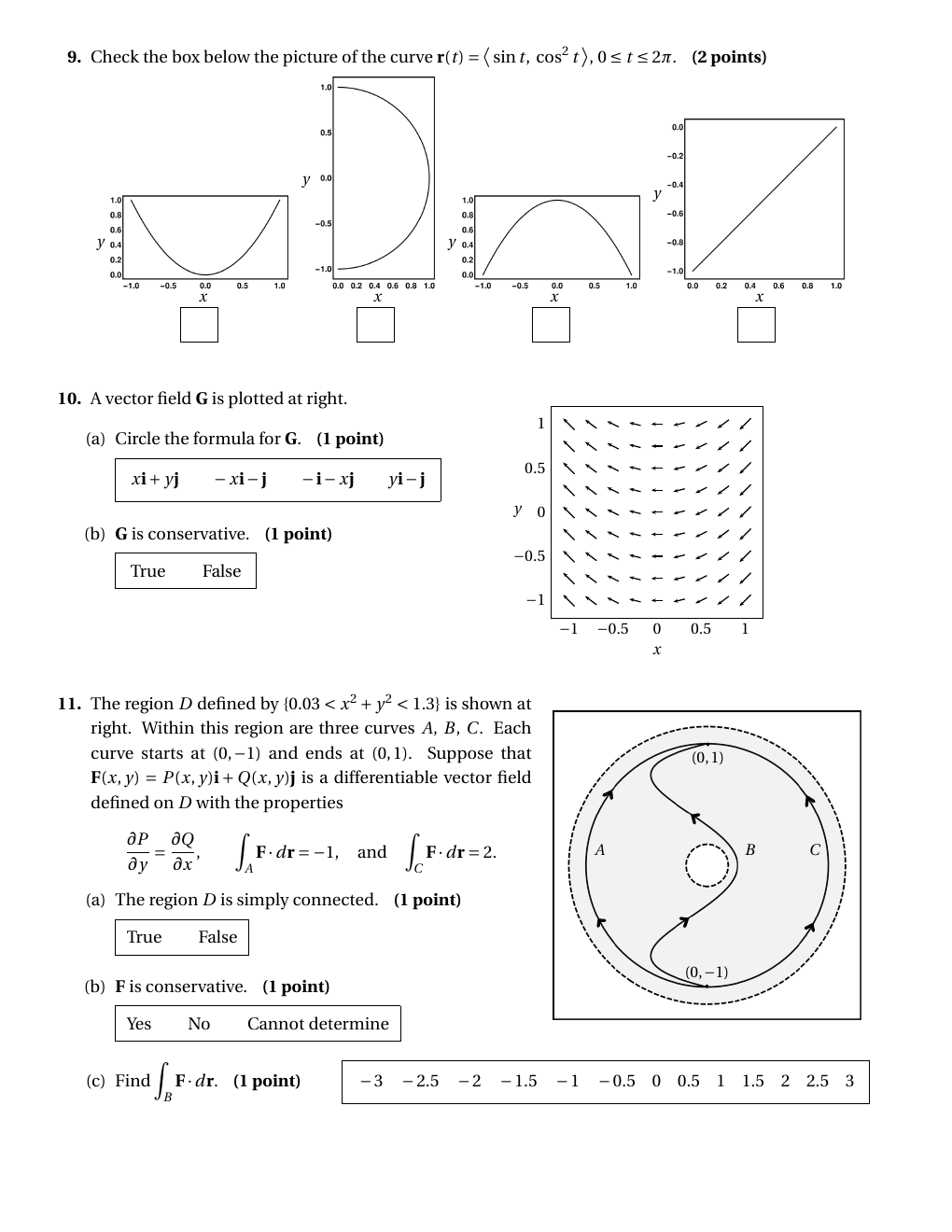
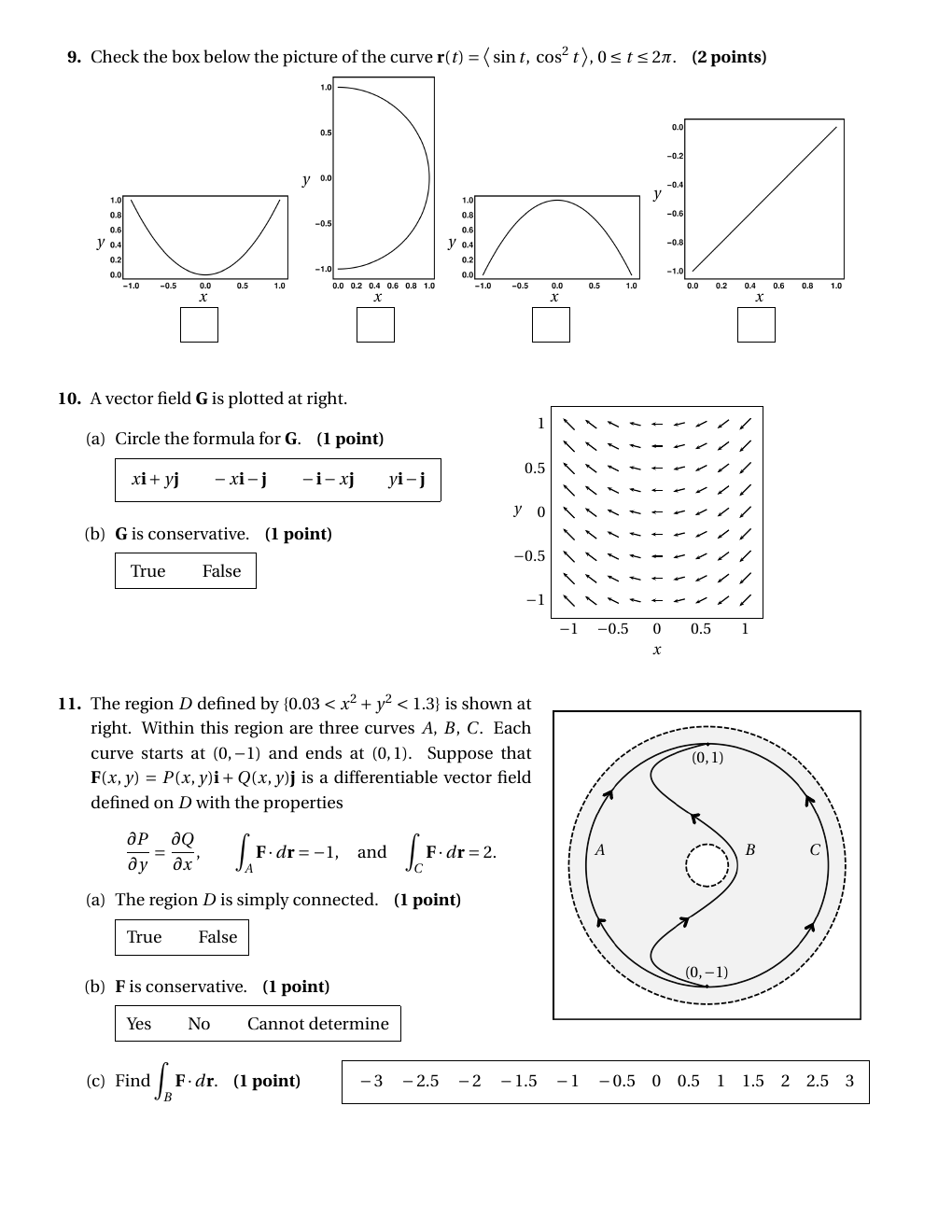
#R18-98 Pick the picture of r(t) · real exam · 2018 M2 #9 · 2 pt
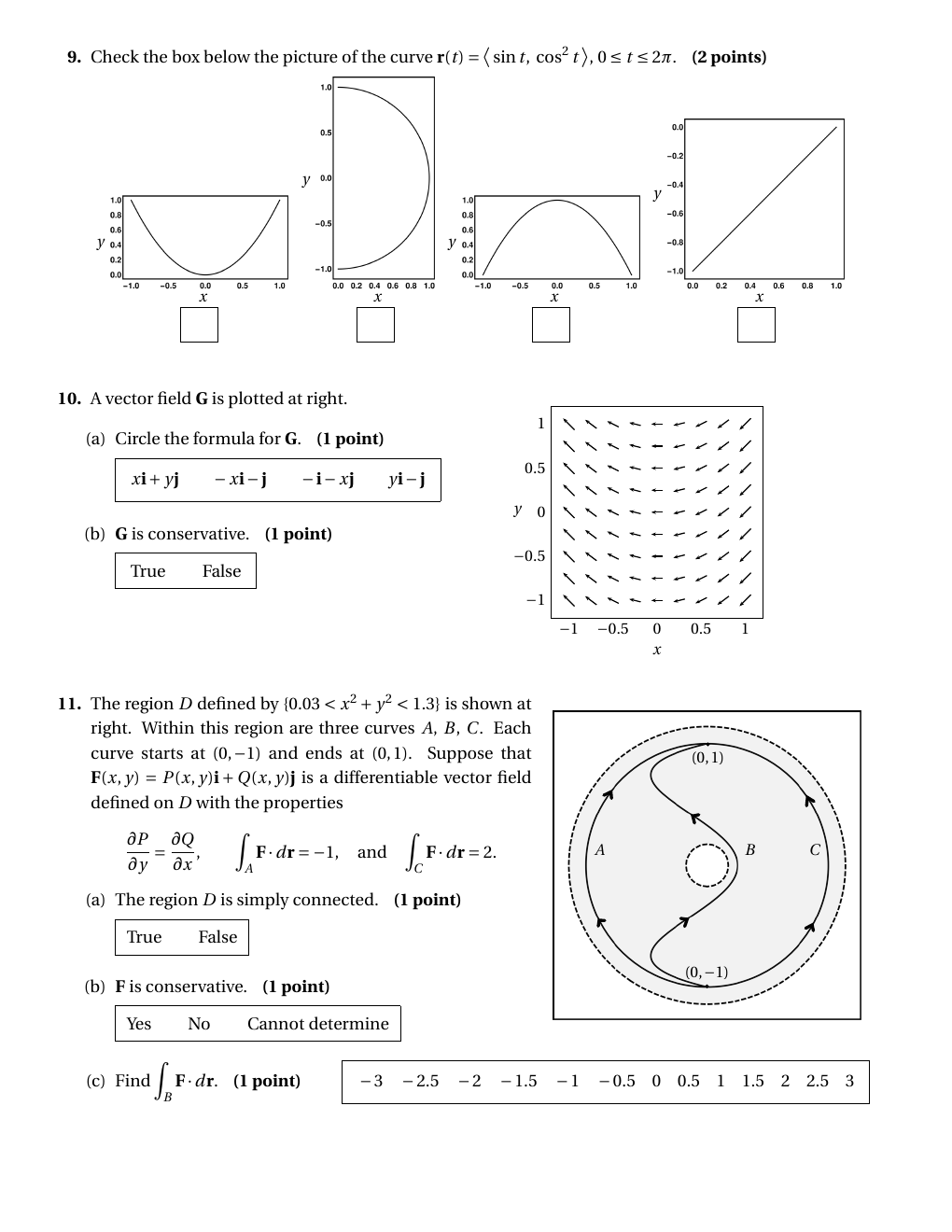
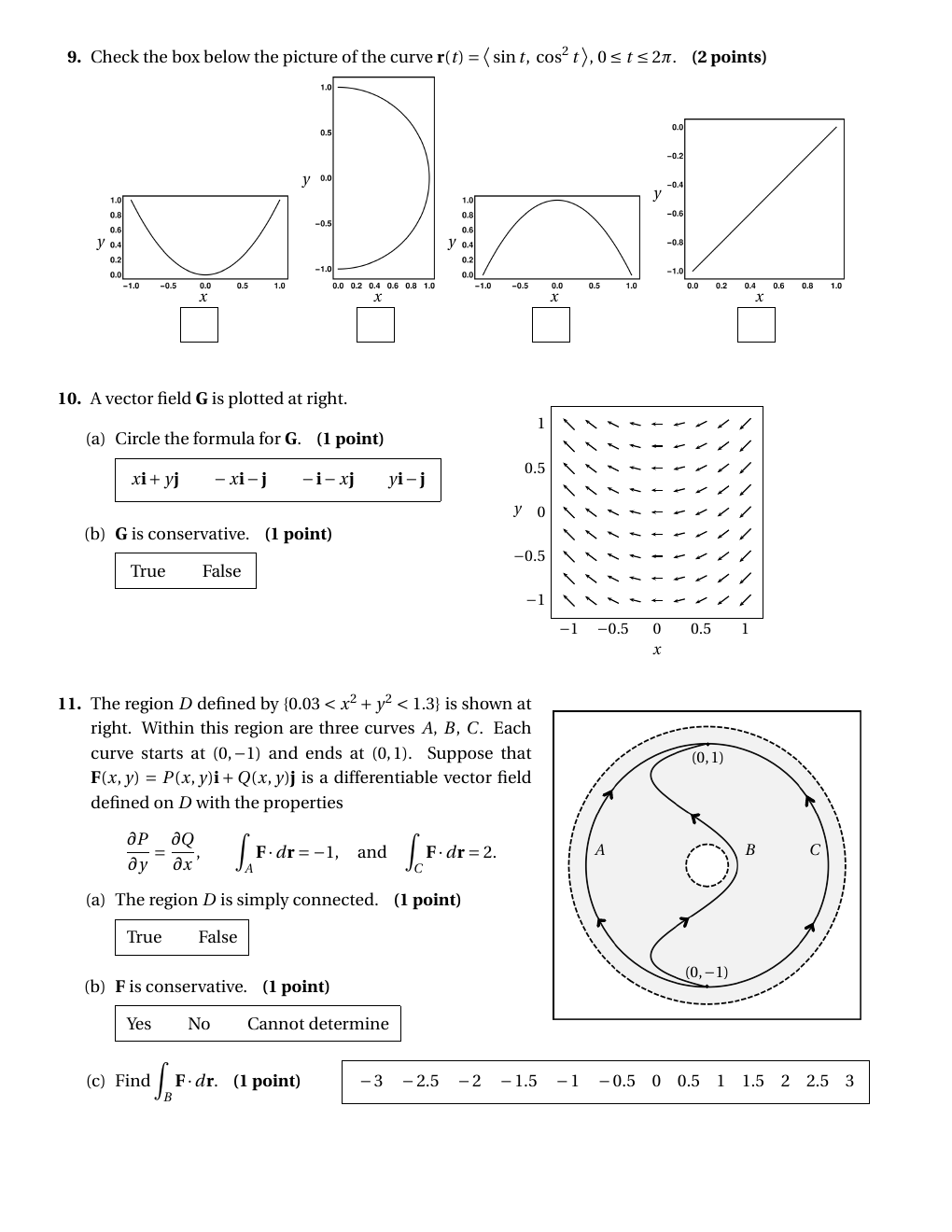
Figure: Question 9 on the page shown (four plots, left to right). Check the box below the picture of the curve r(t) = ⟨sin t, cos²t⟩, 0 ≤ t ≤ 2π.
Stuck? Tell Claude: #R18-9
Eliminate t.
Answer: The third picture (parabola opening downward, from (−1,0) up to (0,1))
x = sin t, y = cos²t = 1 − sin²t = 1 − x², with x ranging over [−1, 1]: a downward-opening parabola.
#R19-58 Pick the picture of r(t) · real exam · 2019 M2 #5 · 2 pt
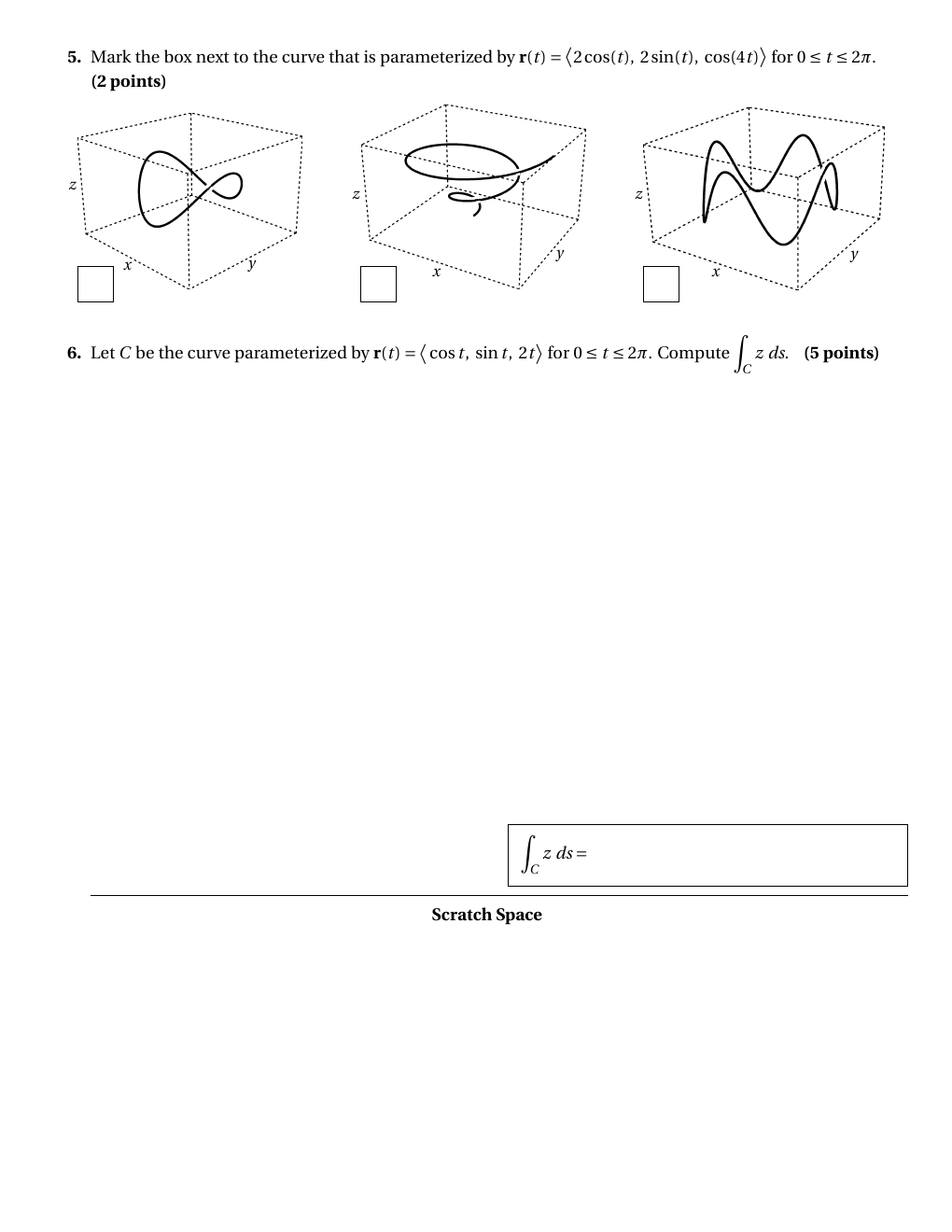
Figure: Question 5 on the page shown (three 3D curves, left to right). Mark the box next to the curve parameterized by r(t) = ⟨2cos t, 2sin t, cos 4t⟩ for 0 ≤ t ≤ 2π.
Stuck? Tell Claude: #R19-5
Project onto the xy-plane first, then look at how z oscillates.
Answer: The third picture (the circle with four up/down oscillations).
xy-projection is a circle of radius 2; z = cos 4t oscillates 4 full times (up/down) as t goes around once, so the curve is a circle that wavers up and down 4 times and closes up.
#R25-8b9 Mass of a wire ∫ρ ds · real exam · 2025 M2 #8b · 5 pt
The wire r(t) = ⟨−2 sin t, 2 cos t⟩, 0 ≤ t ≤ π has density ρ(x, y) = 3 + x. Find the total mass of the wire.
Let C be the curve parametrized by r(t) = ⟨3cos t, 3sin t, 4t⟩ for 0 ≤ t ≤ π. Find the mass of a thin wire in the shape of C if the density function is ρ(x, y, z) = x + z.
Stuck? Tell Claude: #V9-2
Mass = ∫ ρ ds = ∫ ρ(r(t))|r'(t)| dt.
Answer: Mass = 10π²
r' = ⟨−3sin t, 3cos t, 4⟩, |r'| = √(9 + 16) = 5.
ρ(r(t)) = 3cos t + 4t.
Mass = 5∫₀^π (3cos t + 4t) dt = 5[3sin t + 2t²]₀^π = 5(2π²) = 10π².
#V9-39 Mass of a wire ∫ρ ds · new variant · 5 pt
Let C be the curve parameterized by r(t) = ⟨t², 2t⟩ for 0 ≤ t ≤ √3. Compute ∫_C y ds.
Stuck? Tell Claude: #V9-3
∫_C f ds = ∫ f ds = ∫ f(r(t))|r'(t)| dt.
Answer: 28/3
r' = ⟨2t, 2⟩, |r'| = 2√(t² + 1).
y = 2t on C, so ∫_C y ds = ∫₀^√3 2t·2√(t²+1) dt = 4∫₀^√3 t√(t²+1) dt.
u = t² + 1: = 4·(1/2)∫₁⁴ √u du = 2·(2/3)[u^{3/2}]₁⁴ = (4/3)(8 − 1) = 28/3.
#R10-3c9 Mass of a wire ∫ρ ds · real exam · 2010 M2 #3c · 3 pt
Suppose C is made of material with density ρ(x,y,z) = x + z. Give a line integral for the mass of C and reduce it to an ordinary definite integral.
#R18-7a9 Mass of a wire ∫ρ ds · real exam · 2018 M2 #7a · 5 pt
Let C be the curve parametrized by r(t) = ⟨2cos t, 2sin t, t⟩ for −π ≤ t ≤ π. Find the mass of a thin wire in the shape of C if the density function is ρ(x,y,z) = x + z + 10.
Stuck? Tell Claude: #R18-7a
mass = ∫_C ρ ds = ∫ ρ(r(t))|r′(t)| dt.
Answer: Mass = 20√5 π
r′ = ⟨−2sin t, 2cos t, 1⟩, |r′| = √5.
Mass = √5 ∫_{−π}^{π} (2cos t + t + 10) dt = √5 [2sin t + t²/2 + 10t]_{−π}^{π} = √5 (20π).
#R19-69 Mass of a wire ∫ρ ds · real exam · 2019 M2 #6 · 5 pt
Let C be the curve parameterized by r(t) = ⟨cos t, sin t, 2t⟩ for 0 ≤ t ≤ 2π. Compute ∫_C z ds.
Let C be as in #7a, r(t) = ⟨2cos t, 2sin t, t⟩, −π ≤ t ≤ π; a particle moves along C from r(−π) = (−2,0,−π) to r(π) = (−2,0,π). Find the work done on the particle by the force F(x,y,z) = y i − x j.
C is the oriented straight line segment from (0,0) to (1,1). Circle the best estimate for (1/√2) ∫_C e^{xy/200} cos(xy/200) ds. Choices: −3, −2, −1, 0, 1, 2, 3.
Stuck? Tell Claude: #R19-7c
(1/length)∫ g ds is the average of g on C, and length(C) = √2.
Answer: 1
On C, xy/200 ≤ 1/200, so e^{xy/200} cos(xy/200) is very close to 1 everywhere.
(1/√2)∫_C g ds = average value of g on C ≈ 1.
#R25-12a11 Vector field pictures E/F/G · real exam · 2025 M2 #12a · 1 pt
Question 12 (bottom of the page, three vector fields E, F, G on [0,1]×[0,1]). (a) One of these vector fields is ⟨x − y, x⟩. Circle its name: E F G.
Stuck? Tell Claude: #R25-12a
Check the vector at (0, y) and (x, 0).
Answer: F
At (0, y): ⟨−y, 0⟩ points left. At (x, 0): ⟨x, x⟩ points up-right. Only F has arrows pointing left along x = 0.
#R25-12b11 Vector field pictures E/F/G · real exam · 2025 M2 #12b · 1 pt
Question 12 (bottom of the page, three vector fields E, F, G on [0,1]×[0,1]). (b) Exactly one of these vector fields is conservative. Circle it: E F G.
Stuck? Tell Claude: #R25-12b
Test a closed loop, or look for circulation.
Answer: G
Going around the square loop on E, the field points along the path on average, so ∮ E·dr > 0, not conservative. F is given by ⟨x−y, x⟩ with ∂Q/∂x = 1 ≠ −1 = ∂P/∂y, not conservative.
G is conservative.
#R25-12c11 Vector field pictures E/F/G · real exam · 2025 M2 #12c · 1 pt
Question 12 (bottom of the page, three vector fields E, F, G on [0,1]×[0,1]). (c) Exactly one of the following is a flowline for G parameterized by time for 0 ≤ t ≤ 1: r(t) = ⟨t, 1 − t⟩, r(t) = ⟨e^(−t), t⟩, r(t) = ⟨t, e^t⟩, r(t) = ⟨t, √t⟩. Circle it.
Stuck? Tell Claude: #R25-12c
A flowline's velocity must match the field arrows at each point.
Answer: r(t) = ⟨e^(−t), t⟩
G points up-left near x = 0 and down-right in the bulk. Along r(t) = ⟨e^(−t), t⟩ the curve moves left and up, matching the arrows at the left of G's picture.
#R25-12d11 Vector field pictures E/F/G · real exam · 2025 M2 #12d · 1 pt
Question 12 (bottom of the page, three vector fields E, F, G on [0,1]×[0,1]). (d) Let L be the oriented line segment from (0, 0) to (1, 1). Then ∫_L G·dr is negative / zero / positive.
Stuck? Tell Claude: #R25-12d
Compare G with the direction ⟨1,1⟩ along the segment.
Answer: Positive
Along the diagonal from (0,0) to (1,1), G arrows point in the direction of travel (up-right) along L, so G·T > 0.
#R10-4a11 Vector field pictures E/F/G · real exam · 2010 M2 #4a · 2 pt
Consider the vector field F = ⟨1, 2y⟩. Circle the picture of F (three plots in the figure, left to right).
Stuck? Tell Claude: #R10-4a
Evaluate F for y > 0, y = 0, y < 0.
Answer: The third picture.
For y > 0 the arrows point up-right, F = ⟨1,2y⟩ (steeper as y grows). For y = 0: ⟨1,0⟩ points right. For y < 0: down-right.
The third plot: arrows tilt up-right on the top half, horizontal at y = 0, down-right below.
#R11-5a11 Vector field pictures E/F/G · real exam · 2011 M2 #5a · 2 pt
Consider F = ⟨x − y, y⟩. Mark the picture of F (three plots left to right in the figure).
Stuck? Tell Claude: #R11-5a
Check the field along y = 0 and along x = 0.
Answer: The first plot.
On y = 0, F = ⟨x, 0⟩: horizontal arrows pointing right, growing with x. On x = 0, F = ⟨−y, y⟩ points up-left.
On the line y = x, F = ⟨0, y⟩ is purely vertical, but the second plot has a nonzero horizontal component there, so it is not F.
F(0,0) = ⟨0,0⟩, but the third plot has a nonzero arrow at the origin, so it is not F. The first plot is F.
#R11-7c11 Vector field pictures E/F/G · real exam · 2011 M2 #7c · 2 pt
Exactly one of the three vector fields in the figure is not conservative. Which one (left, middle, right)?
Stuck? Tell Claude: #R11-7c
Look for a closed loop with nonzero integral.
Answer: The middle one.
Use the closed-loop test: take a rectangular loop in the middle plot, traversed counterclockwise.
The field points right with magnitude varying in y, so the top and bottom edges (traversed in opposite directions) do not cancel, while the vertical edges are perpendicular to the field. The official solution gets ∮ F·dr > 0 on the drawn rectangle, so the middle field is not conservative.
#R12-6bi11 Vector field pictures E/F/G · real exam · 2012 M2 #6b(i) · 1 pt
Three vector fields E, F, G on R² are shown in the figure. One of them is yi + xj. Which one?
Stuck? Tell Claude: #R12-6bi
Evaluate at a point such as (0.5, 0.5).
Answer: F
At (0.5, 0.5), yi + xj = ⟨0.5, 0.5⟩: a 45° up-right arrow, and the field vanishes at the origin and grows away from it.
In the figure F is the one that is zero at the origin and points up-right with growing length as x and y grow (E points up-left at the top left; G has nonzero arrows along x = 0 and y = 0 pointing in other directions).
#R12-6bii11 Vector field pictures E/F/G · real exam · 2012 M2 #6b(ii) · 1 pt
Exactly one of the vector fields E, F, G (same figure) is not conservative. Which one?
Stuck? Tell Claude: #R12-6bii
A non-conservative field has some closed loop with nonzero line integral.
Answer: E
For a conservative field, ∫ over every closed curve is 0.
In E there is a closed loop (e.g. the one that goes around the corner region up, over and back down) along which the field points with the direction of travel almost everywhere, so ∫ E·dr over it is non-zero. Hence E is not conservative.
#R12-6biii11 Vector field pictures E/F/G · real exam · 2012 M2 #6b(iii) · 1 pt
Exactly one of the following is a flowline for G parameterized by time for 0 ≤ t ≤ 1. Circle it: r(t) = ⟨t, 1−t⟩; r(t) = ⟨e^(−t), e^(−t)⟩; r(t) = ⟨t, √t⟩; r(t) = ⟨1−t, 1−t⟩.
Stuck? Tell Claude: #R12-6biii
A flowline has velocity r′(t) = G(r(t)).
Answer: r(t) = ⟨e^(−t), e^(−t)⟩
In the plot G points along y = x toward the origin, with arrows shrinking near the origin.
r(t) = ⟨e^(−t), e^(−t)⟩ moves toward the origin along y = x, with speed decreasing as t grows (r′ = −r), matching the shrinking arrows.
#R12-8e11 Vector field pictures E/F/G · real exam · 2012 M2 #8e · 1 pt
Mark the plot (of the three at the bottom of the figure, left to right) of the gradient vector field ∇f.
Stuck? Tell Claude: #R12-8e
Gradient is perpendicular to level curves and points toward increasing f.
Answer: The second plot.
Check near the saddle at about (1, 0.9) and along the curved contours near the right edge: the gradient is orthogonal to level curves and points in the direction f increases.
This matches the second plot.
#R14-511 Vector field pictures E/F/G · real exam · 2014 M2 #5 · 6 pt
Consider F(x,y) = ⟨e^(x²), sin(y)⟩. Is F conservative? Circle: Yes / No / We do not have enough information. Justify your answer.
Stuck? Tell Claude: #R14-5
Check ∂P/∂y = ∂Q/∂x and the domain.
Answer: Yes: ∂P/∂y = 0 = ∂Q/∂x on all of R² (open, simply connected).
P = e^(x²), Q = sin y.
∂P/∂y = 0 and ∂Q/∂x = 0, so they are equal.
F is defined on all of R², which is open and simply connected, so the mixed-partials test applies and F is conservative.
#R16-511 Vector field pictures E/F/G · real exam · 2016 M2 #5 · 2 pt
Which one of the following vector fields is conservative? (Domain = where the formula makes sense.) ⟨−y/(x²+y²), x/(x²+y²)⟩, ⟨x², y²⟩, ⟨y², x²⟩, ⟨xy, xy⟩
Stuck? Tell Claude: #R16-5
Test ∂P/∂y = ∂Q/∂x, and watch the domain.
Answer: ⟨x², y²⟩
⟨y², x²⟩: Py = 2y, Qx = 2x, not equal. ⟨xy, xy⟩: Py = x, Qx = y, not equal.
⟨x², y²⟩: Py = 0 = Qx on all of R², so it is conservative (f = x³/3 + y³/3).
The first field has Py = Qx but lives on the punctured plane (has a hole), and its circulation around the origin is 2π, so it is not conservative.
#R16-811 Vector field pictures E/F/G · real exam · 2016 M2 #8 · 2 pt
Figure: Question 8 on the page shown (three vector field pictures, left to right). Mark the box below the only one of these three vector fields which is not conservative.
Stuck? Tell Claude: #R16-8
Compare ∂P/∂y with ∂Q/∂x, or integrate around a rectangle.
Answer: The third (rightmost) field
In the third picture the field is independent of x (all columns identical) but its x-component grows going up, so Py > 0 and Qx = 0.
Equivalently, a clockwise rectangle gives a positive integral: sides cancel, bottom is orthogonal, top is positive.
#R18-10a11 Vector field pictures E/F/G · real exam · 2018 M2 #10a · 1 pt
Figure: Question 10 on the page shown (vector field G plotted on [−1,1]²). Circle the formula for G: x i + y j, −x i − j, −i − x j, y i − j.
Stuck? Tell Claude: #R18-10a
Check the vector at (0,1).
Answer: −i − x j
At (0,1) the plotted arrow points left (−1, 0): matches −i − x j (and not −x i − j or the others, which give ⟨0,−1⟩ or ⟨1,−1⟩ there).
#R18-10b11 Vector field pictures E/F/G · real exam · 2018 M2 #10b · 1 pt
For the field G in #10 (same picture), G = ⟨−1, −x⟩ is conservative: True or False?
Stuck? Tell Claude: #R18-10b
Compare ∂P/∂y and ∂Q/∂x.
Answer: False
P = −1, Q = −x: ∂P/∂y = 0 but ∂Q/∂x = −1. Not equal.
Equivalently, the integral around the square shown is positive (top and bottom cancel, sides both contribute positively).
#R19-10a11 Vector field pictures E/F/G · real exam · 2019 M2 #10a · 2 pt
Figure: Question 10 on the page shown. Part (a): match F = ⟨−y, x⟩ and G = ⟨xy, 1⟩ on R² with the three direction-field pictures (left, middle, right) (1 point each).
Stuck? Tell Claude: #R19-10a
Evaluate each field at a corner, e.g. (0,1) and (1,0).
Answer: F is the middle picture; G is the right picture (the left picture matches neither).
F = ⟨−y,x⟩ rotates counterclockwise: at (0,1) it is ⟨−1,0⟩ (points left), at (1,0) it is ⟨0,1⟩ (up).
G = ⟨xy,1⟩ always has upward component 1; along y = 0 it is exactly ⟨0,1⟩ and tilts right as xy grows.
#R19-10b11 Vector field pictures E/F/G · real exam · 2019 M2 #10b · 2 pt
Figure: Question 10 on the page shown. Part (b): exactly one of the four vector fields pictured in the row below (left to right) is not conservative; which one?
Stuck? Tell Claude: #R19-10b
Check the closed-loop integral or compare ∂P/∂y with ∂Q/∂x from the picture.
Answer: The fourth (rightmost) picture
Compare how the x-component changes moving up versus how the y-component changes moving right; a conservative field needs them equal.
The fourth field fails this test.
#R19-10c11 Vector field pictures E/F/G · real exam · 2019 M2 #10c · 2 pt
Figure: Question 10 on the page shown. Part (c): circle the formula for r(t) that gives a streamline (flowline, integral curve) for the vector field shown at right. Choices: ⟨t/2, t⟩, ⟨t²/2, t⟩, ⟨t, t²/2⟩, ⟨1/2, t⟩.
Stuck? Tell Claude: #R19-10c
A flowline satisfies r′(t) = F(r(t)); read F off the picture (the field is vertical on y = 0 and tilts right as y increases, independent of x).
Answer: ⟨t²/2, t⟩
The picture is F = ⟨y, 1⟩.
Try r = ⟨t²/2, t⟩: r′ = ⟨t, 1⟩ = F(r(t)) = ⟨y, 1⟩ with y = t. ✓.
#R19-10d11 Vector field pictures E/F/G · real exam · 2019 M2 #10d · 1 pt
Suppose E is a vector field on R² where the streamline through (1,0) is the ellipse x² + y²/4 = 1. Is E conservative? (yes / no / cannot determine)
Stuck? Tell Claude: #R19-10d
If E = ∇f, what happens to f along a flowline?
Answer: no
If E = ∇f, then f strictly increases along a streamline (df/dt = |∇f|² > 0), so f could not return to its starting value after going around a closed ellipse.
Question 5 (right side of the page, bottom): g: R² → R has the graph shown (surface z = g(x,y) with level heights 10, 20, 30), and C is the indicated curve in the xy-plane from A to B. Evaluate ∫_C ∇g · dr.
Stuck? Tell Claude: #R25-5
Fundamental Theorem of Line Integrals.
Answer: −10
∫_C ∇g · dr = g(B) − g(A) = 10 − 20 = −10 (read the heights above the endpoints from the graph).
Let g: R² → R have the graph shown in the figure (levels z = 10, 20, 30) and let C be the indicated curve in the xy-plane from A to B. Evaluate ∫_C ∇g · dr.
Stuck? Tell Claude: #R11-9
Fundamental Theorem of Line Integrals; read g(A) and g(B) from the graph.
Figure: Question 11 on the page shown (annular region D = {0.03 < x² + y² < 1.3} with curves A, B, C from (0,−1) to (0,1)). F = P i + Q j is differentiable on D with ∂P/∂y = ∂Q/∂x, ∫_A F·dr = −1, ∫_C F·dr = 2. (a) The region D is simply connected. True or False?
Stuck? Tell Claude: #R18-11a
Does D have a hole?
Answer: False
D has a hole in the middle, so it is not simply connected.
Figure: Question 11 on the page shown (annular region D = {0.03 < x² + y² < 1.3} with curves A, B, C from (0,−1) to (0,1)). F = P i + Q j is differentiable on D with ∂P/∂y = ∂Q/∂x, ∫_A F·dr = −1, ∫_C F·dr = 2. (b) F is conservative: Yes / No / Cannot determine.
Stuck? Tell Claude: #R18-11b
Look for a closed loop with nonzero integral.
Answer: No
Going along A then back along −C is a closed curve with ∫ = −1 − 2 = −3 ≠ 0, so F is not conservative (despite ∂P/∂y = ∂Q/∂x, because D is not simply connected).
Figure: Question 11 on the page shown (annular region D = {0.03 < x² + y² < 1.3} with curves A, B, C from (0,−1) to (0,1)). F = P i + Q j is differentiable on D with ∂P/∂y = ∂Q/∂x, ∫_A F·dr = −1, ∫_C F·dr = 2. (c) Find ∫_B F·dr. Choices: −3, −2.5, −2, −1.5, −1, −0.5, 0, 0.5, 1, 1.5, 2, 2.5, 3.
Stuck? Tell Claude: #R18-11c
Compare B with C.
Answer: 2
B and C lie in a simply connected open subset of D (the right half), where F is conservative, so their integrals agree.
C is the indicated portion of the ellipse x²/4 + y² = 1 between A = (0,−1) and B = (0,1), the right half going from A to B (see figure). Give a parameterization r of C, with domain, tracing exactly that segment.
Stuck? Tell Claude: #R10-5a
Use y as the parameter and solve for x with x ≥ 0.
Answer: r(t) = ⟨2√(1−t²), t⟩, −1 ≤ t ≤ 1.
x²/4 + y² = 1 gives x² = 4(1 − y²), so x = 2√(1 − y²) on the right half.
Let y = t: r(t) = ⟨2√(1 − t²), t⟩, −1 ≤ t ≤ 1 (from (0,−1) to (0,1)).
A spaceship orbits on x² + y² = 4. The solar radiation at (x,y) is f(x,y) = (x+2)y = xy + 2y. Use Lagrange multipliers to find the maximum value M and minimum value m of f on the orbit.
Stuck? Tell Claude: #R12-3a
∇f = ⟨y, x+2⟩, g = x² + y². If x = 0 then y = 0, which is not on the circle.
Answer: M = 3√3, m = −3√3.
∇f = λ∇g gives y = 2λx and x + 2 = 2λy, with x² + y² = 4.
If x = 0 then y = 0 (first eq), not on the circle, so x ≠ 0 and 2λ = y/x. Then x + 2 = y²/x, so x² + 2x = y².
Substitute y² = 4 − x²: 2x² + 2x = 4, so x² + x − 2 = 0, x = 1 or x = −2.
x = 1: y² = 3, y = ±√3. x = −2: y = 0.
f(1,√3) = 3√3, f(1,−√3) = −3√3, f(−2,0) = 0. The circle is closed and bounded, so the extremes are among these.
Let f(x,y) be differentiable on the disk D = {x² + y² ≤ 100}, where f = 20 on the circle x² + y² = 100, f(0,0) = 5, and f has only one critical point, at (1,2). Which is true: f(1,2) > 5, f(1,2) < 5, f(1,2) = 5, or cannot be determined?
Stuck? Tell Claude: #R16-6
Extreme Value Theorem on the closed disk: where can the minimum occur?
Answer: f(1,2) < 5
D is closed and bounded, so f has an absolute min. Since f(0,0) = 5 < 20, the min is not on the boundary, so it is at an interior critical point, i.e. at (1,2).
If f(1,2) were 5, the minimum value 5 would also be attained at the interior point (0,0), forcing (0,0) to be a critical point (it is not (1,2)), a contradiction. So f(1,2) < 5.
Figure: Question 6 on the page shown. A curve C in R³ has projections onto the xy-, xz- and yz-planes (the three small plots); check the box below the correct three-dimensional plot of C (left, middle, or right).
Stuck? Tell Claude: #R18-6
Use the endpoints of the xz-projection (a spiral) to rule out plots.
Answer: The first (left) plot
The xz-projection is a spiral ending at (0.5, 0.5), and its start and end points differ (not a closed curve).
The middle plot's xz-projection does not end at (0.5, 0.5); the right plot's xz-projection would be a closed curve (start = end), which does not match.
#B1Lagrange · practice · 8 pt
Find the absolute max and min of f(x,y) = x + 2y on the circle x² + y² = 5, and the points where they occur.
Stuck? Tell Claude: #B1
Write ∇f = λ∇g with g = x² + y².
Answer: max 5 at (1,2); min −5 at (−1,−2)
∇f = ⟨1,2⟩, ∇g = ⟨2x,2y⟩. ⟨1,2⟩ = λ⟨2x,2y⟩ gives 1 = 2λx and 2 = 2λy, so y = 2x (divide the equations; λ ≠ 0).
Constraint: x² + (2x)² = 5x² = 5, so x = ±1.
Candidates: (1,2) and (−1,−2).
f(1,2) = 1 + 4 = 5; f(−1,−2) = −1 − 4 = −5. Circle is closed and bounded, so both extremes exist.
#B10Extrema · practice · 10 pt
Find the absolute max and min of f(x,y) = xy on the disk x² + y² ≤ 2, with the points. Classify the interior critical point.
Stuck? Tell Claude: #B10
Interior critical point, then Lagrange on the circle x² + y² = 2.
Answer: max 1 at (1,1) and (−1,−1); min −1 at (1,−1) and (−1,1); (0,0) is a saddle
f_x = y = 0, f_y = x = 0: (0,0), f = 0. f_xx = f_yy = 0, f_xy = 1, D = −1 < 0: saddle.
Boundary: ⟨y,x⟩ = λ⟨2x,2y⟩ gives y = 2λx, x = 2λy, so y = 4λ²y, so y² = x² (y ≠ 0).
x² + x² = 2, x = ±1. Points (1,1), (−1,−1): f = 1. Points (1,−1), (−1,1): f = −1.
Compare 0, 1, −1.
#B11Conservative/FTLI · practice · 10 pt
(a) Show F = ⟨y cos x + 2, sin x + 3y²⟩ is conservative and find the potential f with f(0,0) = 0. (b) Evaluate ∫_C F·dr for any smooth curve C from (0,0) to (π/2, 1).
Stuck? Tell Claude: #B11
Test P_y = Q_x, then integrate P with respect to x and add C(y).
Answer: (a) f = y sin x + 2x + y³; (b) π + 2
P = y cos x + 2, Q = sin x + 3y². P_y = cos x = Q_x, defined on all of R², so F is conservative.
∫P dx = y sin x + 2x + C(y). f_y = sin x + C′(y) = sin x + 3y², so C′ = 3y², C = y³.
f = y sin x + 2x + y³ (f(0,0) = 0). Check: f_x = y cos x + 2 ✓, f_y = sin x + 3y² ✓.
FTLI: f(π/2,1) − f(0,0) = 1·1 + π + 1 = π + 2.
#B12Conservative/FTLI · practice · 8 pt
Let F = ⟨yz, xz + 1, xy + 3z²⟩. Show F is conservative, find a potential, and evaluate ∫_C F·dr for any path from (1,1,1) to (2,1,2).
Stuck? Tell Claude: #B12
Check all three: P_y = Q_x, P_z = R_x, Q_z = R_y. Then f = ∫P dx + g(y,z).
Answer: f = xyz + y + z³; integral = 10
P_y = z = Q_x; P_z = y = R_x; Q_z = x = R_y. All hold on R³, so conservative.
f = xyz + g(y,z). f_y = xz + g_y = xz + 1, so g_y = 1, g = y + h(z).
f_z = xy + h′(z) = xy + 3z², so h′ = 3z², h = z³. f = xyz + y + z³.
Use Lagrange multipliers to find the minimum of x² + y² + z² on the plane x + 2y + 3z = 14, and where it occurs.
Stuck? Tell Claude: #B2
∇f = ⟨2x,2y,2z⟩ must be parallel to the plane's normal ⟨1,2,3⟩.
Answer: min 14 at (1,2,3); no max
2x = λ, 2y = 2λ, 2z = 3λ, so (x,y,z) = μ⟨1,2,3⟩ with μ = λ/2.
Plane: μ(1 + 4 + 9) = 14μ = 14, so μ = 1 and the point is (1,2,3).
f(1,2,3) = 1 + 4 + 9 = 14. The plane is unbounded, so there is no maximum; this is the minimum (squared distance from the origin to the plane).
#B20Line integrals · practice · 8 pt
F = ⟨−y, x⟩ and C is the rectangle with corners (0,0), (3,0), (3,2), (0,2) traversed counterclockwise. Compute ∮_C F·dr piece by piece. Is F conservative?
Stuck? Tell Claude: #B20
Parametrize each side in the direction of travel.
Answer: 12; not conservative
Bottom r = ⟨t,0⟩, 0≤t≤3: F = ⟨0,t⟩, r′ = ⟨1,0⟩, dot 0. Integral 0.
Right r = ⟨3,t⟩, 0≤t≤2: F = ⟨−t,3⟩, r′ = ⟨0,1⟩, dot 3. Integral 6.
Top r = ⟨3−t,2⟩, 0≤t≤3: F = ⟨−2,3−t⟩, r′ = ⟨−1,0⟩, dot 2. Integral 6.
Left r = ⟨0,2−t⟩, 0≤t≤2: F = ⟨−(2−t),0⟩, r′ = ⟨0,−1⟩, dot 0. Integral 0.
Total 12 ≠ 0 on a closed curve, so F is not conservative (P_y = −1 ≠ 1 = Q_x).
#B21Line integrals · practice · 6 pt
Compute ∫_C xy ds where C is the quarter circle x² + y² = 4 in the first quadrant.
Stuck? Tell Claude: #B21
Scalar integral: parametrize r = ⟨2cos t, 2sin t⟩, 0 ≤ t ≤ π/2, and use |r′|.
Answer: 4
r′ = ⟨−2 sin t, 2 cos t⟩, |r′| = 2. xy = 4 sin t cos t.
∫₀^{π/2} 4 sin t cos t · 2 dt = 8 ∫₀^{π/2} sin t cos t dt = 8·(1/2) = 4.
#B22Line integrals · practice · 7 pt
Compute ∫_C z ds where C is the helix r(t) = ⟨3cos t, 3sin t, 4t⟩, 0 ≤ t ≤ π.
Stuck? Tell Claude: #B22
Speed |r′| first; it is a constant.
Answer: 10π²
r′ = ⟨−3 sin t, 3 cos t, 4⟩, |r′| = √(9 + 16) = 5.
z = 4t. ∫₀^π 4t·5 dt = 20·(π²/2) = 10π².
#B23Curves · practice · 8 pt
Let C be the intersection of the cylinder x² + y² = 4 with the surface z = (x − y)². Give a vector function r(t) that traverses C exactly once, with its domain.
Stuck? Tell Claude: #B23
Parametrize the circle first, then solve for z.
Answer: r(t) = ⟨2cos t, 2sin t, 4(cos t − sin t)²⟩, 0 ≤ t ≤ 2π
x = 2 cos t, y = 2 sin t.
z = (2 cos t − 2 sin t)² = 4(cos t − sin t)².
Full circle once: 0 ≤ t ≤ 2π. Check t = 0: (2,0,4) and z = (2−0)² = 4 ✓.
#B24Curves · practice · 10 pt
Let r(t) = ⟨t², 2t, ln t⟩, t > 0. (a) Find the length of the curve from t = 1 to t = e. (b) Find the tangent line at t = 1.
Stuck? Tell Claude: #B24
Compute |r′|²; look for a perfect square.
Answer: (a) e²; (b) r = ⟨1,2,0⟩ + s⟨2,2,1⟩
r′ = ⟨2t, 2, 1/t⟩. |r′|² = 4t² + 4 + 1/t² = (2t + 1/t)², so |r′| = 2t + 1/t for t > 0.
(b) r(1) = ⟨1,2,0⟩, r′(1) = ⟨2,2,1⟩. Line: ⟨1+2s, 2+2s, s⟩, s in R.
#B25Curves · practice · 10 pt
A particle has position r(t) = ⟨2t, t², t³/3⟩. (a) Find velocity, speed and acceleration at t = 1. (b) Find the arc length from t = 0 to t = 3. (c) Give the tangent line at t = 1.
Stuck? Tell Claude: #B25
v = r′; look for a perfect square in |r′|².
Answer: (a) v = ⟨2,2,1⟩, speed 3, a = ⟨0,2,2⟩; (b) 15; (c) ⟨2,1,1/3⟩ + s⟨2,2,1⟩
v(t) = ⟨2, 2t, t²⟩, a(t) = ⟨0, 2, 2t⟩. At t = 1: v = ⟨2,2,1⟩, a = ⟨0,2,2⟩, speed = √(4+4+1) = 3.
Which parametrization starts at (0,2) and moves counterclockwise around the circle of radius 2? (i) ⟨2cos t, 2sin t⟩ (ii) ⟨2sin t, 2cos t⟩ (iii) ⟨−2sin t, 2cos t⟩ (iv) ⟨−2cos t, 2sin t⟩
Stuck? Tell Claude: #B26
Check r(0) first, then the direction of r′(0).
Answer: (iii)
r(0): (i) (2,0); (ii) (0,2); (iii) (0,2); (iv) (−2,0). So (ii) or (iii).
(ii) r′(0) = ⟨2,0⟩: moves right from the top, which is clockwise.
(iii) r′(0) = ⟨−2,0⟩: moves left from the top, which is counterclockwise ✓.
#B27Gradient/Directional · practice · 6 pt
Find the tangent plane to x² + 2y² + 3z² = 18 at P = (2,1,2). Write it as ax + by + cz = d.
Stuck? Tell Claude: #B27
The normal is ∇F(P).
Answer: x + y + 3z = 9
F = x² + 2y² + 3z²; F(2,1,2) = 4 + 2 + 12 = 18 ✓.
∇F = ⟨2x,4y,6z⟩ = ⟨4,4,12⟩ at P.
4(x−2) + 4(y−1) + 12(z−2) = 0, so 4x + 4y + 12z = 36, i.e. x + y + 3z = 9. Check P: 2 + 1 + 6 = 9 ✓.
#B28Gradient/Directional · practice · 10 pt
Let f(x,y) = x²y + y³ and P = (1,2). (a) Find D_u f(P) for u in the direction ⟨3,4⟩. (b) Find the direction of fastest increase at P and the maximum rate. (c) Give a unit vector u with D_u f(P) = 0.
Stuck? Tell Claude: #B28
Compute ∇f(P), then NORMALIZE the direction vector.
Answer: (a) 64/5; (b) direction ⟨4,13⟩/√185, max rate √185; (c) u = ⟨13,−4⟩/√185
∇f = ⟨2xy, x² + 3y²⟩; at (1,2): ⟨4, 13⟩.
(a) u = ⟨3,4⟩/5. D_u f = (4·3 + 13·4)/5 = 64/5.
(b) Direction ⟨4,13⟩/√185 (16 + 169 = 185). Max rate = |∇f| = √185.
(c) u ⟂ ∇f: u = ⟨13,−4⟩/√185 (4·13 − 13·4 = 0), or its negative.
#B29Gradient/Directional · practice · 8 pt
f(x,y,z) = x² + yz and P = (1,2,1). (a) Find D_u f(P) for u in the direction ⟨2,−1,2⟩. (b) Max rate of change of f at P. (c) Tangent plane to the level surface f = 3 at P.
So f strictly increases along the flowline and cannot return to its starting value: no closed flowline. FALSE.
Contrast: ⟨−y,x⟩ has circular flowlines and is not conservative.
#B36Concept T/F · practice · 4 pt
T/F: If D = 0 at a critical point, the second derivative test says it is a saddle point.
Stuck? Tell Claude: #B36
What does D = 0 mean for the test?
Answer: FALSE (D = 0 is undetermined)
D = 0 means the test is inconclusive, not saddle.
f = x⁴ + y² at (0,0): f_xx = 0, f_yy = 2, f_xy = 0, D = 0, and (0,0) is a local (indeed absolute) minimum.
g = x³ + y² at (0,0): D = 0 and it is neither (g(−ε,0) < 0 < g(ε,0)). FALSE.
#B37Concept T/F · practice · 4 pt
T/F: Every continuous function on the open disk x² + y² < 1 attains an absolute maximum. Justify.
Stuck? Tell Claude: #B37
Which two hypotheses does the Extreme Value Theorem need?
Answer: FALSE (EVT needs closed and bounded)
EVT needs a closed AND bounded region. The open disk is bounded but not closed.
Counterexample f = x: x < 1 at every point of the open disk, but x gets arbitrarily close to 1. The sup 1 would be at (1,0), which is on the boundary and not in the set. No max. FALSE.
#B38Concept T/F · practice · 4 pt
T/F: If ∇f(P) = 0 then f has a local max or min at P.
Stuck? Tell Claude: #B38
Think of a saddle.
Answer: FALSE
f = xy: ∇f = ⟨y,x⟩ = 0 at (0,0). f_xx = f_yy = 0, f_xy = 1, D = −1 < 0: saddle.
Critical points can be saddles (or undetermined). FALSE.
#B4Lagrange · practice · 8 pt
Maximize f(x,y,z) = xyz subject to x + y + z = 12 with x, y, z ≥ 0. Give the maximum value and the point.
Stuck? Tell Claude: #B4
∇f = ⟨yz,xz,xy⟩ = λ⟨1,1,1⟩.
Answer: max 64 at (4,4,4)
yz = xz = xy = λ. If any variable is 0 then f = 0 (the minimum, not the max). So assume x,y,z > 0.
yz = xz gives x = y (divide by z); xz = xy gives y = z. So x = y = z.
3x = 12, x = 4. Point (4,4,4), f = 64. The region (triangle in the plane with x,y,z ≥ 0) is closed and bounded, and the boundary has f = 0, so 64 is the max.
#B5Lagrange · practice · 6 pt
Find the minimum of f(x,y) = x² + y² subject to xy = 4. Is there a maximum?
Stuck? Tell Claude: #B5
∇f = ⟨2x,2y⟩, ∇g = ⟨y,x⟩.
Answer: min 8 at (2,2) and (−2,−2); no max
2x = λy and 2y = λx. Multiply first by x, second by y: 2x² = λxy = 2y², so x² = y².
With xy = 4 we need x and y with the same sign, so y = x. Then x² = 4, x = ±2.
Points (2,2) and (−2,−2): f = 8.
No maximum: along x = t, y = 4/t, f = t² + 16/t² → ∞. The curve is not bounded.
#B6Extrema · practice · 8 pt
A function f(x,y) has continuous second partials and this data. For each point say: not critical / local min / local max / saddle / undetermined.
(x,y): f_x f_y f_xx f_yy f_xy
(0,0): 0 0 2 3 1
(1,0): 0 0 1 1 2
(0,1): 0 0 −2 −3 1
(1,1): 0 0 2 2 2
(2,0): 1 0 5 5 0
Stuck? Tell Claude: #B6
First check f_x = f_y = 0, then compute D = f_xx f_yy − (f_xy)².
Answer: (0,0) local min; (1,0) saddle; (0,1) local max; (1,1) undetermined; (2,0) not critical
(0,0): critical, D = 2·3 − 1² = 5 > 0, f_xx = 2 > 0: local min.
(1,0): critical, D = 1·1 − 2² = −3 < 0: saddle.
(0,1): critical, D = (−2)(−3) − 1² = 5 > 0, f_xx = −2 < 0: local max.
Bottom edge y = 0, 0 ≤ x ≤ 2: f = x² − x, critical at x = 1/2 (f = −1/4); ends f(0,0) = 0, f(2,0) = 2.
Left edge x = 0, 0 ≤ y ≤ 2: f = y² − y by symmetry: −1/4 at (0,1/2), f(0,2) = 2.
Hypotenuse y = 2 − x, 0 ≤ x ≤ 2: f = x² + (2−x)² − 2 = 2x² − 4x + 2, min 0 at x = 1 (point (1,1)); ends f = 2 at (2,0) and (0,2).
Compare −1/2, −1/4, 0, 2.
#H1Extrema · hard · 12 pt
Find the absolute max and min of f(x,y) = xy − x on the closed triangle with vertices (0,0), (4,0), (0,4). Give the values and the points. Show all three edges.
Stuck? Tell Claude: #H1
Interior critical point first (watch where it lands!), then each edge as a one-variable problem, include corners.
Answer: max 9/4 at (3/2, 5/2); min −4 at (4,0)
Interior: f_x = y − 1 = 0, f_y = x = 0 gives (0,1). That is ON the edge x = 0, not interior, so there is no interior critical point. f(0,1) = 0.
Edge y = 0, 0 ≤ x ≤ 4: f = −x, monotone. Ends: f(0,0) = 0, f(4,0) = −4.
Edge x = 0, 0 ≤ y ≤ 4: f = 0 everywhere.
Hypotenuse y = 4 − x, 0 ≤ x ≤ 4: f = x(4 − x) − x = 3x − x². Derivative 3 − 2x = 0 gives x = 3/2, y = 5/2, f = 9/4. Ends: f(0,4) = 0, f(4,0) = −4.
Compare 0, −4, 9/4. Closed and bounded, so EVT guarantees both.
#H10Curves · hard · 10 pt
The surfaces x² + y² + z² = 6 and z = x² + y² intersect in a curve C passing through P = (1,1,2). (a) Check P is on both surfaces. (b) Find a direction vector for the tangent line to C at P. (c) Write the tangent line and the equation of the normal plane to C at P.
Stuck? Tell Claude: #H10
The tangent to C is perpendicular to BOTH surface normals, so use a cross product of the two gradients.
Answer: direction ⟨1,−1,0⟩; line (1+t, 1−t, 2); normal plane x − y = 0
Normal plane through P with normal ⟨1,−1,0⟩: (x − 1) − (y − 1) = 0, i.e. x − y = 0.
#H11Gradient/Directional · hard · 14 pt
Let f(x,y) = 3x² + 4y² and P = (1,1). (a) Find the max and min possible values of D_u f(P) over unit vectors u, and the directions achieving them. (b) Give two unit vectors u with D_u f(P) = 0 and the tangent line to the level curve of f through P. (c) If D_u f(P) = 5, what is the angle between u and ∇f(P)? (d) Compute D_u f(P) for u = ⟨1,1⟩/√2. (e) The level curve through P is an ellipse. Is ∇f(P) pointing toward or away from the center?
Stuck? Tell Claude: #H11
D_u f = |∇f| cos θ. ∇f is perpendicular to the level curve.
Answer: (a) max 10 along ⟨3,4⟩/5, min −10 along ⟨−3,−4⟩/5; (b) u = ±⟨4,−3⟩/5, tangent line 3x + 4y = 7; (c) 60°; (d) 7√2; (e) away from center
∇f = ⟨6x, 8y⟩, ∇f(P) = ⟨6, 8⟩, |∇f(P)| = 10.
(a) Max = 10 in direction ⟨3,4⟩/5. Min = −10 in direction ⟨−3,−4⟩/5.
(b) D_u f = 0 when u ⊥ ∇f: u = ±⟨4,−3⟩/5. Tangent line to level curve: 6(x−1) + 8(y−1) = 0, i.e. 3x + 4y = 7.
(c) 10 cos θ = 5, cos θ = 1/2, θ = 60° (π/3).
(d) ⟨6,8⟩·⟨1,1⟩/√2 = 14/√2 = 7√2.
(e) Away from the center: f increases outward on the ellipse 3x² + 4y² = 7 (center has f = 0, smallest value), and ∇f points toward increasing f.
#H12Conservative/FTLI · hard · 10 pt
A particle of mass m = 2 moves in the force field F = −∇φ with potential energy φ(x,y,z) = xyz. At A = (1,2,3) its speed is 2. (a) Find the force and acceleration at A. (b) Find the work done by F as it moves from A to B = (2,1,1) along ANY path. (c) Find its speed at B.
Stuck? Tell Claude: #H12
Conservation of energy: ½mv² + φ is constant. Work by F = φ(A) − φ(B).
Answer: (a) F = ⟨−6,−3,−2⟩, a = ⟨−3, −3/2, −1⟩; (b) 4; (c) 2√2
(a) ∇φ = ⟨yz, xz, xy⟩; at A: ⟨6,3,2⟩. F = −⟨6,3,2⟩. Acceleration = F/m = ⟨−3, −3/2, −1⟩.
True or false, with a one-line justification (counterexample if false). (a) If ∮_C F·dr = 0 for one particular closed curve C, then F is conservative. (b) If f is differentiable on R² and has a local max at P, then ∇f(P) = 0. (c) If f_x(P) = f_y(P) = 0 and f_xx(P) = 0, then P cannot be a local min. (d) For any C and f, ∫_{−C} f ds = ∫_C f ds. (e) Every continuous f on the closed triangle with vertices (0,0),(1,0),(0,1) has an absolute max and min there. (f) If F is conservative and f is its potential, ∫_C F·dr depends only on the start and end points of C.
Stuck? Tell Claude: #H13
For each, ask: which theorem is it imitating, and what hypothesis is missing?
Answer: (a) F, (b) T, (c) F, (d) T, (e) T, (f) T
(a) FALSE. Conservative needs ∮ = 0 for EVERY closed curve. F = ⟨−y, x⟩ over the segment from (0,0) to (1,0) and straight back: F·dr = 0 on the x-axis, so ∮ = 0, yet F is not conservative (P_y = −1 ≠ 1 = Q_x).
(b) TRUE. At a local max of a differentiable function on an open set, f_x = f_y = 0 (one-variable Fermat in each direction).
(c) FALSE. f = x⁴ + y² has ∇f(0,0) = 0, f_xx(0,0) = 0, and (0,0) is a global min. (D = 0 only means the test is inconclusive.)
(d) TRUE. ds uses |r'| ≥ 0, so reversing direction does not change a scalar line integral. (Contrast: F·dr flips sign.)
(e) TRUE. Closed and bounded + continuous: Extreme Value Theorem.
(f) TRUE. FTLI: ∫_C ∇f·dr = f(end) − f(start).
#H14Gradient/Directional · hard · 15 pt
PICTURE (described). The contour map of a differentiable f on the disk D = {x² + y² ≤ 4} shows: the two crossing straight lines y = x and y = −x both labeled f = 0; hyperbola branches opening to the right and left labeled f = 1 (vertices (±1,0)) and f = 4 (vertices (±2,0)); hyperbola branches opening up and down labeled f = −1 (vertices (0,±1)) and f = −4 (vertices (0,±2)). Let P = (0,1), Q = (1,0), A = (2,0), and u = ⟨0,−1⟩. (a) How many critical points does f have in D, and what type? (b) Sign of D_u f(P): negative, zero, or positive? (c) Is f_x(Q) positive, zero, or negative? f_y(Q)? (d) Is |∇f(A)| greater than, equal to, or less than |∇f(Q)|? Why from the picture? (e) Does f have an absolute max on D? Where? (f) What is ∫_C ∇f·dr for C any path from Q to A? (g) Is ∇f(A) parallel to ⟨1,0⟩?
Stuck? Tell Claude: #H14
Moving from lower to higher label means f increases. Closer spacing of level curves means larger |∇f|. ∇f is perpendicular to level curves.
Answer: (a) 1 saddle at the origin; (b) positive; (c) f_x(Q) positive, f_y(Q) zero; (d) greater (4 > 2, contours denser at A); (e) yes, 4 at (±2,0); (f) 3; (g) true
Picture is f(x,y) = x² − y² (hyperbolas, saddle at origin).
(a) One critical point, at the origin where the level curves f = 0 cross: a saddle.
(b) From P = (0,1) (on f = −1) moving down toward the origin (f = 0), f goes from −1 up to 0: increasing. D_u f(P) POSITIVE. (Check: f_y = −2y = −2, u = ⟨0,−1⟩, D_u f = +2.)
(c) At Q = (1,0) on f = 1, f increases to the right: f_x(Q) POSITIVE (= 2). Level curve is vertical there, so f_y(Q) = ZERO.
(d) Along the x-axis f rises by 1 from the origin to x = 1 (f = 0 to 1) but by 3 from x = 1 to x = 2 (f = 1 to 4): the level curves get closer together per unit of f farther out, so the gradient is larger at A. |∇f(A)| = 4 > |∇f(Q)| = 2: GREATER.
(e) D is closed and bounded, so yes (EVT). The max on the boundary x² + y² = 4: f = x² − (4 − x²) = 2x² − 4, max at x = ±2: f = 4 at (±2, 0). Absolute max 4 at (2,0) and (−2,0).
(f) FTLI: f(A) − f(Q) = 4 − 1 = 3.
(g) TRUE: ∇f(A) = ⟨4,0⟩, perpendicular to the vertical tangent of the level curve.
#H15Line integrals · hard · 14 pt
PICTURE (described). A vector field G on R² minus the origin is drawn with every arrow of length 1, tangent to the circle centered at the origin through its tail, and pointing counterclockwise. A second field K has every arrow of length 1 pointing directly away from the origin. Let C₁ be the circle of radius 3 centered at the origin, counterclockwise; C₂ the quarter of C₁ from (3,0) to (0,3); L the segment from (1,0) to (2,0). (a) Find ∮_{C₁} G·dr. (b) Find ∫_{C₂} G·dr. (c) Find ∫_L G·dr. (d) Find ∮_{C₁} K·dr and ∫_L K·dr. (e) Which of G, K could be conservative? (f) Find the scalar integral ∫_{C₂} |G| ds.
Stuck? Tell Claude: #H15
Arrows tangent to the path and in the direction of travel give F·T = 1; arrows perpendicular to the path give F·T = 0. Then F·dr integral = (length of path) × (F·T).
Answer: (a) 6π; (b) 3π/2; (c) 0; (d) 0 and 1; (e) only K; (f) 3π/2
Formulas: G = ⟨−y, x⟩/√(x²+y²), K = ⟨x, y⟩/√(x²+y²) = ∇√(x²+y²).
(a) G is tangent to C₁ and in the direction of travel, |G| = 1, so G·T = 1: ∮ = length = 6π.
(b) Same reasoning on a quarter circle: (1)(3π/2) = 3π/2.
(c) On L, G is vertical (perpendicular to the horizontal segment), so G·dr = 0: integral 0.
(d) K is perpendicular to C₁, so ∮_{C₁} K·dr = 0. On L, K points along L (to the right), |K| = 1: ∫_L K·dr = length = 1.
(e) Only K. G has a nonzero loop integral (6π), so G is not conservative; K = ∇√(x²+y²) is a gradient.
(f) |G| = 1, so ∫_{C₂} |G| ds = length = 3π/2. It equals (b) only because G is tangent to C₂ and along the direction of travel; on L the ds integral is 1 but ∫_L G·dr = 0.
#H16Gradient/Directional · hard · 15 pt
PICTURE (described). The contour map of f is a family of vertical lines: f = 0 on the y-axis, f = 1 on x = ±1, f = 4 on x = ±2, f = 9 on x = ±3. Let C be the circle x² + y² = 4 counterclockwise, P = (1,1). (a) Does f have any critical points? Describe them. (b) Estimate ∫_C f ds using (length)·(average value), then find it exactly. (c) Find ∮_C ∇f·dr. (d) Find ∫ ∇f·dr along the arc of C from (2,0) to (0,2). (e) Find D_u f(P) for u pointing from P toward the origin. (f) Is the second derivative test conclusive at points on the y-axis?
Stuck? Tell Claude: #H16
Read f off the contours: f = x². Average of x² over a circle of radius 2 is half of 4, by symmetry with y².
Answer: (a) the whole y-axis, all (non-strict) minima; (b) 8π; (c) 0; (d) −4; (e) −√2; (f) D = 0, inconclusive
From the picture, f(x,y) = x².
(a) ∇f = ⟨2x, 0⟩ = 0 exactly when x = 0: the entire y-axis (infinitely many critical points). They are all (non-strict) minima, f = 0.
(b) Length of C = 4π. f on C ranges from 0 (at (0,±2)) to 4 (at (±2,0)), average 2 by symmetry (x² and y² have equal averages and sum to 4). Estimate 4π · 2 = 8π. Exact: ∫₀^{2π} 4cos²t · 2 dt = 8π.
(c) ∇f is conservative and C is closed: 0.
(d) FTLI: f(0,2) − f(2,0) = 0 − 4 = −4.
(e) u = −⟨1,1⟩/√2. ∇f(P) = ⟨2,0⟩. D_u f = −2/√2 = −√2.
(f) D = f_xx f_yy − f_xy² = 2·0 − 0 = 0. Inconclusive (even though each is a min, as the picture shows).
#H2Extrema · hard · 12 pt
Find the absolute max and min of f(x,y) = x² + 2y² − 4x on the closed disk x² + y² ≤ 9, with the points where they occur. (Circle the points where the max occurs: how many are there?)
Stuck? Tell Claude: #H2
Interior: ∇f = 0. Boundary: substitute y² = 9 − x² and treat x ∈ [−3,3] as a one-variable problem (or Lagrange).
Answer: max 22 at (−2, √5) and (−2, −√5) (two points); min −4 at (2,0)
Use Lagrange multipliers with TWO constraints to find the absolute max and min of f(x,y,z) = x + 2y + 3z on the curve where x + y + z = 0 and x² + y² + z² = 2. Give the points. Why must the max and min exist?
Stuck? Tell Claude: #H3
∇f = λ∇g₁ + μ∇g₂ with g₁ = x+y+z, g₂ = x²+y²+z². Dot the vector equation with ⟨1,1,1⟩ to find λ quickly.
Answer: max 2 at (−1,0,1); min −2 at (1,0,−1)
∇f = ⟨1,2,3⟩, ∇g₁ = ⟨1,1,1⟩, ∇g₂ = ⟨2x,2y,2z⟩. Equations: ⟨1,2,3⟩ = λ⟨1,1,1⟩ + μ⟨2x,2y,2z⟩, plus the two constraints.
Dot both sides with ⟨1,1,1⟩: 1 + 2 + 3 = 3λ + 2μ(x+y+z) = 3λ + 0, so λ = 2.
Then ⟨−1, 0, 1⟩ = 2μ⟨x,y,z⟩, so (x,y,z) = k⟨−1,0,1⟩ for some k (μ ≠ 0 since the left side is nonzero).
Constraint 1 holds automatically (−k + 0 + k = 0). Constraint 2: 2k² = 2, so k = ±1.
k = 1: (−1,0,1), f = −1 + 0 + 3 = 2. k = −1: (1,0,−1), f = −2.
The curve is a circle (plane ∩ sphere): closed and bounded, so EVT guarantees a max and min exist, and they must be among the Lagrange candidates.
#H4Lagrange · hard · 10 pt
Let C be the curve g(x,y) = y² − x³ = 0 (a cusp). (a) Try to find the minimum of f(x,y) = x on C using Lagrange multipliers ∇f = λ∇g. What happens? (b) Find the true min and max of f on C directly. (c) Explain the discrepancy: where is ∇g?
Stuck? Tell Claude: #H4
Lagrange needs ∇g ≠ 0 on the constraint. Check ∇g at the origin.
Answer: Lagrange system has no solution; true min of x on C is 0 at (0,0) where ∇g = 0; no max
From the first, λ ≠ 0 and x ≠ 0. From the second, y = 0. Then y² = x³ gives x = 0. Contradiction: the system has NO solutions.
Direct: y² = x³ forces x ≥ 0 (since y² ≥ 0), and (0,0) is on C. So the min of x on C is 0 at (0,0). There is no max: x → ∞ along y = x^(3/2).
Discrepancy: ∇g(0,0) = ⟨0,0⟩. The origin is a singular point of the constraint, where the Lagrange condition ∇f = λ∇g can fail even though the point is the extremum. You must check points where ∇g = 0 separately.
#H5Line integrals · hard · 10 pt
Let F = ⟨y², x⟩ and let C be the closed triangular path (0,0) → (2,0) → (2,3) → (0,0), made of straight segments. (a) Compute ∮_C F·dr piece by piece. (b) Is F conservative? Justify using the answer to (a) AND the partial-derivative test.
Stuck? Tell Claude: #H5
Three segments. Parametrize each. The return segment can be r(t) = ⟨2 − 2t, 3 − 3t⟩, 0 ≤ t ≤ 1.
Answer: (a) −3; (b) not conservative (loop integral ≠ 0; P_y = 2y ≠ Q_x = 1)
C₁: r = ⟨t,0⟩, 0 ≤ t ≤ 2, r' = ⟨1,0⟩, F = ⟨0,t⟩, F·r' = 0. Integral 0.
C₂: r = ⟨2,t⟩, 0 ≤ t ≤ 3, r' = ⟨0,1⟩, F = ⟨t²,2⟩, F·r' = 2. Integral 6.
C₃: r = ⟨2−2t, 3−3t⟩, 0 ≤ t ≤ 1, r' = ⟨−2,−3⟩, F = ⟨(3−3t)², 2−2t⟩. F·r' = −18(1−t)² − 6(1−t). Integral = −6 − 3 = −9.
Total = 0 + 6 − 9 = −3.
Not conservative: closed-loop integral ≠ 0. Also P_y = 2y ≠ 1 = Q_x.
#H6Curves · hard · 14 pt
Let C be r(t) = ⟨2t, t², ln t⟩, 1 ≤ t ≤ 2. (a) Show |r'(t)| is a perfect square expression and find the length of C. (b) Compute ∫_C y ds. (c) Let F = ⟨0, 1, x⟩. Compute ∫_C F·dr. (d) What is ∫_{−C} F·dr and ∫_{−C} y ds?
Stuck? Tell Claude: #H6
|r'|² = 4 + 4t² + 1/t² = (2t + 1/t)². ds = |r'| dt for scalar integrals, but F·r' dt for vector ones: do not mix them up.
Answer: (a) 3 + ln 2; (b) 9; (c) 5; (d) −5 and 9
r' = ⟨2, 2t, 1/t⟩. |r'|² = 4 + 4t² + 1/t² = (2t + 1/t)², so |r'| = 2t + 1/t (positive for t > 0).
(d) Vector integral flips sign: −5. Scalar (ds) integral does NOT flip: still 9.
#H7Conservative/FTLI · hard · 12 pt
F = ⟨2xy + z, x² + z², x + 2yz⟩. (a) Show F is conservative on R³. (b) Find a potential f with f(0,0,0) = 0. (c) Compute ∫_C F·dr where C is r(t) = ⟨t, sin(πt/2), t²⟩, 0 ≤ t ≤ 1. Do NOT integrate directly.
Stuck? Tell Claude: #H7
Check P_y = Q_x, P_z = R_x, Q_z = R_y. Integrate P in x, then fix up with Q and R. Then FTLI: f(end) − f(start).
Answer: (b) f = x²y + xz + yz²; (c) 3
P_y = 2x = Q_x ✓. P_z = 1 = R_x ✓. Q_z = 2z = R_y ✓. R³ is simply connected, so F is conservative.
∫P dx = x²y + xz + g(y,z). f_y = x² + g_y must equal x² + z², so g_y = z², g = yz² + h(z).
f_z = x + 2yz + h' must equal x + 2yz, so h' = 0. f = x²y + xz + yz² (+C, set C = 0).
Let F = ⟨−y, x⟩/(x² + y²) on D = R² minus the origin. (a) Verify P_y = Q_x on D. (b) Compute ∮ F·dr on the unit circle (counterclockwise). (c) What does (a)+(b) tell you about F on D? (d) Now let C be the circle (x−3)² + y² = 1 counterclockwise. Find ∮_C F·dr using the function f = arctan(y/x). Explain why the answer differs from (b).
Stuck? Tell Claude: #H8
Zero partial-derivative test passing is only enough on a simply connected domain. For (d), where is arctan(y/x) a legitimate potential?
Answer: (b) 2π; (c) not conservative on D (D not simply connected); (d) 0
(b) r = ⟨cos t, sin t⟩, F(r) = ⟨−sin t, cos t⟩, r' = ⟨−sin t, cos t⟩, F·r' = 1, integral = 2π.
(c) A conservative field has zero integral on every closed curve; (b) gives 2π ≠ 0. So F is NOT conservative on D even though P_y = Q_x. D is not simply connected (hole at the origin).
(d) The disk bounded by C lies in x > 0, where f = arctan(y/x) is smooth with ∇f = F. So F is conservative on the half-plane x > 0, and C is a closed loop there: integral = 0.
Difference: the unit circle encircles the hole, C does not.
#H9Concept T/F · hard · 10 pt
Let F(x,y,z) = ⟨y, x, 2z⟩. (a) Circle all of these that are flowlines of F: (i) ⟨cosh t, sinh t, e^{2t}⟩ (ii) ⟨e^t, e^t, e^t⟩ (iii) ⟨e^{−t}, −e^{−t}, 0⟩ (iv) ⟨t, t, t²⟩ (v) ⟨e^t, e^t, e^{2t}⟩. (b) Find the flowline with r(0) = (2,0,1). (c) Show x² − y² is constant along any flowline.
Stuck? Tell Claude: #H9
A flowline needs r'(t) = F(r(t)) for EVERY t. Plug in and compare all three components. Recall cosh' = sinh, sinh' = cosh.
(b) x' = y, y' = x gives x = a cosh t + b sinh t, y = a sinh t + b cosh t. x(0) = 2, y(0) = 0: a = 2, b = 0. z' = 2z, z(0) = 1: z = e^{2t}. r = ⟨2cosh t, 2sinh t, e^{2t}⟩.
(c) d/dt (x² − y²) = 2xx' − 2yy' = 2xy − 2yx = 0.
2024 Midterm 2 · sealed mock
Questions stay hidden until you start. Take it once, timed (60 min), closed book, on paper, ideally this afternoon after drilling. Answers unlock when you finish.